Check the Pool Inspection Score Before Your Kids Swim
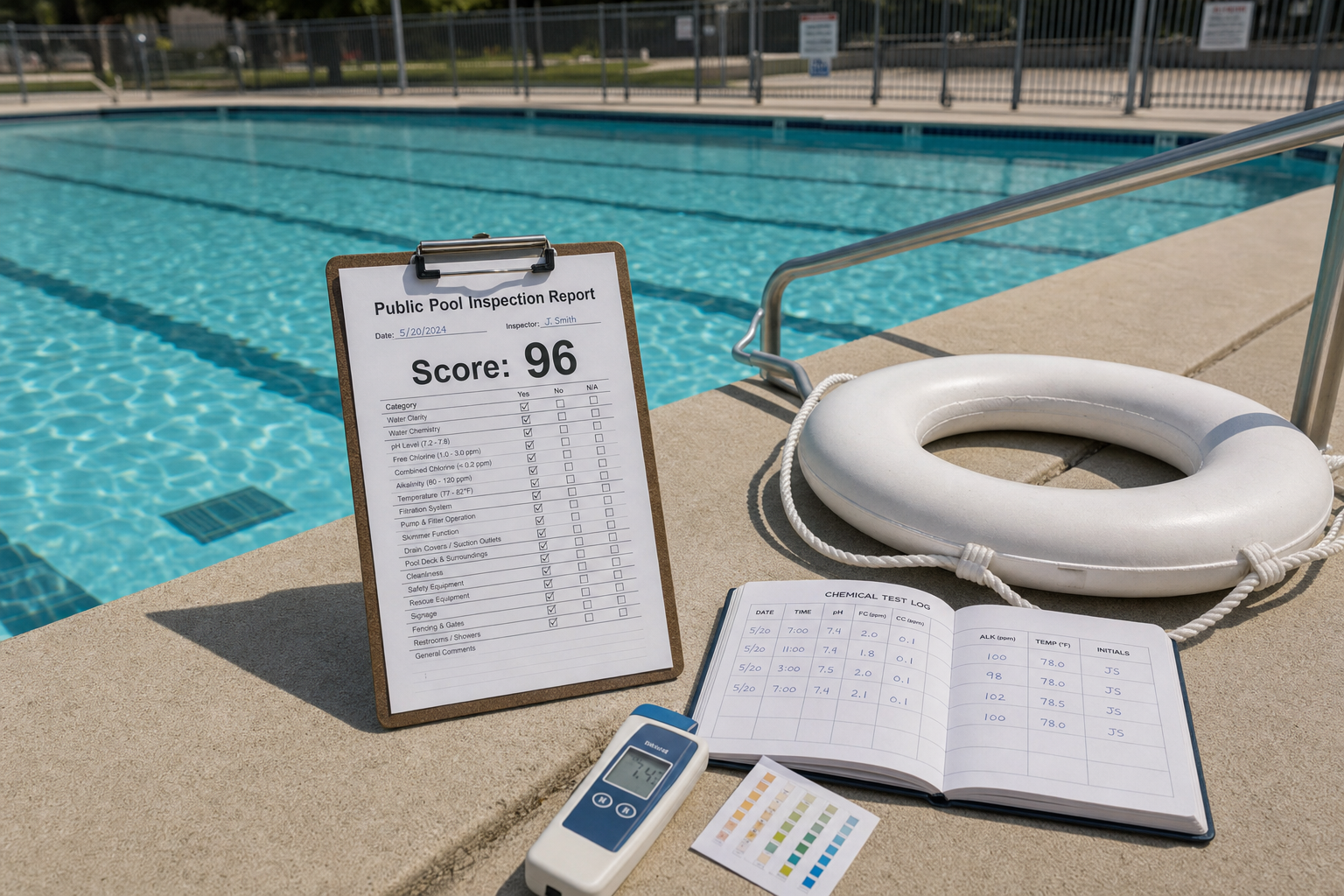
Here’s what parents need to know right away: always check the latest inspection results for public pools before letting kids aged 3-12 swim. Inspection portals show violations that could mean unsafe water, missing safety gear, or even pool closures. Combine those official records with a fast, on-deck visual scan—clear water, rescue equipment, visible test logs—to make smart decisions for your children’s safety.
Where to Find Pool Inspection Results Near Me
First, search “pool inspection results near me.” Many U.S. counties and states maintain public portals where you can search by pool name or address.
In Florida, the Department of Health lets you view inspection reports for public pools and bathing places by county. You can pull up a county report to see violations and whether a pool is currently under permit. (floridahealth.gov)
In Georgia’s DeKalb County, there’s a portal listing inspection scores for public swimming pools, beaches, and spas. Pools are graded on a 100-point scale, based on how many points were deducted for violations. (dekalbpublichealth.com)
Many jurisdictions now publish open datasets for pool inspections. Montgomery County, MD provides real-time data including critical violations requiring immediate correction. (catalog.data.gov)
If you live in the UK or Australia, local council websites or state health departments may offer similar tools. These platforms help parents find up-to-date MAHC guideline compliance. (More on MAHC in a moment.)
Understanding What Violations Mean
Inspection scores refer to specific safety and health risks. Not every violation is equally serious, but some are critical and require immediate action.
Critical violations include problems like disinfectant (chlorine or bromine) levels out of safe range, pH too high or low, missing or broken main drain covers, broken safety equipment such as ring buoys or shepherd’s crooks, or fences and gates that don’t self-close or latch properly. These pose immediate health or drowning risks. (cdc.gov)
Other violations might be less urgent—things like chipped tile, faded signage, or slightly delayed filter maintenance. They still matter, but might fall under “fix within 30 days” rather than “pool closure.” (mynethealth.org)
The MAHC (Model Aquatic Health Code) is voluntary guidance that many jurisdictions refer to in setting their health codes. It states that inspection scores are calculated by comparing compliance points against non-compliance points; critical item failures often force a failing grade regardless of overall score. (cdc.gov)
For families interested in lessons or improving swimming ability, programs like the 10-Week Plan from swimy.org can teach kids ages 3-12 important skills. While that’s about water confidence and technique, it’s just as important to make sure the pool itself meets safety standards. (Naturally, check inspection results before enrolling.) “10-Week Plan”
Deck-Side Cues When Records Aren’t Available
What if there’s no portal or you can’t pull up recent inspection reports? Before your 3- to-12-year-old jumps in, do a quick visual check:
Look first at water clarity. If you can’t see the pool bottom clearly or main drain, that’s a red flag; cloudy water often signals poor filtration or incorrect chemical balance. (manchesternh.gov)
[[ctakid]]
Scan for safety gear. Is there a life ring (USCG-rated ring buoy) with rope, a shepherd’s crook or rescue pole, first aid kit easily accessible, door gates that close on their own? The absence of any of these could make a serious violation in many jurisdictions. (mynethealth.org)
Check for visible test logs. Operators should post or keep on hand logs of free chlorine/bromine levels, pH readings, date and time of tests, maintenance activity. Without those, it’s hard to trust what’s happening in the water. (manchesternh.gov)
Also inspect deck condition. Are tiles loose, surfaces slippery or cracked? Are gates and fences in good repair and self-latching? Broken, sharp edges and broken barriers are not just unpleasant—they’re risky. (district4health.org)
Combining Official Records with Visual Check
You get the best safety outcome when you pair official inspection records with a fast, smart visual check.
Start by searching inspect-your-area portals for “public pool inspection results near me,” entering the facility name or address. Look for recent scores, any critical violations, and whether the pool was closed temporarily. Then, go see the pool. If the water’s murky, or lifesaving equipment is missing, skip swimming even if the inspection score was good.
MAHC Guidelines Parents Should Know
The MAHC is the benchmark many American jurisdictions use (or try to mirror). It gives guidance on those big risks: disinfectant level (often minimum 1.0 ppm free chlorine in pools), proper pH (usually 7.2–7.8), safety equipment, physical barriers, and operator training. Violations in any of those may lead to an immediate closure. (cdc.gov)
MAHC also highlights that scores are “a snapshot” in time. Just because a facility passed six months ago doesn’t guarantee it’s safe today—equipment breaks, filters clog, chemical readings drift. So never rely solely on an old inspection at face value.
Common Pitfalls Parents Make
One pitfall is assuming a new or fancy facility is automatically safe. New pools can still fail safety standards. Without posted inspection scores or visible safety gear, newer doesn’t always mean better.
Another mistake is ignoring cloudy water or missing ring buoys or shepherd’s crooks. These are often critical violation items. Just because nothing says “Pool Closed” doesn’t mean everything is okay.
Trusting verbal promises from staff without asking to see recent test logs or inspection certificates can also leave gaps.
What To Do If You Find Problems
If records show serious violations, contact local health department or pool operator before letting kids in. Public pools with critical failures are often legally required to close until issues are fixed. (cdc.gov)
If during your visual check something’s off—cloudy water, no safety gear, broken drain covers—don’t swim. Ask to see where the facility posts its most recent inspection report or test log. If they can’t produce it, walk away.
Putting it all together: always search for “pool inspection results near me” before visiting a public pool. Look for the inspection score, check for critical violations to see whether the pool is safe now—not just last month. Once at the pool, use your eyes: can you see to the drain? Is rescue gear present? Are logs visible? This combination keeps kids aged 3-12 safer and lets you enjoy swim time with peace of mind.
120+ swimming exercises sorted by age — with video and instructions. Developed by swim instructors, completely free.

120+ swimming exercises sorted by age — with video and instructions. Developed by swim instructors, completely free.