Hypermobility & Swim Lessons for Ages 6–12: Joint-Safe Tips
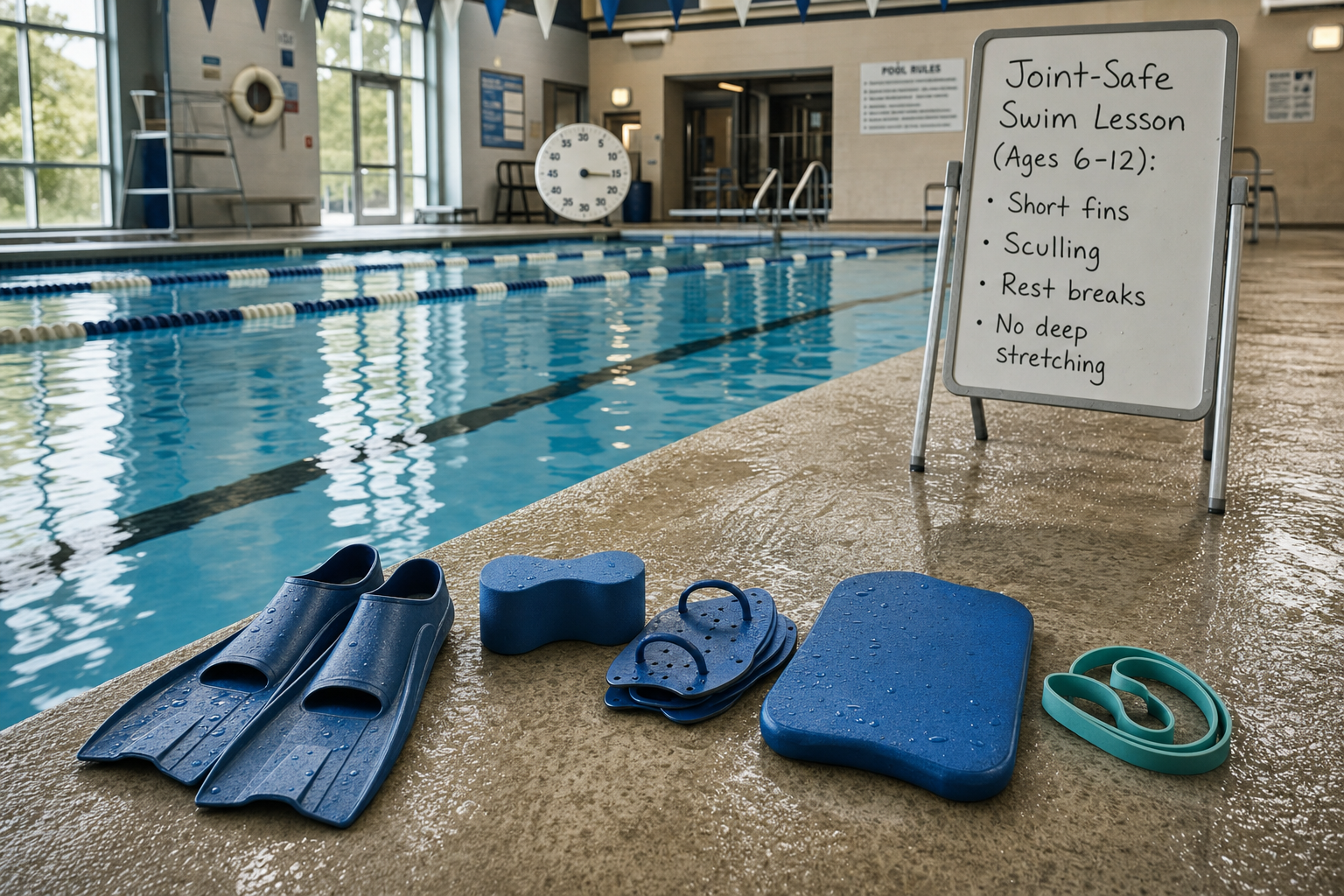
Kids between ages 6-12 who are “extra bendy” often love swimming—it’s low impact and fun—but long kick sets or huge arm pulls can lead to aching knees, floppy ankles, or tired shoulders. If your child has hypermobility or a diagnosis like Hypermobility Spectrum Disorder (HSD) or hypermobile Ehlers-Danlos syndrome, it matters how swim lessons are structured and how parents and instructors tweak the training. Let’s go over what works best.
What to Modify in Swim Lessons to Protect Lax Joints
First, some tweaks that really help make swimming safer and more enjoyable:
Shorter fins, not long, stiff blades. Oversized paddles or long fins multiply leverage and may strain ankles, knees, or shoulders. Choosing softer, shorter fins helps maintain propulsion without pushing joints beyond their comfort zone. Swim paddles should be used sparingly, only when technique is good, not as a way to build brute strength.
Neutral-grip or sculling drills for the arms or hands: Instead of full extension with hand flat, using “sculling”—which means lightly moving hands as if drawing small figure-eights just off your sides—reduces stress on the shoulder and wrist. This helps with proprioception (knowing where joints are) and encourages control without over-stretching.
Spacing rest breaks and pacing on kick and pull sets: Kids with hypermobility often tire quickly. Rest every few laps so joints can recover. Instead of forcing long kick sets with floppy ankles, mix in gentle kicking, use boards to support legs, and keep ankle motion neutral. Substitute flippers for buoyancy tools when needed.
Warm-ups that focus on strength, stability, not stretching the hypermobile range. Over-stretching warm-ups—or pushing joints into extremes—can irritate ligaments and tendons. Guidelines from major pediatric hypermobility care (like the APTA guideline on pediatric HSD) recommend exercise that strengthens muscle support, joint protection and gradual progression rather than deep stretching. (apta.org)
What to Tell Instructors So They Help, Not Hurt
You’re your child’s advocate. Here’s what to share and request from their swim coach:
Explain that your child has hypermobile joints (or suspected HSD/EDS), that fatigue or joint ache can come from too much leverage or too much repetition. Ask instructor to watch for signs of collapse in knees or ankles, or arms flaring out excessively during pulls.
Ask for modified drills: say “can we use neutral ankle kicks with a board” or “short-blade fins for kicks”, “sculling instead of full catch arms”, “limiting paddles or eliminating them till strength improves”.
Make sure the lesson plan includes rest days or lighter days after tougher sets. Parents can refer to the swimy.org’s 10-Week Plan if instructor allows adaptation: parents and coaches can pick drills each week that gradually build up technique and strength without overloading lax joints. Use it as a template to negotiate lesson intensity. (Note: the 10-Week Plan aims to alternate harder and easier sessions and build gradual improvement.) Hyperlinks to that plan show how this kind of gradual approach is evidence-aligned.
If you want a structured way to help your child progress at home, the 10-Week Plan guides you step by step.
Why Swimming Helps & What Guidelines Back It Up
Swimming, when adjusted a little, is highly recommended for kids with hypermobility because it is low-impact and builds strength without weight-bearing stress. Buoyancy cushions joints, water resistance helps muscles, and core stability tends to improve. Sources like Mayo Clinic Connect explain that swimming helps improve cardiovascular fitness and reduces joint pain for people with HSD or hypermobile EDS, but “extra monitoring” is needed so that stroke style and training load don’t trigger instability. (connect.mayoclinic.org)
[[ctakid]]
The Therapeutic Management of Pediatric Hypermobility Spectrum Disorder guideline from Cincinnati Children’s Hospital offers strong recommendations for ages 6-12 that include strength training, caregiver education, activity modification, and limiting repetitive stress. Exercise should be low-impact, five days per week ideally, for about 30 minutes daily. Swimming is among the primary choices. (apta.org)
Red Flags: When Pain Means It’s Time for a Pediatric Physical Therapist
Sometimes tweaks aren’t enough. Watch for warning signs. Consult a pediatric PT (or the child’s doctor) if:
Pain occurs suddenly during swimming, especially if a joint feels misaligned or a dislocation or partial dislocation (subluxation) happens. If your child complains of pain that persists for more than 48 hours or occurs at rest, not just during activity, that is serious.
Joint swelling or warmth—especially in knees, wrists or ankles. Persistent swelling isn’t normal, even in hypermobility.
Changes in movement: for example, knee or ankle “giving way”, inability to do what was easy before, difficulty with swimming stroke form because of weak stability or pain.
Morning stiffness that eases with activity, widespread symptoms, or any evidence of systemic issues such as cardiovascular, skin or connective tissue problems. These are red flags noted in guidelines for referral. (cincinnatichildrens.org)
Sample Session: Joint-Safe Swim Lesson Flow
Here’s how a single swim lesson might go for a 6- to 12-year-old with hypermobility:
Gentle warm-up with floating, kickboard work using soft short fins, focusing on neutral ankle position. Then core activation on deck or in water (e.g. flutter kicks while holding board with legs supported). Move into arm drills: sculling or using resistance bands, avoiding large paddles. Pull sets are short, with rest breaks every 2–3 strokes or laps. Cool down with easy strokes—backstroke works well—and light stretching within pain-free range (no extreme hyperextension). After the workout, allow rest time (24-48 hrs before another heavy kick or pull session) so joints recover.
Bottom-Line for Parents
Swimming can be one of the best sports for children with hypermobility, but only if lessons are adapted: shorter fins, neutral grips, judicious use of paddles, spaced rest, gentle warm-ups. Teach instructors what your child needs and watch for fatigue, pain, or odd joint behavior. Follow up with a pediatric physical therapist when red flags arise. With the right support, HSD/EDS kids can progress beautifully in the pool without overloading their joints and enjoy all the life and confidence swimming brings.
120+ swimming exercises sorted by age — with video and instructions. Developed by swim instructors, completely free.

120+ swimming exercises sorted by age — with video and instructions. Developed by swim instructors, completely free.