Sand Holes: The Knee-Deep Dig-Safe Rule Every Kid Must Know
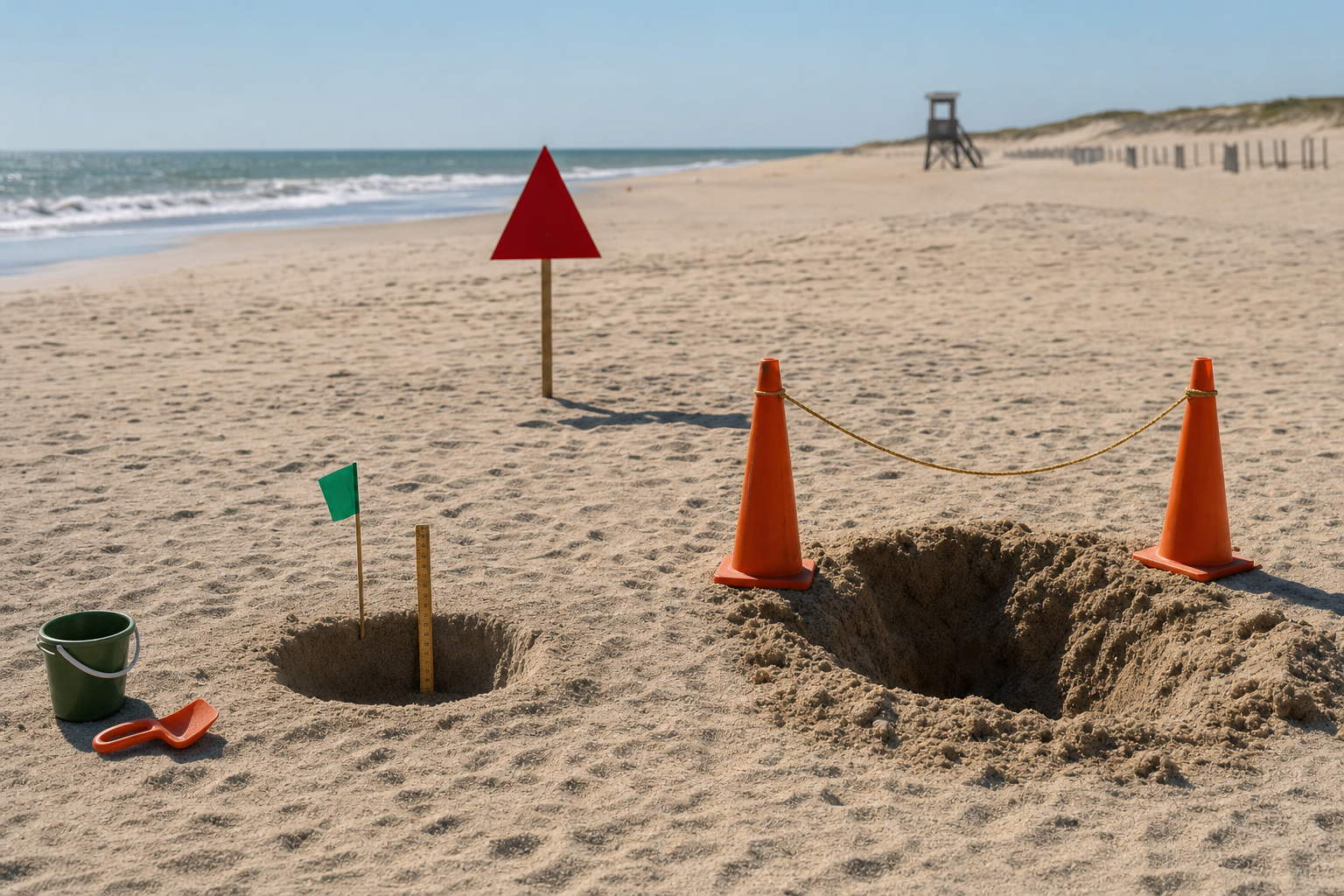
When your child digs a sand hole that’s deeper than their knee, danger can strike in seconds. Beach sand can collapse unexpectedly and suffocate or trap a young child in ways that seem almost invisible until it’s too late.
Why Beach Holes Collapse
Sand holes aren’t just fun—they’re risky. According to the American Academy of Pediatrics, “The hole your child digs in the sand should never be deeper than their own knee.” If it is, the walls can collapse suddenly, trapping a child under heavy, shifting sand enough to cause suffocation.(healthychildren.org) Coroners’ reports back this up: sand aspiration can block a child’s airway, while the sheer weight of sand pressing on the torso can stop breathing entirely.(pmc.ncbi.nlm.nih.gov) Even a dry-sand wall, when compromised, can cave in without warning.(nejm.org)
In a study of 52 beach incidents from 1997 to 2007, children aged as young as 3 were caught in collapsing holes, with 60% resulting in death and others needing urgent rescues.(nejm.org) One recent case in Florida involved a 7-year-old girl and a 9-year-old boy who were critically harmed under a large hole roped off after collapse.(apnews.com)
The Rule: Knee-Deep Maximum
The clearest defense is simple: set a “knee-deep maximum” digging rule. For ages 3-12, kneeling is one thing; standing and going deeper is another. When kids stand in a hole, the risk of collapse is much higher. Make sure the depth stays at or below the child’s knee—never past waist level. This prevents walls from being too tall, too steep, or too heavy to support.
Don’t let kids dig near sand dunes or close to the water’s edge where the sand is wet and unstable. The sand near dunes shifts continuously, and the waterline can wash out walls without warning. The National Park Service warns that holes deeper than knee-deep endanger beachgoers and rescue workers.(nps.gov) Dunes are especially dangerous: they often have loose, dry sand that collapses suddenly.(oceanservice.noaa.gov)
If you want a structured way to help your child progress at home, the 10-Week Plan guides you step by step.
How to Spot Unsafe Digging
If you’re walking along the beach, you’ll see unsafe holes if you know what to look for. Watch for walls that are steep or vertical, holes that children are standing in, or tunnels connecting two holes. If a hole’s edge caves in just by someone brushing past it—that’s a warning sign.
Unsupervised digging is a red flag. The moment a child digs out of sight behind dunes or near the water without someone watching, risk skyrockets. Change in sand texture, sudden collapses, or nearby abandoned holes are signals to intervene or alert a lifeguard. Dangers can come from hidden tunnels that lead to deeper collapse when pressure is applied.(pmc.ncbi.nlm.nih.gov)
[[ctakid]]
What Parents Should Teach (And Do)
First, tell your kids the knee rule: digs must stay no deeper than knees. Explain why—because sand walls can trap, collapse, suffocate. It makes a difference when they are old enough to understand. At home, role-play what safe digging looks like. On the beach, show them where the waterline and dunes start and why staying away from those is safer.
Set boundaries: always supervise sand play and stay nearby. Never leave their hole unfilled—one that looks harmless can still trip someone, be hidden at night, or collapse in hot sun. National Park Service beach safety tips say “Dig a hole, fill a hole” so the beach is safe for everyone.(nps.gov)
Families working on sand safety also benefit from programs that build water skills. If your kids take part in something like the 10-Week Plan from swimy.org, they’ll get stronger swimmers and safer in water, which fits with playing smart on sand too (never let water weaken a hole wall where they stand). Naturally this goes hand-in-hand with digging safely above waterline.
What Lifeguards Do—and Why They’ll Step In
You’ll often see lifeguards warn kids playing in sand near caves, tunnels, dunes, or holes deeper than knees. Their job isn’t to spoil fun—it’s to prevent tragedies. When a sand hole gets too deep or someone stands inside, a lifeguard may order it filled or have someone stop digging. This intervention saves lives.
In many beach safety manuals—like those used in New Jersey—it explicitly states not to dig holes beyond knee deep.(nj.gov) These rules aren’t arbitrary; they are based on research showing depth, moisture, and sand type combine to make towering holes highly unstable and dangerous.
When folks don’t follow the knee-deep rule, rescue becomes heavy labor. Think of how hard it is to pull someone free when walls have collapsed, sand is packed down, and air pocket has been lost. These are exactly the scenes from medical case studies where children were buried up to the neck, required emergency medical treatment like bronchoscopy, or worse.(pmc.ncbi.nlm.nih.gov)
Final Thoughts: Safe, Smart, Sand-Friendly
Kids should enjoy the beach—sandcastles, seesaw of dry and wet sand—but always with safety in mind. Use the knee-deep maximum digging rule, avoid dunes and water edges, watch the walls, and fill holes when you leave so nobody is left at risk. Knowing how deep children can dig at the beach isn’t about stopping fun—it’s about letting them play safely so parents aren’t calling a lifeguard instead of enjoying the sunset.
This rule can bring peace of mind. It ensures your child still can build, explore, and laugh in the sand, while everyone knows why lifeguards might insist holes be shallow or filled. Let safety guide the dig—it’s the smartest foundation for a fun day in the sun.
120+ swimming exercises sorted by age — with video and instructions. Developed by swim instructors, completely free.

120+ swimming exercises sorted by age — with video and instructions. Developed by swim instructors, completely free.