Backstroke Balance Cup Drill: The Head-Still Game Kids Love
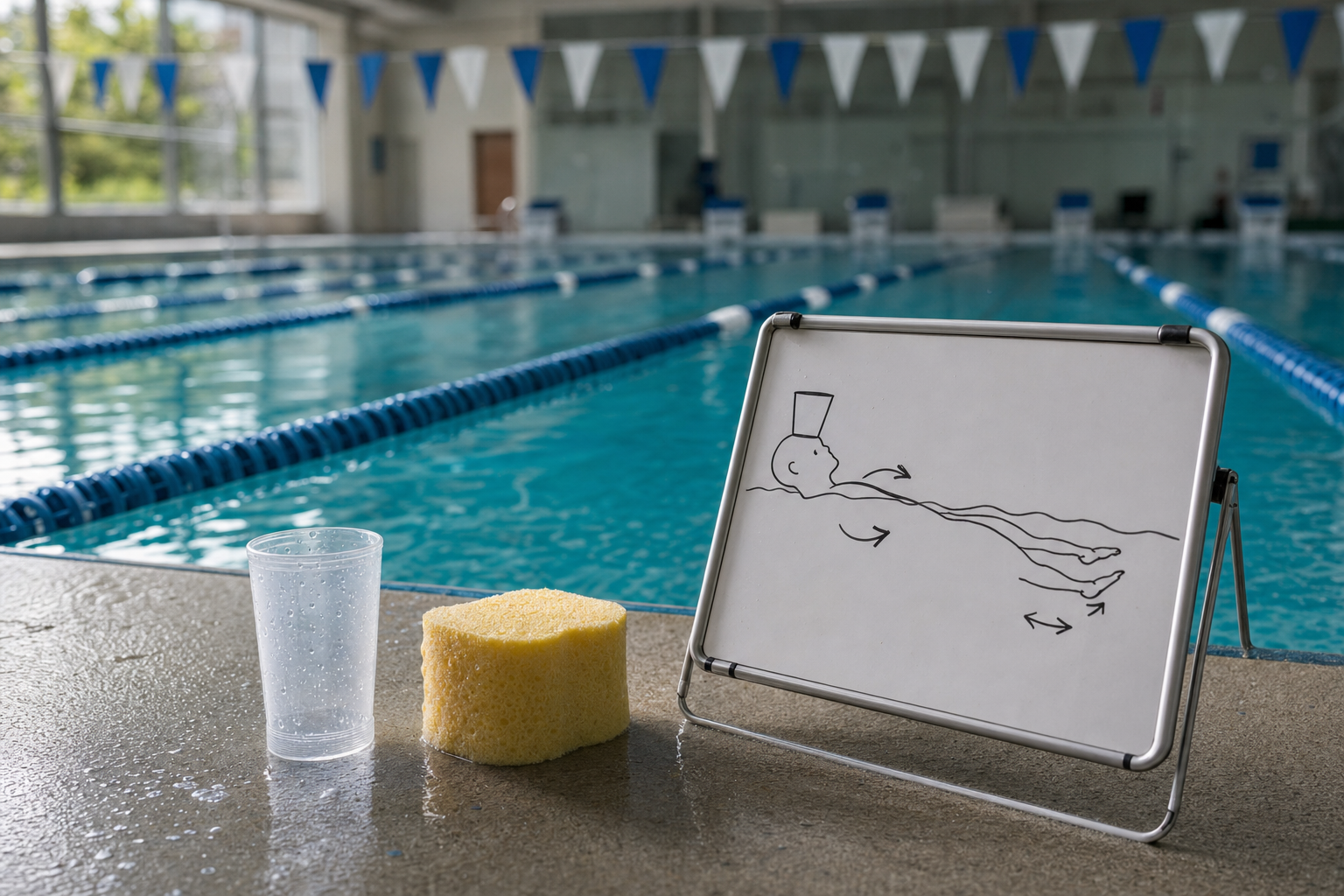
Want to fix your child’s backstroke fast? Try the Backstroke Balance Cup drill. It’s simple, fun, and builds that ever-important head-still technique—crucial for straight lines and faster tempos. Learn what to watch for, how to run the drill safely, and how to avoid common pitfalls.
What Is the Backstroke Balance Cup Drill—and Why It Works
Place a soft plastic cup or sponge on the child’s forehead, then have them swim backstroke trying not to lose the object. This visual feedback forces the head to stay still, eyes looking up, rather than lifting the chin or arching the neck. If the head moves, the cup/widget falls. OCAquatics names it “Cup Drill,” where the child learns to keep the head steady instead of looking forward—which would otherwise drop their hips and slow them down. (ocaquatics.com)
U.S. Masters Swimming’s instructional drills include balancing a cup (or small object) on the forehead while swimming backstroke, stressing steady kick, head position, and smooth arm movement. It’s an intuitive way for kids ages 6-10 to refine coordination without feeling like they’re being lectured. (fastswim.co)
How to Do the Balance Cup Drill Right: Step-by-Step
First, pick a soft plastic cup or sponge—no glass. Use it in non-crowded lane, so there’s plenty of space and minimal disturbance from other swimmers. Begin with kick sets: child floats on their back, with arms by their side, cup on forehead, flutter kicking only. This helps build balance and body alignment. Gradually add in arm strokes and shoulder roll, still with the cup on—steady kicks must remain continuous. When they can hold the cup steady for a length, try using more dynamic drills or faster tempos. U.S. Masters Swimming flags “rock and roll” drills to train shoulder/hip rotation around a fixed head. (fastswim.co)
Encouraging smooth shoulder rotation is essential: the body should roll about 45° each side during the arm recoveries, while the head stays still. This prevents dropping hips, zigzagging paths down the lane, and speed loss. Special Olympics training guides advise keeping ears submerged just under water, eyes pointed up, chest high—balanced, streamlined body position all around. (media.specialolympics.org)
If you want a structured way to help your child progress at home, the 10-Week Plan guides you step by step.
Avoiding Common Pitfalls: Chin, Neck, Kick
Chin tucked too hard makes neck uncomfortable and can force shoulders up, which sinks hips. It’s better to gently tuck chin just enough to align head with spine. Arching neck (looking back behind you) also creates drag. The head position needs to be stable—not too low, not lifted. If you see the cup slipping forward or backward, these issues are likely.
Another mistake is forgetting steady flutter kick. The kick is not just for propulsion—it supports balance. Without a fast, even kick, the body wobbles. The hips drop. Speed suffers. LaneMate guides remind that steady kick combined with neutral head position allows higher hips and less resistance. (lanemate.usms.org)
[[ctakid]]
Making It Fun & Keeping Kids Engaged
Kids love games. Turn this into a challenge: who can swim the farthest before the cup drops? Or use a floating sponge—softer, more forgiving but still gives feedback. Ask children to swim slowly first (so the cup stays), then test their balance at increasing speed. Shared laughter when the cup tumbles is part of the learning. One coach’s favourite progression: start with a coin on the forehead, then goggles, then cup of water. The order builds confidence. (ncmasters.org)
Where This Fits into Broader Swim Learning
For children ages 6-10, mastering fundamentals like backstroke head still drills opens the door to joining pre-team or swim team with confidence. Many swim programs expect kids this age to swim 25-50 yard/meter repeats of freestyle and backstroke, use proper breathing, maintain legal turns, and follow instructions over a full practice. The “10-Week Plan” by Swimy.org is a great structure for parents wanting a steady progression of skills over time. It builds in drills, technique, stroke development, including backstroke and head still work. (swimy.org)
Integrating the Balance Cup drill within a larger rotation of drills ensures that technique becomes the default. For example, alternating this game with single-arm backstroke, L-holds, or rhythm drills helps reinforce rotation, arm pattern, and body alignment. U.S. Masters Swimming provides free guides listing progressive backstroke drills that emphasise head stillness paired with rotation and balanced kick. (usms.org)
Safety & Best Practice Tips
Always use a soft object, never glass. Soft plastic or sponge is ideal. Choose lanes where the child won’t bump shoulders with others—crowded lanes increase risk. Maintain supervision: head position influences breathing, so watch that nostrils aren’t dragged underwater or face isn’t rotated in dangerous ways.
Do this drill year-round—indoor pools, summer league, holiday sessions. Because head-still backstroke isn’t seasonal. Regular practice means your child internalizes steady head position, smooth shoulder roll, and steady kick, translating into cleaner strokes, better posture in the water, and faster, straighter swims.
By combining fun balance games like the Backstroke Balance Cup with consistent guidance, you give children aged 6-10 a shot at mastering one of the trickiest parts of backstroke. Straight paths, stronger tempos, fewer corrections—and more joy in the water.
120+ swimming exercises sorted by age — with video and instructions. Developed by swim instructors, completely free.

120+ swimming exercises sorted by age — with video and instructions. Developed by swim instructors, completely free.