Decode Swim Reports: What Those Levels Actually Mean
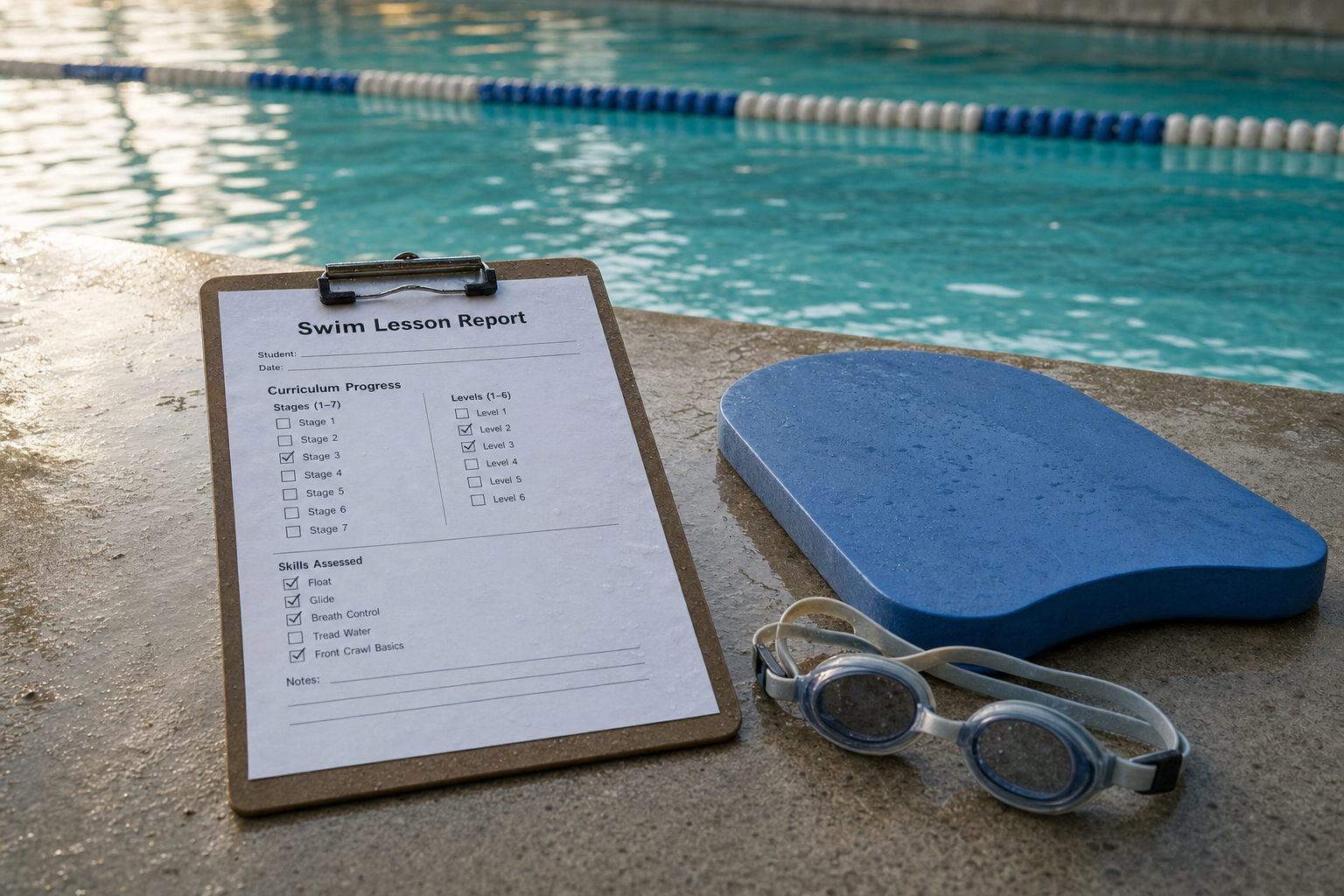
When you get a swim lesson report card and see your child is “Stage 3,” “Level 2,” or “Water Introduction,” it can feel like decoding a map in a foreign language. Here’s what those cryptic level names really mean in plain English — so you can track progress, reinforce the right skills at home, and make sure your child is building strong foundations between classes.
What Do Swim England Stages Mean?
Swim England uses the “Learn to Swim” framework to guide children (typically ages 3–12) from total beginners to competent swimmers. It’s divided into Stages 1 through 7 with clear outcomes at each step.(swimming.org)
- Stage 1 is about the basics: entering the water safely, moving five metres (forward, backward, sideways) with or without floating aids, scooping water, and simple floats on front and back.(swimsaway.co.uk)
- Stage 2 introduces jumping in, blowing bubbles, independent floats without support, simple log rolls and travelling through water with recognisable leg actions.(swimming.org)
- Stage 3 steps up to longer swims (about 10 metres), more independent skills (no floatation), retrieving objects from underwater, and coordinating rotation skills.(swimwise.dev)
- Stage 4 to 7 progress through solid stroke basics (front crawl, backstroke, breaststroke, butterfly), endurance (swimming further distances), safety skills like treading water, rescue actions, and refining technique.(swimwise.dev)
If you want, I can send you a side-by-side plain-English translation of your child’s current outcomes vs. the next stage — so you know exactly what to practice.
YMCA Swim Levels Meaning: The U.S. Version
If your child is in a YMCA swim program, they’ll use a different naming system (Levels 1-6 or so), but it follows the same logic: confidence → movement → strokes → stamina → refinement.(regionalymca.org)
- Level 1 “Water Acclimation” helps kids become comfortable in water, putting their face in, blowing bubbles, floating with support, kicking, and learning how to safely get in and out.(regionalymca.org)
- Level 2 “Water Movement” emphasizes independent movement without assistance, improved body position, directional changes, and basic self-rescue skills.(ymcacolumbus.org)
- Level 3 “Water Stamina” focuses on swimming longer distances, breath control, combining front and back floats, and being able to tread water.(regionalymca.org)
- Levels 4–6 cover stroke introduction (front crawl, backstroke, breaststroke, butterfly), working on proper technique, increasing endurance, starting diving or turns, and preparing for swim team or more advanced recreational swimming.(ymcaeastbay.org)
[[ctakid]]
If you want a structured way to help your child progress at home, the 10-Week Plan guides you step by step.
What Should You Look for on a Swim Lesson Report Card?
A good swim report card does more than list a level name. It should answer three questions clearly:
What level is my child at right now?
Find specific outcomes (e.g., “can push and glide on front for 5 metres without float aid”) and get a sense of where that fits in the curriculum.Which skills have they already mastered?
Names like “streamline,” “rotation,” or “breathing rhythm” matter — break those down into drills you can practice outside class.What comes next?
The report should list what needs work before moving up: leg kick, breathing, stamina etc. That tells you what practice at home will hit the sweet spot.
Home Practice Tips to Match Report Cards
Once you know what your child’s report card is measuring, you can reinforce those exact outcomes at home:
- Practice short drills: blowing bubbles, floating, gliding to a wall.
- Time-based games: “tread water for 20 seconds,” or “swim-float-swim for 10 feet.”
- Focus on one stroke element at a time: breathing, kick, arm pull.
- Build confidence in water safety actions like safe entries, exits, and resurfacing after underwater play.
Pitfalls When Comparing Programs: Don’t Do a One-to-One Swap
If your child moves from a Swim England program to a YMCA program or vice versa, or even just between swim schools, watch out:
You might see “Stage 4 equals Level 3” listed somewhere in marketing. It’s tempting to map them directly. But outcomes at one Stage or Level may be more or less demanding depending on depth of pool, lesson frequency, or instructor approach.
Always ask for a brief in-water assessment when switching schools. That lets the new teacher see what your child can already do, rather than forcing them to repeat or fall behind.
Bringing It All Together
You want your child’s report card to be something you use, not archive. When you decode Swim England stages or YMCA levels into plain skills — floating independently, changing strokes, breathing, treading water — you can coach at home more precisely. Use your swim school’s framework to guide weekend practice. If progress plateaus, check in on technique, not just effort. And if you’re looking for a path forward, resources like the 10-Week Plan from swimy.org can help structure skill-building between classes.
Parents who understand these levels end up giving their children the confidence to swim with safety, enjoyment, and lasting skill — all by turning cryptic stage names into everyday cues that make the journey visible at home.
120+ swimming exercises sorted by age — with video and instructions. Developed by swim instructors, completely free.

120+ swimming exercises sorted by age — with video and instructions. Developed by swim instructors, completely free.