Dryland Basics (Ages 6–12): A Simple Two-Day Plan
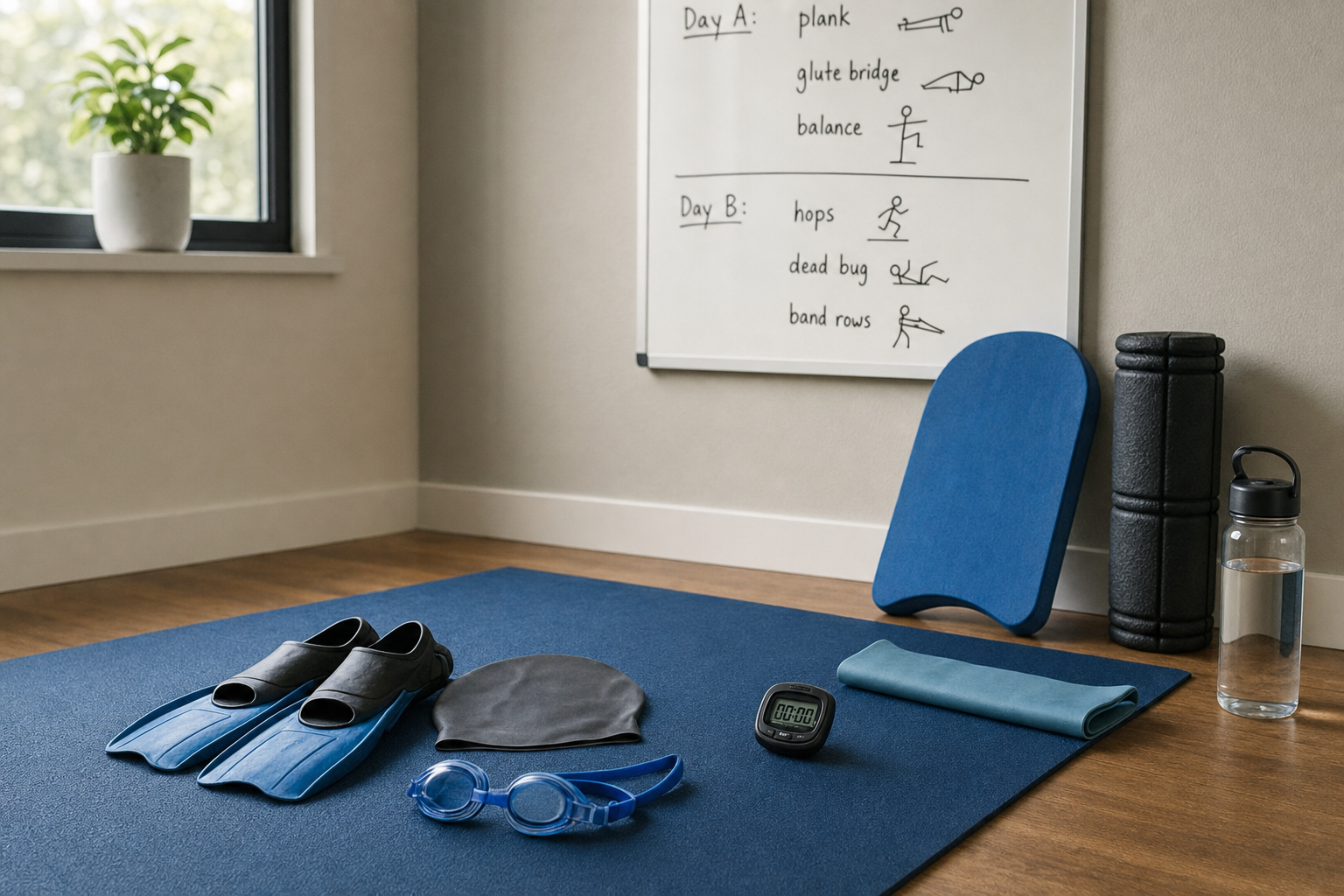
If your 8- or 10-year-old wants stronger kicks, better posture, and smoother coordination between swim lessons, this plan gets you there with minimal gear and maximum safety. Skip adult-style workouts. Avoid pushing weights. Rest is essential. Here’s a two-day-a-week, 15–25-minute routine designed for school-age young swimmers.
Why This Matters: Swim Strength for 8-12 and What Dryland Does
Proper dryland work builds swim strength for 8-12 year-olds by targeting body control, posture, and kick power without risking joints. Experts at the NSCA explain that core stability and shoulder mobility are key to better stroke mechanics and fewer overuse injuries like swimmer’s shoulder.(nsca.com) When children improve their trunk stability, their legs stay up in freestyle and their body rolls improve—movement becomes efficient and speed gains follow.(nsca.com)
Kids also are in a sensitive window for coordination development. Age-appropriate exercises—push-ups on knees, squats, balance work, playful core moves—lay solid foundations. In contrast, copying adult workouts or doing heavy lifting too early can overload growing muscles or cause pain.(swimclass.sg)
Safety First: What to Watch Out For
Form always comes before reps. Avoid any exercise that compresses the spine or demands excessive core flexion like full situps or super deep bending. No max lifts. Keep weights (if any) light and movements clean. Ensure 48 hours between sessions to allow recovery. Warm-ups and cool-downs aren’t optional—kids who skip them often struggle with flexibility or get edge injuries.
Two-Day Routine You Can Coach at Home
Here’s a simple plan for two non-consecutive days each week—say Monday and Thursday, or when pool lessons are off during travel weeks or winter closures. Each day takes about 15-25 minutes. Minimal gear means none, or maybe a light resistance band (if available).
Day A – Posture + Core Stability (≈ 20 min)
Warm-up (3–4 minutes): Begin with gentle movements—marching or jogging in place, arm circles forward and backward, torso twists while standing or seated.
If you want a structured way to help your child progress at home, the 10-Week Plan guides you step by step.
Main set (12–15 minutes):
Start with Superman extensions: lie face down, lift arms and legs gently, hold for 2-3 seconds. Builds lower back and posterior chain—vital for swim posture. Then plank holds: forearms and toes, keeping body straight; 20-30 seconds. Push-ups on knees or full if ready—shoulder strength without strain. Glute bridges: lying on back, knees bent, lift hips; strengthens hips for kick power. Balance drill: stand on one leg, knee slightly bent, hold 20 seconds each side. Bonus twist: lunges with a small twist of torso toward leading leg.
Cool-down (3 minutes): Stretch shoulders (arm across chest, overhead), gentle chest opener, quad stretch, deep breathing.
Day B – Coordination + Kick Power (≈ 15-25 min)
Warm-up (3 minutes): Light jogging or skipping, “ankle pedals” (lying on back, circle ankles), hip hinges (touch toes while keeping back as flat as possible).
Main set (12–15 minutes):
Kid-friendly hops and jumps—small bounds to improve lower body explosiveness for push-offs and starts. Single-leg dead bug: on back, opposite arm and leg reach, keep core tight. Flutter-kick drills on dry ground: on belly, lift legs slightly, kick alternately, engage core and glutes. Use resistance band (if present) for light one-arm rows or “Ts and Ys” to strengthen back and shoulders gently. Crab walks or bear crawls for fun core activation and coordination.
Cool-down (3 minutes): Gentle hip-flexor stretch, shoulder circle, calf stretch, sit & reach for hamstrings.
[[ctakid]]
How to Adapt and Make It Last Season to Season
Adjust for age and ability: younger or less steady kids might start with shorter planks or fewer single-leg drills. Older ones (11-12) can increase time or add light resistance, still staying far from max lifts. Pay attention to fatigue—if form dips, stop. Rest days are recovery days so muscles grow and joints heal.
During travel or pool shutdowns, this simple routine keeps them moving. Pair it with some full-body swim drills or play in shallow water to reinforce skills.
One useful timeline is from a structured program like the swimy.org 10-Week Plan, which gives families guidance on progressing swim and land work together in manageable steps, helping children improve safely between lessons.
Common Pitfalls and How to Avoid Them
A big mistake is treating kids like mini-adults: stacking heavy weights, over-loading shoulders, or doing adult core routines with much flexion. Another is skipping warm-ups or cool-downs; tight hips and shoulders often begin there. Also, trainers and parents sometimes skip rest or ignore signs of soreness, which can lead to injury.
Kids often love doing something intense—but short, consistent, clean-form work beats long, sloppy sessions every time. If their core is flexed too much (e.g. sit ups), the back and abdominal muscles can get misaligned or overstressed.
Bottom Line: Home Swim Exercises That Matter
Dryland for kids swimmers, done right, boosts posture, coordination, and kick power between lessons. With two short, well-formed sessions each week, ages 6-12 build strength without stressing joints. Keep it simple, keep it safe, follow form over speed, and always warm up and cool down. Your young swimmer will be stronger, more confident in the water, and better prepared when lessons resume or picks up speed.
120+ swimming exercises sorted by age — with video and instructions. Developed by swim instructors, completely free.

120+ swimming exercises sorted by age — with video and instructions. Developed by swim instructors, completely free.