Fountain Safety for Curious Toddlers
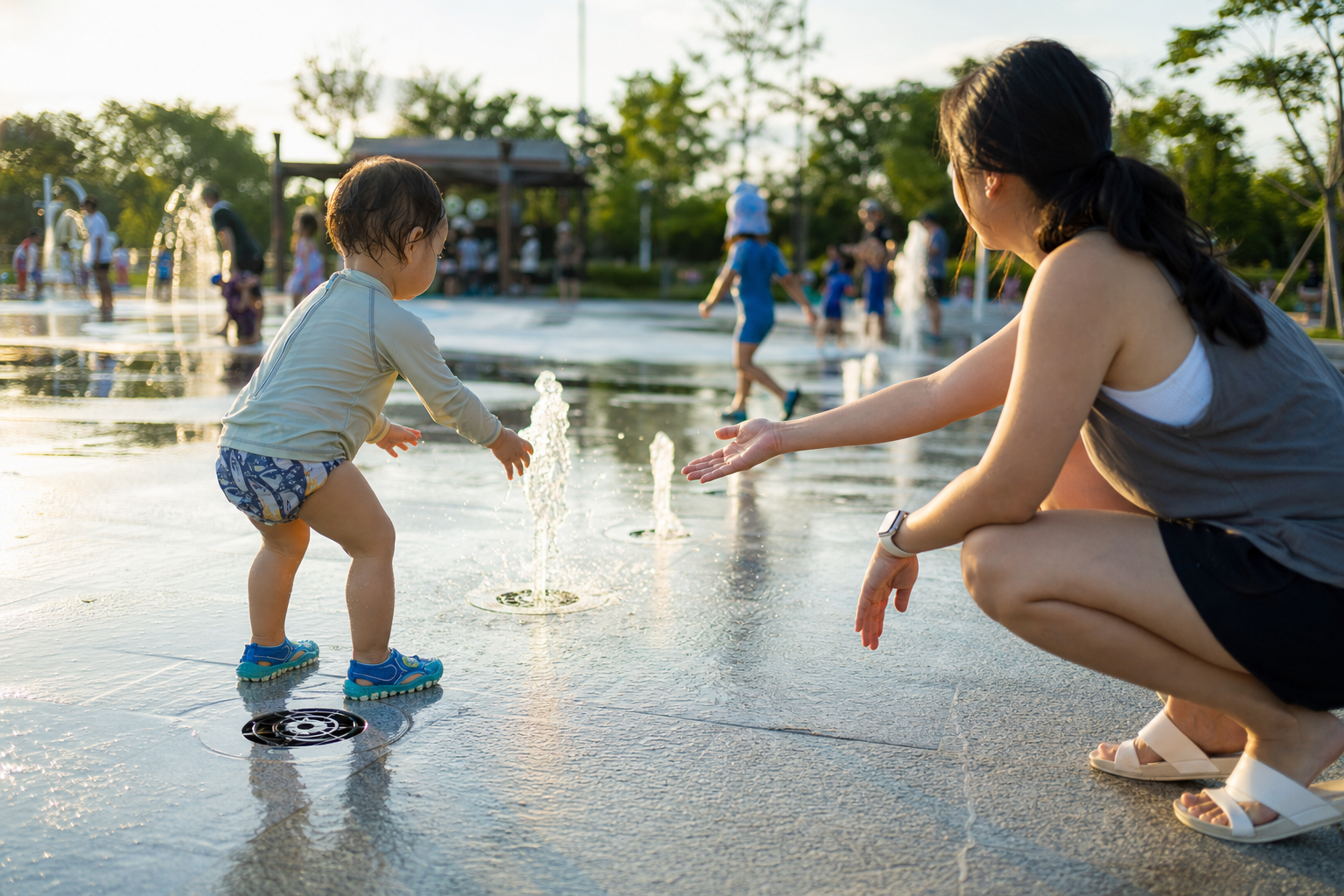
Toddlers between 12–36 months are superheroes in motion: fast walkers, climbers, and explorers. When you’re in the city, at a park, or on holiday, decorative water features and public fountains can be mesmerizing—but they’re not the same as a baby swim class. If you want to know when “baby playing in fountain” is safe and when to steer clear, keep reading for what to do, what to check, and how to make supervision and exit routines rock-solid.
What Makes Public Fountains Risky
Even the fountains that look most harmless can hide serious dangers. First, water in many decorative features is recycled or untreated. A study of ornamental fountains in Hannover found health risks from E. coli, Salmonella, Pseudomonas, and Enterococci, with some fountains exceeding illness thresholds for young children.(pubmed.ncbi.nlm.nih.gov) Additionally, splash pads and interactive fountains often aren’t regulated or disinfected the way pools are, raising risks of recreational water illnesses—and in rare cases, brain infections—from germs like Naegleria fowleri.(cdc.gov)
Next, shallow depth is deceiving. Even basins six to eighteen inches deep are dangerous if a toddler slips, leans face-first, or falls in. WaterwiseKids warns that assuming shallow water is safe can lead to serious accidents.(waterwisekids.com) Rough stone or tile surrounding fountains becomes slippery. Pumps, wires, and lighting linked with decor fountains are often not built to safety standards for human contact.(waterwisekids.com) Needless to say, decorative fountains are open water hazards—treat them like the hazard they are, not like supervised pools.
Supervision Rules and Hygiene Checks
Close, constant supervision with “touch supervision”—which means staying within arm’s reach—is essential. The American Academy of Pediatrics stresses that toddlers and infants near any water must be watched without distractions.(doi.org) Designate one adult water watcher, especially in busy plazas or fountains where people drift in and out.(cdph.ca.gov) Always check water quality visually: is the water clear or cloudy? Any odor? Signs of algae, debris, biofilm, or broken tiles mean skip playing. Decorative fountains may allow stagnant water to brew germs fast.(cdc.gov) Also inspect the surroundings: slippery surfaces need textured mats or sturdy footwear; sharp edges or climbable ledges invite risky behavior. Electric components should be sealed and safe for human contact. If you can’t verify, assume the worst.
If you want a structured way to build water confidence at home, the 10-Week Plan guides you step by step.
[[ctababy]]
Teaching Toddlers to Exit Water Safely
Leaving the water well matters as much as entering it safely. A structured exit routine helps toddlers aged 12–36 months learn when water fun is over—and avoid dangerous return attempts. Swim lesson experts recommend building this type of exit pattern into routines. One great example is from a swim class framework like the 10-Week Plan at swimy.org, where towel-off routines, dry clothing, exit cues, and snack breaks become predictable rituals.(swimy.org) Start early: when you say the exit cue (such as “All done with water”), grab your toddler’s hand, offer a dry towel, and redirect with warm clothes or a favorite toy. Keep this consistent everywhere.
Also teach your toddler that shoes and dry clothes matter. Wet feet are slippery; wet clothes chill. Don’t let toddlers wander back into fountains right after they’ve gotten wet. Reinforce a rule: “Wet = shoes on, clothes changed before play again.” Over time toddlers learn not just rules, but the physical signals—slipping, cold, soggy—that tell their body it’s time to stop.
Fast Rules for Public Trips and City Holidays
When you're out exploring:
- Before letting them play, scan the fountain for hazards: is there strong suction under the water? Sharp edges inside the basin? Lighting or electrical parts low enough to touch?
- Always stay at the edge, not on your phone. Even a brief glance or photo session counts as a lapse in supervision.
- Rinse off as soon as possible. If there’s a public shower, use it before and after fountain play to reduce germs. Change into dry clothes quickly.
- Check diaper status often. Young children should be changed on a clean surface and diapers disposed of properly. Diapers in water or at the edge risk contamination.
When Play Fountains Are Designed for Toddlers
Some fountains or splash areas are made for kids. They have gentle water jets, shallow well-drained basins, anti-slip flooring, and regular checks. Even then, pretend like there’s no lifeguard. Hygiene checks, touch supervision, and exit routines still trump everything. Use them selectively: a clean, well-maintained splash pad beats a decorative fountain any day for toddler water fun.
Final Thoughts: Treat Fountains Like Open Water Hazards
If you're asking whether public fountain water is safe for kids, here’s the truth: it can be—but only under specific conditions, and only with sharp vigilance. “Baby playing in fountain” should happen in areas built for play, with good water treatment, slip-proof surfaces, and strong supervision. Otherwise, it remains a risky situation. Use supervision rules, hygiene checks, exit routines, and your better judgment. Ignore assumptions like “shallow means safe” or “just a quick photo” at your peril. Your toddler’s safety depends every bit as much on what happens outside the water as what they do in it.
120+ swimming exercises sorted by age — with video and instructions. Developed by swim instructors, completely free.

120+ swimming exercises sorted by age — with video and instructions. Developed by swim instructors, completely free.