Why Your Baby Grabs Your Neck in the Pool (And How to Help)
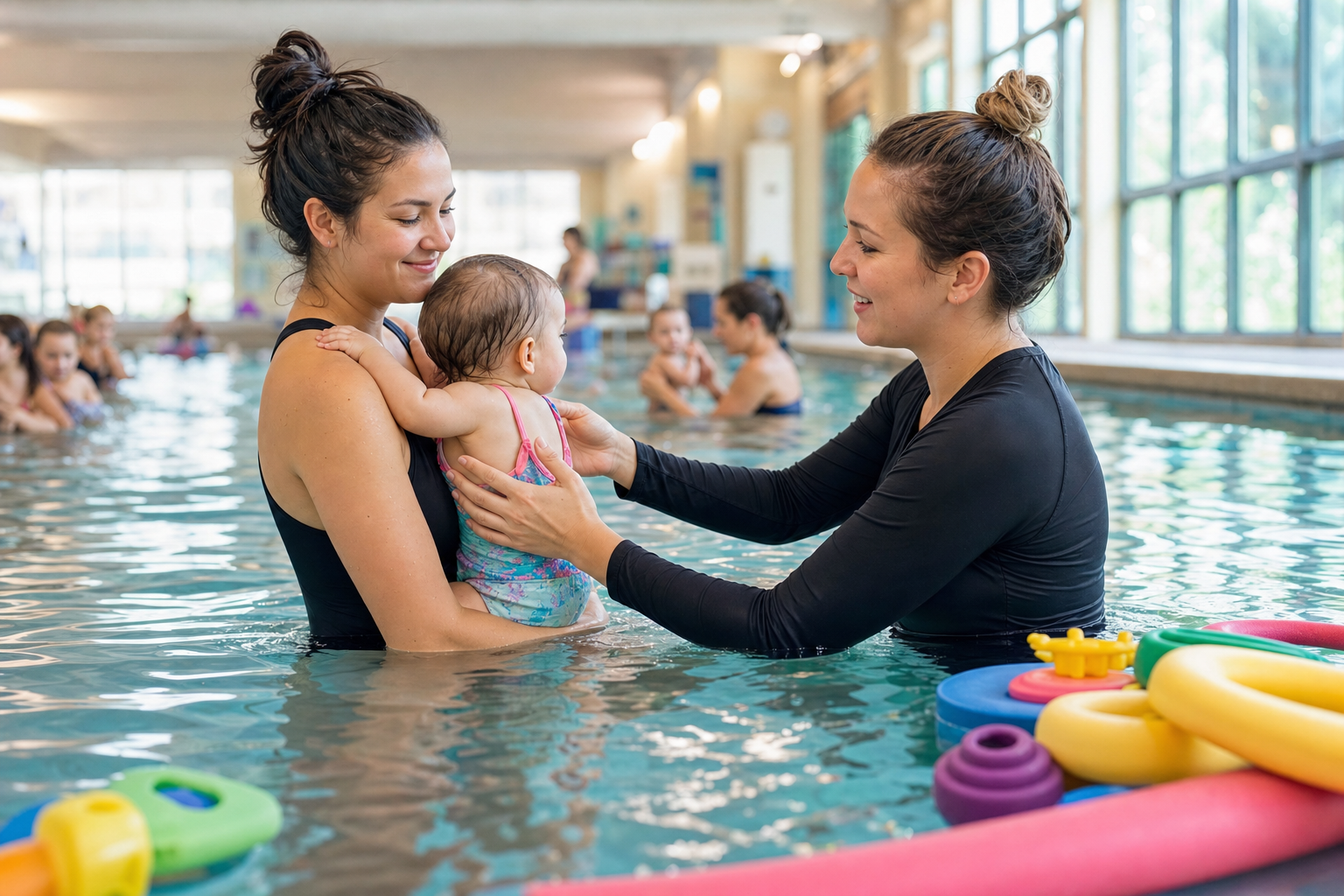
When your baby, aged anywhere from about four months up to 30 months, clings and grabs your neck as you enter the swimming pool or during class, they’re speaking through movement—not misbehaving. Understanding what’s behind that neck grab can help you respond in ways that feel safe, caring, and skill-building. Let’s dive into the real reasons, and what calm holds, gradual games, and confidence progressions can do to help both baby and parent feel more at ease.
The Message Behind the Grasp
Some babies grab your neck in the pool because they’re communicating: “I need help,” “I feel out of balance,” “I’m frightened.” At 4–6 months, babies are developing head and neck control. When buoyancy shifts suddenly—or water splashes unexpectedly—they may instinctively cling to you because they don’t yet trust their body’s balance or the water’s feel. As toddlers approach 18–30 months, new fears often arise: moving water, face wetness, or awkward supports can all feel overwhelming.
Academics studying infant behavior in aquatic sessions show that when parents are present and behave predictably, infants use more exploration and show fewer distress signals. In these settings, clinging dips significantly as comfort, routine, and trust build. (pmc.ncbi.nlm.nih.gov)
How Clinging Can Be About More Than Fear
Not all clinginess in the pool is fear. Sometimes it’s about balance-seeking, or feeling a lack of control. Imagine floating for the first time—it’s sensory overload, a mix of weightlessness and cold. Babies often grab your neck to re-establish a solid anchor. They’re not being “bad,” they’re doing something deeply human and entirely expected.
Physical readiness matters too. Motor development—holding up their head, controlling shoulder muscles—plays into how secure a baby feels. Studies show that playing in the water, with structured activities, accelerates motor skills. Clinging becomes less needed when babies build these skills gradually. (pmc.ncbi.nlm.nih.gov)
What Parents Can Do: Calmer Holds & Gradual Release
If your baby grabs your neck, you can help repair trust and build progress without force.
Calmer Holds First: Instead of lifting under the arms or grabbing limbs, try supporting with one hand behind the neck and head, and the other under the lower back. Keep your movements slow. Maintain an upright or slightly backward-leaning posture. Always keep their face clear of water—never force floating or push them under before they’re ready.
If you want a structured way to build water confidence at home, the 10-Week Plan guides you step by step.
Gradual Release Games: Play games in shallow water or even the bath that mirror a pool experience. Incorporate water familiarization—splashing, pouring, letting water gently trickle over shoulders. Use toys to reach for with minimal support. Use the 10-Week Plan from swimy.org to schedule and vary these water games so each week gently increases what your child is being asked to try—without skipping those all-important early trust-building steps. (swimy.org)
[[ctababy]]
Confidence-Building Progressions: Begin with rituals—same way to enter the water, same words, same toys. Let your baby control how much wetness on their face they’ll tolerate. Move into supported floating only when they feel grounded, then slowly extend distances. When they blow bubbles or dive chin-first voluntarily, celebrate. Save unsupported floating or brief submersion for later stages, always listening closely to signs of distress. Studies show slower, consistent exposure builds longer-lasting confidence than rushing skill milestones. (aqzog.com)
Strategies for Toddlers Scared in Swim Class
If your toddler (about 12-30 months) seems tense, cries, or clings to you during class, know that this is normal. These behaviors often stem from sensory overwhelm or uncertainty. As a parent, there are methods you can use so that your child doesn’t freeze in fear or feel forced.
First, choose classes with small student-to-instructor ratios so your child gets individual support. Look for parent-accompanied sessions where your presence is part of the lesson rather than a cameo. Be especially attentive to how face wetness is introduced: nose, lips, mouth near water first; letting them choose when to fully go under. Praise bravery (“You put your hand in, that was brave!”) rather than pushing for compliance. Celebrate the real wins—less hesitation, more curiosity—no matter how small. (swim-central.uk)
What to Avoid and Safety Caveats
It’s tempting to force detachment—to pry a baby off your neck or to insist they float unsupported early. Doing either can backfire badly. Babies who are pried or forced often respond with panic, which wires fear into the brain. Also: never force floating, never push their face under while they’re resisting.
Safety must always come first. Keep your baby’s face clear of water during any transition. Never try to force floating or submersion. Use slow transitions only. Always supervise within arm’s reach. If at any point your baby loses trust, takes long to recover after water splashes, or seems distressed throughout, dial back to simpler, gentler experiences.
Confidence Progression: From Clutching to Calm
When done right, the transformation is worth it: baby moves from grabbing your neck to reaching for toys, blowing bubbles, floating with light support, then gradually letting support go. This isn’t a straight line—some days are great, some days regress—but each session, each tiny brave act, builds lasting water confidence.
Trust the process. A calmer hold today means less clinging tomorrow. Gently guided games today grow into playful exploration. In time, not only will “baby clings in pool” become less frequent, but “baby grabs neck swimming” won’t feel like a problem—it’ll feel like a step on the way to joy in the water.
Safety, patience, and respect for your child’s pace will serve both of you well.
Let me know if you want age-specific games or scripts to try with your own little one.
120+ swimming exercises sorted by age — with video and instructions. Developed by swim instructors, completely free.

120+ swimming exercises sorted by age — with video and instructions. Developed by swim instructors, completely free.