ADHD and Swim Lessons: Focus Tools That Work (Backed by Research)
Kids with ADHD learn best when swim lessons are built around clear cues, short tasks, and enough movement to keep energy and confidence high. These strategies reduce meltdowns, increase wins in the water, and help kids aged 5–12 thrive without floaties that mess with technique. Find out how to choose the right class, brief instructors, and support your child’s attention while keeping safety front and centre.
What Proven Research Says About Swimming and ADHD
A 12-week recreational swimming program for 9- to 12-year-olds with ADHD showed measurable gains in behavior, academic performance, and inhibitory control. The lessons included warm-ups, aquatic games, and motor skill drills that engaged attention and movement alike. (pmc.ncbi.nlm.nih.gov) In another study, an 8-week swim-learning program improved selective attention, cognitive flexibility, lower limb coordination, and calmness among preteens with ADHD. (pubmed.ncbi.nlm.nih.gov) Together, these findings confirm that aquatic exercise delivers benefits across focus, regulation, physical skill, and mood. Official health bodies like HealthyChildren.org also point out that neurodivergent children can improve coordination, anxiety, and behavior by signing up for swim lessons. (healthychildren.org)
Concrete Strategies for ADHD-Friendly Swim Lessons
Here are tools that work well for school-age kids with ADHD. Use them to brief instructors, structure lessons, and support your child’s focus in the pool.
Visual Supports & Predictability
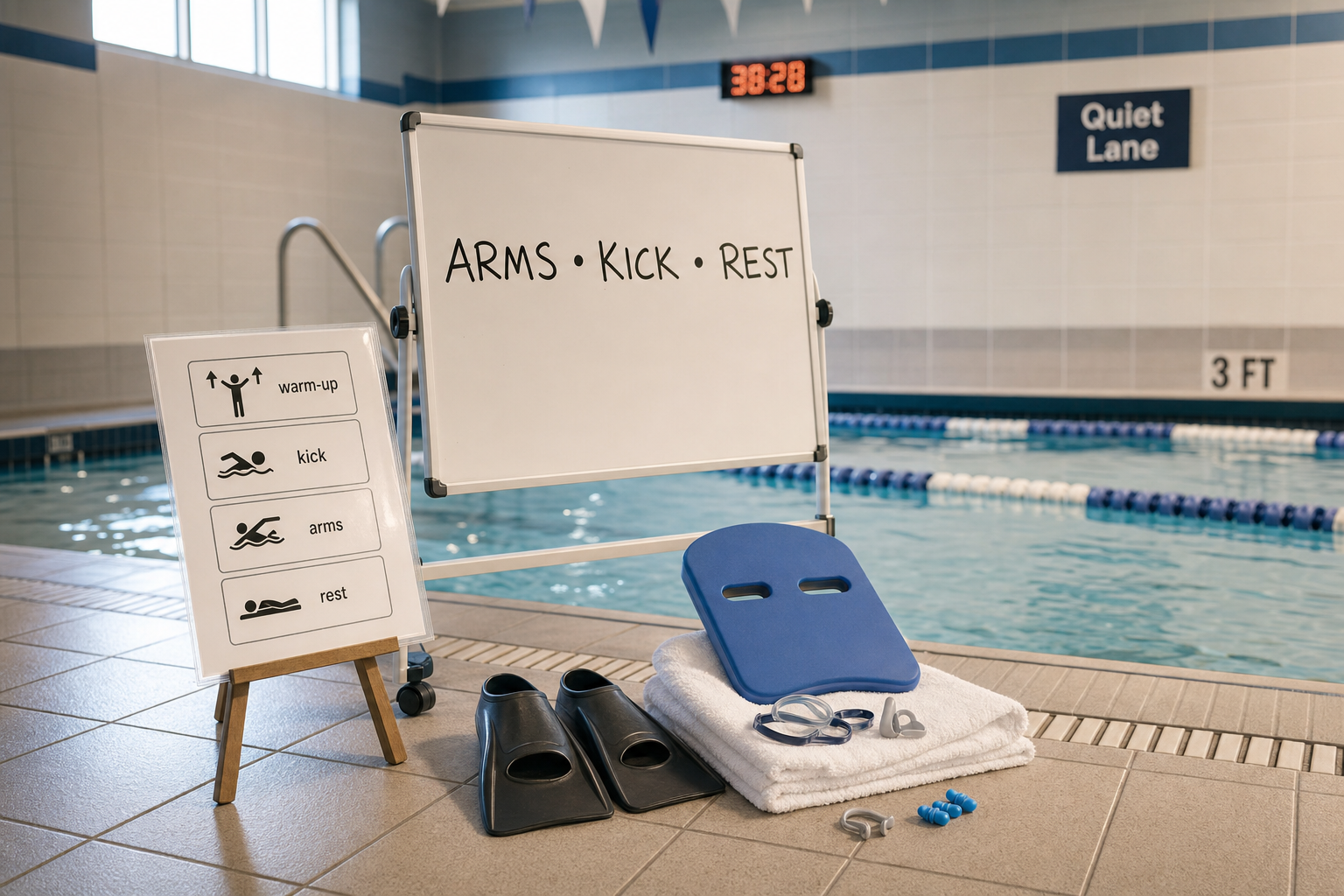
Using a picture storyboard that shows each part of a session—warm-up, submersion, stroke work, warm-down—helps reduce anxiety. Visual schedules or cards your child can point to build agency and predict transitions. In classes designed for neurodivergent learners, these supports are frequently cited as essential. (swimy.org) Poolside routines that repeat the same steps in the same order and simple cues like “arms”, “kick”, “rest” work better than multi-step verbal instructions.
Short Cues and Chunked Tasks
Break skills into tiny pieces. Instead of saying “do breaststroke”, start with “kick with board”, then “arms separate” before combining. Short cues repeated often—such as “strong kick”, “look forward”, “breathe”—help kids with ADHD process information in manageable bites. In the motor learning review for 5- to 12-year-olds, interventions that used small, focused tasks under guidance showed better skill acquisition. (pmc.ncbi.nlm.nih.gov)
Movement Breaks and Sensory Regulation
Even in a pool, energy can build fast. Allowing movement breaks—fast swim stretches, playful games, or walking in the shallow end—helps reset attention. Sensory regulation may mean dimming lights, using quieter lanes, avoiding loud echoing sounds, or using nose clips or goggles if splashes are overwhelming. These breaks and adjustments reduce fatigue and emotional overflow. (mdpi.com)
Describe what works for your child. Let instructors know about what visual aids, pace of instructions, or sensory tolerances are most helpful. You might ask them to use three-step cues or to provide a countdown before transitions: “one more kick, then we try arm stroke.” Use a plan like the 10-Week Plan from swimy.org to map expectations ahead, align with instructor on skill milestones, and decide when to fade supports. Hyperlink this plan into your selection process by showing what kinds of progress are realistic week by week. https://www.swimy.org/10-week-plan
[[ctakid]]
Avoid Floaties That Hinder Technique
Floatation devices like oversized arm floaties or thick foam belts sometimes feel safe—but they often work against building proper body alignment. Instead, lean on instructor-approved supports like kickboards or short fins for occasional help, always with guidance. The goal is technique and skill—not dependent floating—so your child’s movement feels grounded and strong.
Picking the Right Class Format & Working with Instructors
How you select swim lessons matters just as much as what happens in them. Here’s what to ask and set up.
Teacher training matters. Ask whether instructors have adaptive aquatics experience or credentials in working with neurodivergent children. Classes given by those with experience in ADHD, sensory regulation, or special education tend to accommodate needs proactively. Class size should be small—one-to-one or small groups help ensure attention isn’t spread too thin. If classes are large, ask for quieter times or semi-private lessons.
Set class goals together. Is it about reducing fear in deep water, mastering backstroke, or staying calm during instruction? Shared goals let instructors adapt feedback and help you track wins. Ask for video or photo feedback so your child sees what's improving—and feels proud.
Common Pitfalls & How to Avoid Them
Oversized classes and noisy lanes are major distractions. Pools aimed at general public hours can flood in echo and activity. Try off-peak times or request semi-private lessons. Pools with acoustic tiles, fewer overhead speakers, or quieter neighboring rooms can help sensory regulation. Instructor plans that change suddenly—like switching from splash play to technique drills without warning—often trigger protests in kids with ADHD. Use consistent structure.
Devices, music or toys that distract in the water can seem fun but may pull focus. Devices in or near water—MP3 players, tablets showing videos—are unsafe and distract from instruction and safety cues. Stick with the instructor’s plan, avoid adding gadgets, and ensure your child can hear verbal cues clearly.
Lasting Benefits & What Success Looks Like
Over time, neurodivergent swimmers often show boosts in executive function—better self-control, attention, impulse regulation—as well as better motor coordination and mood stability. Regular aquatic exercise has been tied to reduced anxiety, fewer behavior challenges, and improvements in reading, math, and school performance in some studies. (pmc.ncbi.nlm.nih.gov) Success isn’t always linear: a week of tantrums might precede a breakthrough in form or confidence.
Celebrate wins—even small ones—so your child feels motivated. Did they float properly without a belt? Kick rhythm steadily for ten seconds? Transition without a meltdown? These are real victories. Keep feedback immediate, visual, and positive. Parents often report that confidence in the water spills over into school, social relationships, and self-esteem. (healthychildren.org)
Swimming is not just a seasonal thing—it’s year-round practice in self-regulation, poise, and focus. With the right teacher, the right class size, visual supports, short cues, movement breaks, and careful goals, kids with ADHD can feel the wins, face fewer meltdowns, and develop technique that lasts.
120+ swimming exercises sorted by age — with video and instructions. Developed by swim instructors, completely free.

120+ swimming exercises sorted by age — with video and instructions. Developed by swim instructors, completely free.