Baby Swim Badges Without Pressure: Building Confidence, Not Comparison
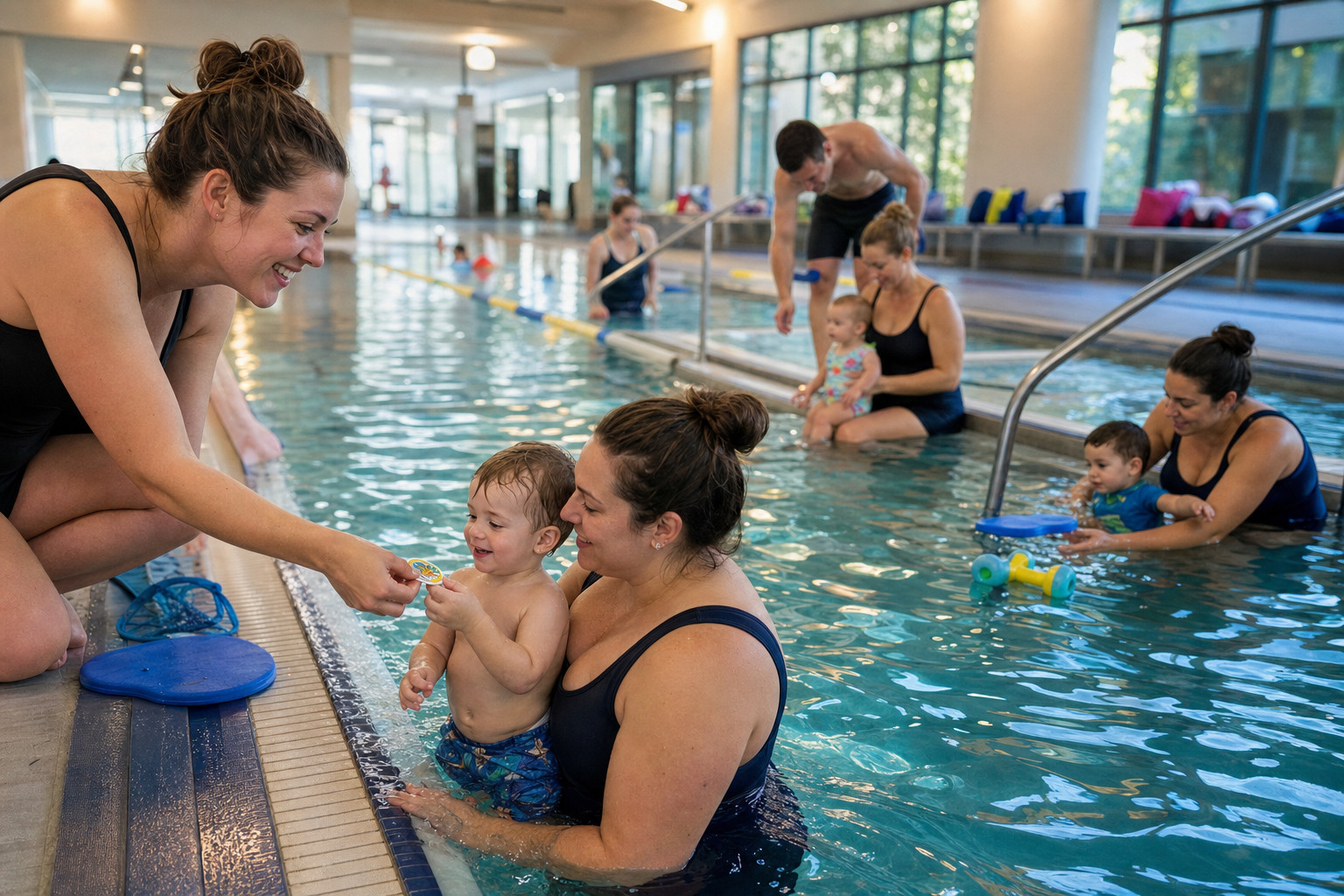
When your 6-month-to-3-year-old earns a baby swimming badge, or advances through toddler swim levels, it’s tempting to focus on the certificate or sticker they’ll take home. But the most valuable progress is often quieter—more about comfort, calm recovery, safe entries, and supported exits than splashy performances. In the UK and Australia, badges or levels are common; in the US, many swim schools offer baby swim progress certificates. Whatever form the award takes, it should support confidence and safety—not create pressure.
What Parents Really Want from Swim Levels and Badges
Parents usually want reassurance that lessons are working: Is my child more at ease in the water? Do they enter safely, listen to simple instructions, respond to being touched or supported? These shifts are critical. As Kim Swim in Australia explains, real progress shows up when babies and toddlers transition from fearful wall-clinging to responding positively to water movement, safe assisted entries and exits, and basic cues like “kick,” “blow bubbles,” or “hold the wall.” (kimswim.com.au)
Badges and progress cards can highlight those smaller steps: gaining trust of the water, learning to float with support, feeling joy in movement—not just logging laps or distances. It’s essential that swim levels prioritize safety behaviours over competition, especially under age 3. The Royal Life Saving Society UK stresses that water safety, entry and exit skills, and confidence are just as important as physical ability. (rlss.org.uk)
US vs UK vs Australia: How Awards Differ—and What That Means for Pressure
In the UK and AU, swim awards often come with named levels or badges: Duckling, Starfish, Water Baby, etc.—each signaling a mix of physical skills and confidence. In the US, many schools use progress certificates, or “report cards,” to show what skills a baby or toddler has begun to master. These are less public, less visible under fellow parents’ eyes—but they can still pressure kids if expectations outpace readiness.
What matters is how the badge is framed. In an Australian program like Waterbabies, the philosophy is doing it with your child, not to them—so badges reflect shared experiences, trust, and joy. (waterbabies.com.au) Similarly, US experts, including the American Academy of Pediatrics, recommend starting swim lessons with parent-child classes and emphasising emotional readiness (comfort with water, separation, basic instruction comprehension) before pushing for stricter performance benchmarks. (healthychildren.org)
If you want a structured way to build water confidence at home, the 10-Week Plan guides you step by step.
How to Use Badges and Levels as Motivation Without Causing Stress
Of course, badges and levels can be powerful motivators. Here’s how to use them gently:
- Focus on calm recovery after stepping into the pool: moments when your baby or toddler regains their composure after being splashed or after being supported for the first time going underwater.
- Celebrate safe entry: entering feet first, or sliding into the pool hand-in-hand, with less panic.
- Track supported exits from the water, such as climbing up the ladder, holding the side safely, or being helped out with fewer hesitations.
[[ctababy]]
Use the 10-Week Plan from Swimy.org to structure these smaller wins. That plan gives week-by-week guidance to build water confidence, preview skill changes, and gradually adjust to toddler swim levels—which helps parents keep expectations aligned and avoid rushing into new badge tests before your child is ready. (swimy.org)
Don’t let badging become ladder climbing. Instead, let it be a gentle map. As experts suggest, skip comparing your child to classmates. What matters is: Are they safer, calmer, happier in water over time? Not whether they’ve matched someone else’s speed or bravery. (kimswim.com.au)
Signs Your Child Is Ready to Move Up Levels
Moving levels too soon can backfire. Here are indicators that your little swimmer may be ready:
- They follow simple cues like "kick," "blow bubbles," “float” consistently across lessons.
- They tolerate being on the pool deck without you—or with you observing rather than holding them in the water.
- Their body control improves: better balance in floats, gliding skills, kicking with support.
- They show less distress during normal transitions: entering, exiting, or when they get splashed accidentally.
UK and AU programs often use these readiness signs rather than strict age cutoffs. For example, UK baby-swimming guidelines stress milestones around comfort, safety entries, breathing, and flotation over age alone. (swimming.org)
What Every Parent Should Know About Badges: The Safety Caveats
Even with the sweetest badge or most encouraging progress certificate, remember: no badge means your child is water-safe or able to swim independently. Never treat swim awards like proof of independence. Constant supervising is vital—and under no circumstances should a toddler be left unsupervised near water just because they earned a badge or level.
Also, avoid comparing growth to others. Two children in the same class might achieve different milestones in different ways. Someone might be great at floating; another might kick stronger. Judging by who does better can undermine confidence. Focus instead on your child’s calm return to comfort after fear, their ability to listen to instructions, and their safe interactions with support.
Badges, levels, progress certificates—they all have potential to encourage. But for babies and toddlers, what truly lasts is confidence, safety behaviour, and love of water. Hold awards lightly. Watch for calm recoveries, safe habits, supported movement. Celebrate badges, yes—but even more, celebrate the smiles, the trust, and the moments when your child says, “I think I like water.” That is a win every badge should reflect.
120+ swimming exercises sorted by age — with video and instructions. Developed by swim instructors, completely free.

120+ swimming exercises sorted by age — with video and instructions. Developed by swim instructors, completely free.