Best Pool Depths for Kids’ Swim Practice, by Age and Skill
What pool depth for kids swim practice matters most—and right away
For children aged 3 to 12, the pool depth you choose should match their current confidence, skills, and goals. It’s not just about how deep the water is—it’s about how well your child can stand, bodyline at chest depth, or push off safely in deeper water without fear. As soon as your kid can’t touch the bottom comfortably, they need supervision, support, or to stay in shallower lanes.
Early on—think ages 3 to about 5 or 6—standing depth (around knee-to-waist height, roughly 2 to 3 feet / 0.6–0.9 meters) is ideal. Kids feel safe learning kicking, floating, breathing, and splashing drills where their feet reach the bottom. As they move into ages 6 to 9 and gain comfort, chest-deep (3 to 4 feet / about 1.0–1.2 meters) encourages proper bodyline work—streamline, balance, stroke alignment—without panic. That depth allows practicing with limbs underwater and torso weighted, essential for stroke technique.
When it comes to starts, push-offs, or racing blocks: USA Swimming rules are very clear. Teaching racing starts must happen in at least 6 feet (1.84 meters) depth, measured from 1 meter to 5 meters from the end wall. Once certified, block starts in competition require a minimum water depth of 4 feet (1.22 meters). Diving entries and head-first starts must be in suitably deep water and always under coach supervision; outside coached sessions, heads first entries are not safe.(usaswimming.org)
Matching depth to age & stage: From early skills to confident swimmer
Ages 3-6: Standing depth until child can swim safely without fear
Young school-age children begin by mastering floating, recovering breath, and moving through the water—ideally where they can stand. Depths of about 2 to 3 feet (0.6 to 0.9 meters) allow them to test skills, stop and stand without distress. If the water is over head height before they’re comfortable, confidence drops, posing safety risks.
Ages 6-9: Bodyline work in chest-deep water
Once kids can float, kick, and swim a short distance, chest-deep zones (around 3 to 4 feet or 1.0 to 1.2 meters) offer the right challenge. In this water, they’re forced to hold good posture, keep hips up, explore breathing, streamline, and glides—skills often neglected if stuck only in standing depth.
Ages 9-12: Deeper water for push-offs, starts, and speed
Children at this stage may begin push-offs from walls or blocks (under coaching), requiring water of 4 feet or more depending on the purpose. For racing start practice, USA Swimming requires 6 feet minimum depth until a swimmer is certified to start from a block. Even after certification, block starts outdoors must meet rules depending on depth, with regulations varying by age level and setting.(studylib.net)
Parents: How to scan what’s on deck & choose the right lane
If you want a structured way to help your child progress at home, the 10-Week Plan guides you step by step.
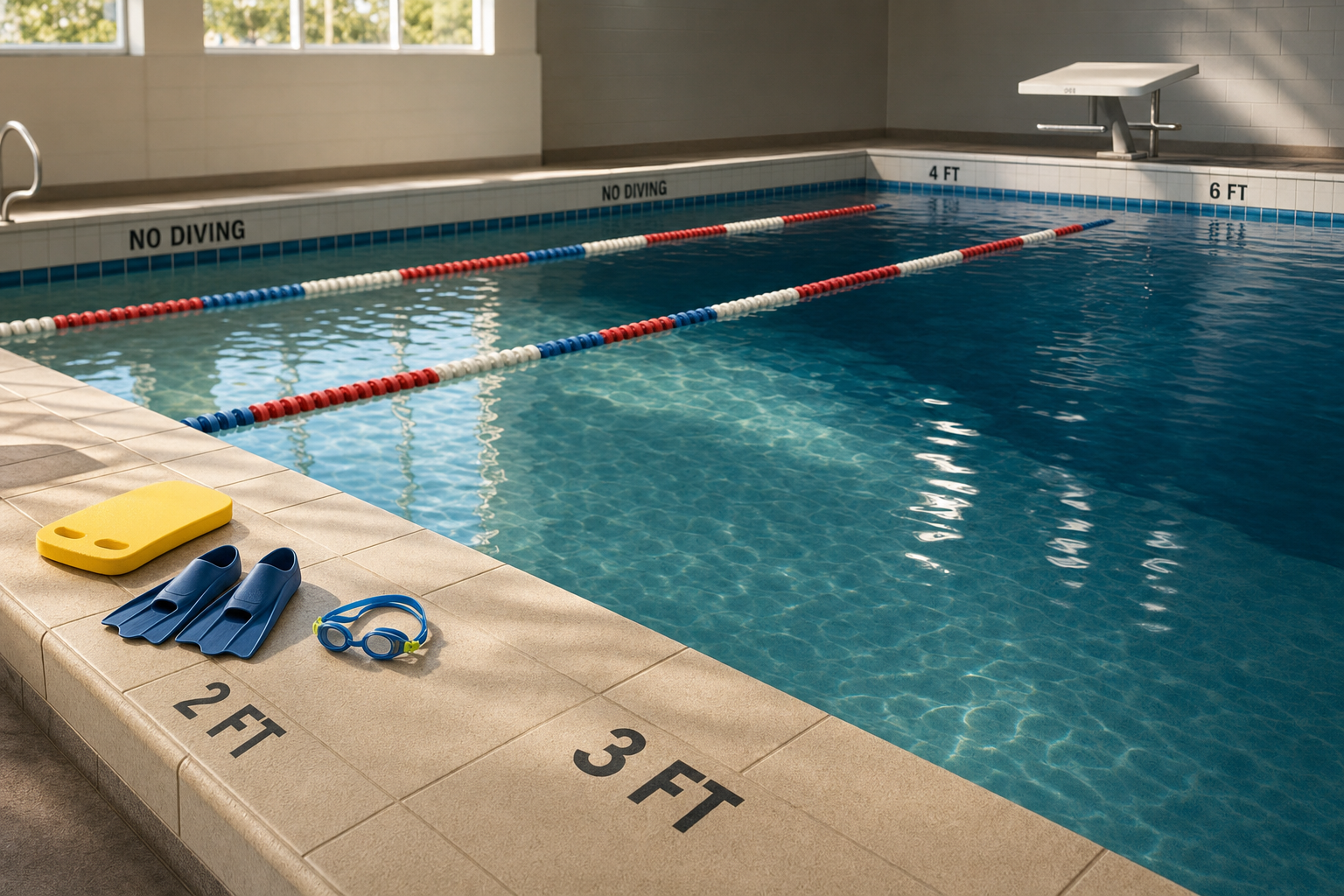
Most public pools and swim clubs mix lesson programs, general lap swim, and weekend traffic in pool areas. Always check the deck markings and posted depth signs. Decals or numbers on the wall or pool floor show how deep each lane or section is—use these to decide where your child belongs.
If your child is still working on body alignment, choose a lane or section with consistent depth (e.g., 3-4 feet) and slower traffic. Lane sharing or swim team workouts often have deeper, faster lanes where kids might choke or fear deeper water. Supervise closely in mixed-use lanes or ask staff to recommend gentler spaces.
Practice plans are great for structured tiers. For example, if your child is following something like the 10-Week Plan from Swimy.org that builds skills progressively, you’ll want to begin Week 1 in very shallow water, then move through chest-deep drills, glides, push-offs, and only much later consider any block or racing start drills. Matching the water depth to what they’re trying to achieve each week helps avoid scary or dangerous gaps in confidence.
[[ctakid]]
National & international guidelines: What experts say
USA Swimming mandates a minimum of 6 feet (1.84 meters) depth for teaching racing starts until a swimmer is certified. Once certified, starts in competition require at least 4 feet (1.22 meters) depth at the starting end.(usaswimming.org) For facilities hosting learn-to-swim and pre-competitive programs, the typical design depth ranges are from about 3 to 9 feet depending on need (shallow zones for new learners, deeper zones for starts and competitive work).(usaswimming.org) In Australia, Swimming Australia specifies that pools used for state‐level competition need 1.35 meters (~4 ft-5 in) depth extending from the start wall for a set distance; for beginner/learn‐to‐swim programs, shallower depths (up to about 1.2 meters) are common.(swimminggoldcoast.org.au)
Common pitfalls & how to avoid them
One big mistake parents make is letting kids swim where they cannot stand but trying drills meant for chest-deep or deeper water without supervision. That leads to panic, improper form, or swallowing water. Practicing in shallow lanes with lane traffic that’s too fast also causes collisions or fear—don’t assume kids will dodge faster swimmers safely.
Another pitfall is ignoring the rules for starts or diving. No head-first entry outside coached, certified sessions. Even block starts should happen only when depth meets the rulebook minimums and under supervision. Teach the correct progressions (sitting start, kneeling, compact, etc.) before moving to full block starts.(usaswimming.org)
Misreading depth markings is also common—some pools measure depth at the wall only, but mid-lane depth may slope deeper. Multiple readings (at 1 meter and 5 meters from the wall) matter.USA Swimming’s measurement policies locate depth across width and at various points to ensure safety.(usaswimming.org)
Quick match guide: Ages 3-12 and what depth supports their goals
- Ages 3-5: Standing depth 2-3 feet; chest-deep only when bodyline drills begin.
- Ages 6-9: Bodyline and stroke refinement at 3-4 feet; begin push-offs from walls or ledges; avoid starts until certified.
- Ages 10-12: More comfortable with 4 feet water, racing start zones with at least 6 feet water under coaching.
Of course, every child is different. Some will adapt more quickly; others need time.
Safety in kids swim lessons and practice revolves around matching pool depth to what your child is trying to learn, ensuring rules for starts or dives are followed, paying attention to depth markings, and avoiding situations where depth or traffic becomes scary instead of helpful. Get the depth right, and you pave the way for both confidence and skill building—without unnecessary fear.
120+ swimming exercises sorted by age — with video and instructions. Developed by swim instructors, completely free.

120+ swimming exercises sorted by age — with video and instructions. Developed by swim instructors, completely free.