Booster Week vs Weekly Lessons: Swim Plateau Busters for Ages 6–12
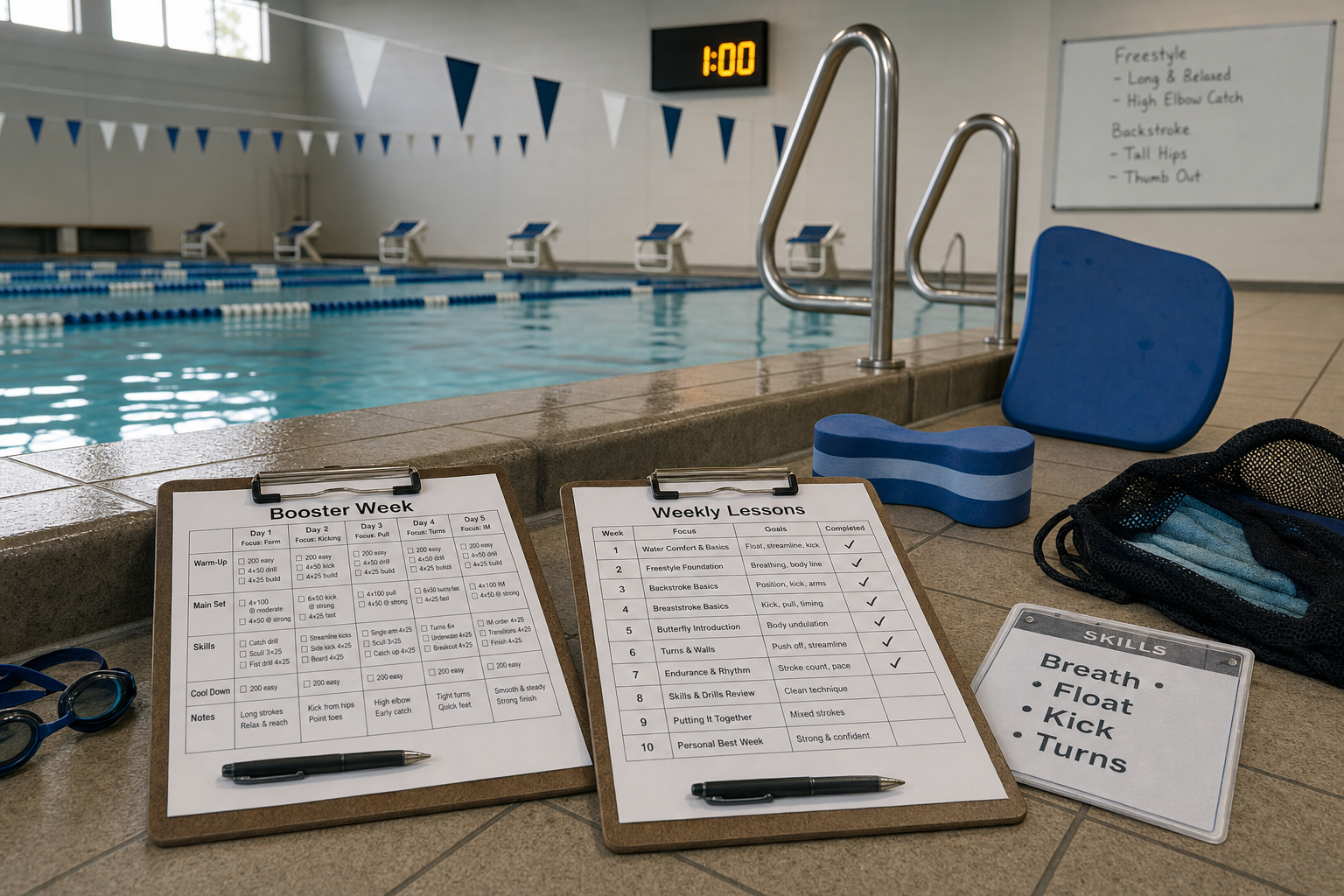
If your child has stalled in swim progression and you're wondering if an intensive week can restart momentum, the short answer is yes—but only if you plan carefully. For school-age swimmers (6–12), balancing intensive swim lessons for kids against standard weekly lessons means matching the format to your goals: water competency, stroke technique, or meet readiness. Here’s how to know what’s best—and how to make either option work while avoiding common pitfalls.
Goals First: What Are You Trying to Achieve?
Water Competency
Water competency means more than just making forward progress—it’s about being safe in and around water. According to the American Red Cross, this includes entering water, resurfacing, floating, controlling breathing, swimming a basic distance, and exiting safely (watersafetyusa.org). If your child is missing one or two of these, weekly lessons offer repetition and gradual exposure over time, which helps skills settle in. A booster week can accelerate them—but it must include enough rest and repetition so the child isn’t overloaded.
Stroke Technique
Refining proper stroke mechanics—body alignment, leg kick, arm pull, breathing—needs consistent, corrective feedback. Weekly lessons spread over months make this easier: parts of technique can be introduced and revised slowly. Intensive sessions, for example daily over a school break, can help handle weak links like flip turns or breathing patterns because the feedback loop is tight. As evidence suggests, massed practice (many lessons in a short period) can produce faster short-term gains, while distributed practice (weekly sessions) tends toward greater long-term retention (waterwisekids.com).
Meet Readiness
If you need to build race skills—starts, turns, speed endurance—for a specific competition, a booster week can pump up readiness, especially if goals are imminent. But kids ages 6-12 must have a foundation first: breath control, ability to swim basic strokes legally, and a measure of stamina. Without that, jumping into intense sessions can overwhelm their bodies and confidence.
Booster Week vs Weekly Lessons: Key Differences
Weekly lessons afford consistency, recovery time, and gradual progression. Children return rested, memory has time to consolidate, and coaches can observe growth over weeks or months. But plateauing often comes from going too slow or from long gaps between lessons. Booster weeks—such as daily or near-daily lessons during school break—provide intensity, build confidence fast, and cut through stagnation. The trade-offs: fatigue, possibly diminished attention, and risk of burnout if expectations outstrip ability.
If you want a structured way to help your child progress at home, the 10-Week Plan guides you step by step.
Swimy.org offers a helpful resource called the 10-Week Plan, which helps parents and swimmers set measurable targets and build toward skills like water competency or stroke refinement in structured blocks.
[[ctakid]]
How Parents Can Judge Readiness & Set Measurable Targets
To decide if your child is ready for booster lessons, watch for signs like comfort putting face underwater, ability to float front & back, swim several lengths of freestyle without stopping, and resilient energy after typical weekly lessons. If your child struggles breathing control, becomes fearful, or cannot maintain form after short sessions, they are not ready for intensives.
Set “SMART” goals: specific, measurable, achievable, relevant, time-bound. For example: “In booster week, finish 5 continuous freestyle lengths with bilateral breathing,” or “reduce time for 25 meters backstroke by 10% with legal kick.” Weekly lessons can plot micro-goals over time, while intensives should have daily targets.
Avoiding Burnout and Overtraining
Overworking with no recovery leads to fatigue, loss of motivation, sometimes injuries. According to the American Academy of Pediatrics, young athletes should have at least one to two rest days per week and longer breaks every two to three months to prevent burnout (health.choc.org). For 6-12 year-olds, intensive lessons should not exceed 90 minutes per day, and should include breaks, fun elements, and perhaps stroke play or water games.
Putting It All Together: Practical Recommendations
If progress has stalled and you're looking at a school holiday or summer break, schedule a booster week—aim for 3-5 lessons in a row rather than cramming too long sessions. Support it with weekly lessons afterward to consolidate gains. If your goal is water competency, ensure the basic skills like breathing, floating, and exiting water are mastered before intensives.
For stroke technique work, video or frequent corrective feedback during intensive weeks helps. After that, spread weekly practices for weeks or months. If your child wants to compete, align booster activity so it finishes slightly before the meet, giving time to taper.
Seasonality matters: school breaks, long summer holidays or spring breaks are ideal windows for intensives. Off-season weekly classes are good when timelines are distant.
Common Pitfalls to Avoid
Booking an intensive without basic breath control is risky: child may panic, form breaks down, confidence suffers. Expecting a level jump in one week is unrealistic—skill consolidation needs repetition. Over-booking or long daily sessions without rest leads to burnout. Skipping weekly follow-ups after a booster means gains often fade.
Bottom Line
Booster week intensives can bust plateaus when progress stalls—especially for stroke technique or meet readiness—but only if foundation skills like water competency are in place. Weekly lessons are essential for long-term growth, durability, and avoiding burnout. As a parent, judge readiness carefully, set measurable goals whether for safety, technique, or racing, and use intensives strategically (around school breaks), followed by weekly lessons for consolidation. With balance, your 6- to 12-year-old can break through the plateau—and still love swimming.
120+ swimming exercises sorted by age — with video and instructions. Developed by swim instructors, completely free.

120+ swimming exercises sorted by age — with video and instructions. Developed by swim instructors, completely free.