Camp Lake Swims: Rules, Swim Tests and Parent Questions
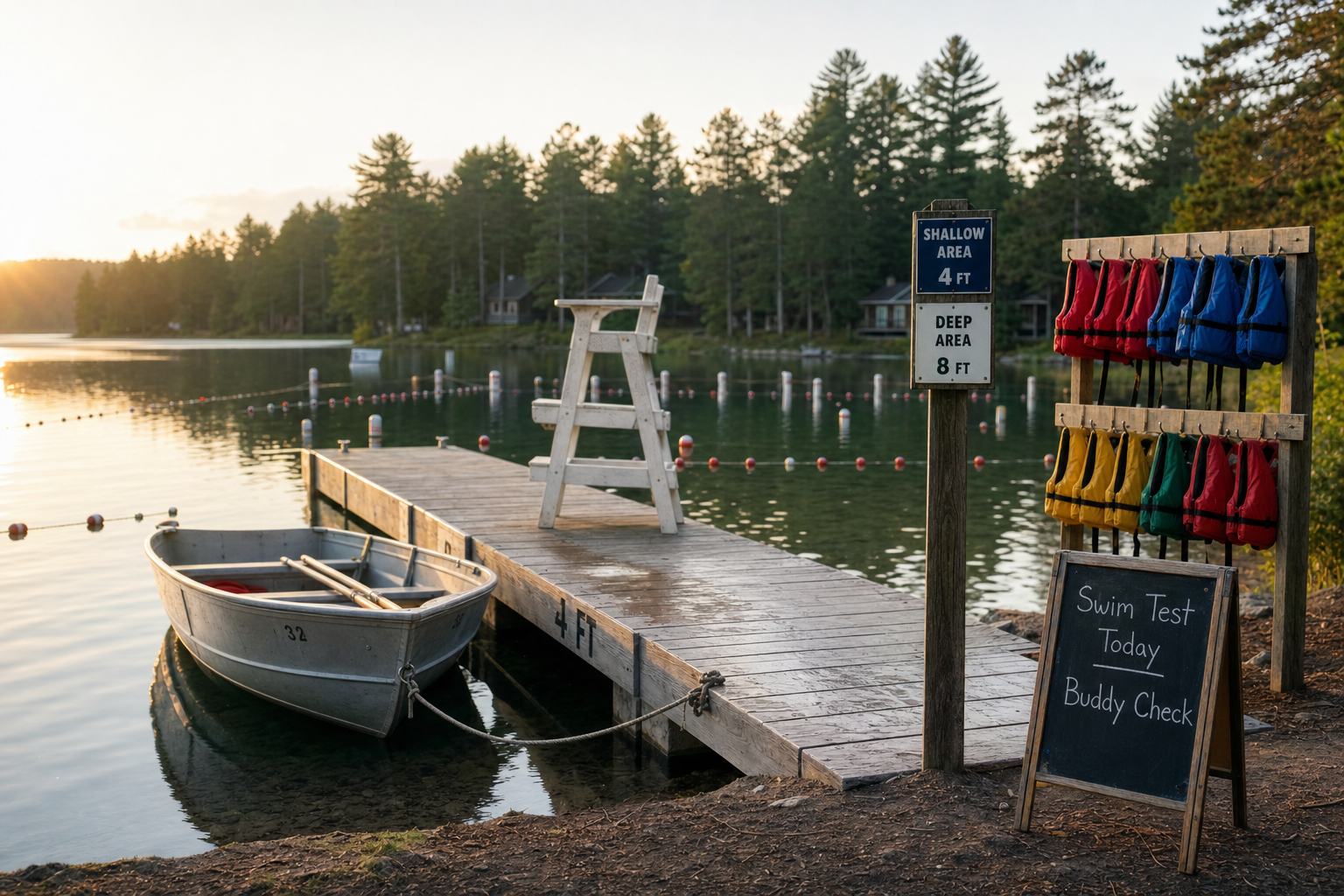
If your child is headed to a day or overnight camp aged 6-12, here’s what you need to have settled before they jump into lake swimming. We’ll walk through camp swim test rules, lake swimming at camp safety, and the key questions to ask summer camp, so you feel confident your child is heading into a safe, well-run aquatic program.
What Exactly Are Camp Swim Test Rules?
On the first day (or sometimes before camp starts), almost every camp gives kids a swim assessment. This isn’t just about whether your child can swim in a pool—it’s to see how they handle open water. Rules vary by state, but in Massachusetts the law (105 CMR, § 432.100) says that camps must swim test every camper at least once per summer, in the body of water they’ll be using if possible, to classify who is a non-swimmer or at-risk swimmer. (law.cornell.edu)
The test must be done by someone certified, and non-swimmers should be identified so they can get proper supervision, stay in shallow or roped-off zones, and use life jackets when necessary. Even strong pool swimmers often struggle in cooler, darker lake water. (kampspire.com)
How Lake Swimming Safety Rules Differ From Pool Rules
Open water like lakes, streams, or rivers comes with unique hazards. Camps need different safeguards than for pools. Rules in California (Title 17, Section 30741) require a camp using lakes to have a designated aquatics supervisor, at least one lifeboat or equivalent rescue craft, and visible signage about depth, currents, or dangerous terrain under and around the water. (regulations.justia.com)
Supervision ratios are tighter or more specific for lakes. Most camps follow standards of one lifeguard per 25 campers in open water, but for mixed-abilities or non-swimmers those ratios go down (for example, one lifeguard per 6-10 children). (waterwisekids.com)
Life jackets must be required for non-swimmers or anyone venturing into deeper water. The policy must be clear and enforced without exception. Pools don’t always have that kind of shifting depth or hidden hazards like submerged logs or changing currents. So lake swim policies need more layers of safety. (regulations.justia.com)
Swim Test Formats: What Kids Will Go Through
When camps describe their swim test, you’ll want to know exactly what they mean. Tests often include: swim a certain distance without stopping (often 25-50 meters or yards), tread water for a set time, or swim back to docks or shore without assistance. Some tests use the actual lake; others use a pool comparison if the lake is unsafe for testing. In Massachusetts, if the lake isn’t usable for testing, camps may test in a pool but still must have lifeguards at the lake when swimming is later held there. (law.cornell.edu)
Kids get grouped by ability—non-swimmers, beginner swimmers, and strong swimmers. Roped-off zones, colored swim caps, or frequent buddy checks are tools camps use to keep groups safe and clearly separated. These make sure expectations are consistent and help kids understand where they should be. (kampspire.com)
Non-swimmers should always have a safe, shallow area or a very supervised permit to only go where depth is controlled, and a life jacket must be available and used. That policy should be explicit. If your camp offers an ability building or swim lesson block, ask how non-swimmers are kept safe while still being included. ## about midway here
[[ctakid]]
Kids improve when expectations are clear. Something like the 10-Week Plan from swimy.org helps young swimmers build skills steadily, so they aren’t nervous or behind on that first swim test. Including a plan like that in pre-camp prep—or choosing a camp that uses it or something like it—can lead to safer, happier lake days. (See the 10-Week Plan here: https://www.swimy.org/10-week-plan)
What Parents Should Always Ask Before Camp
When you’re comparing camps or deciding where your child will go, these are non-negotiables.
Ask about lifeguards: Are they certified? What certification agencies do they use (Red Cross, YMCA, or equivalent)? Are they dedicated just to watching the water or also leading games? Certified lifeguards who are distracted don’t count. (waterwisekids.com)
Ask about supervision ratios: How many campers per lifeguard during lake swim times? What is it for non-swimmers or beginner groups vs strong swimmers? Balance changes depending on age, ability, and how many kids are in the water. (waterwisekids.com)
Ask about illness exclusion and health screening: Does the camp screen for contagious illnesses? Are kids who are unwell kept out of swim groups until tested or cleared? Dirty water or illness outbreaks happen in lakes just like pools. Camps must have health protocols, clean water quality checks, and clear rules so you know when your child should stay out. (in.gov)
Ask about emergency protocols: What rescue craft is available? Are there signs about currents, depth, or underwater hazards at the lake? Is there a waterfront supervisor who is always present—at least 18 years old and with lifeguarding credentials? (regulations.justia.com)
Ask about buddy systems, boundary systems, and life-jacket policies: How does the camp make sure kids stay in pairs or groups? How are swim areas marked (ropes, colored swim caps)? What are the exact rules for life jackets—when and for whom are they mandatory? (kampspire.com)
Why These Details Matter
Clear swim test rules and supervision ratios set expectations for kids. If your child knows what the test will involve, which zone they'll be in, and what rules apply (life jacket or not, buddy everyone, stay within roped area), there’s less anxiety and more safety. Consistency among camps, or at least transparency from your chosen camp, builds confidence for both kids and parents.
When expectations are hazy, mistakes happen—kids swim beyond ability, staff get overstretched, illnesses spread, or rescue craft isn’t ready. None of that happens in well-managed lake sessions with rigorous swim test rules, strong supervision, clear health protocols, and complete aquatic staffing.
Final Checklist: Don’t Leave Without These Answers
Make sure you leave your camp interview with clear answers about:
what the swim test involves and in what environment;
exact lifeguard certification and rescue equipment (boats, etc.);
supervision ratios for different abilities;
life jacket requirements for non-swimmers or risk-classes;
open water safety: boundaries, signage, currents;
illness policy and water-quality testing.
These aren’t optional details—they are safety essentials. A camp that regards them carefully will give your child the chance to build confidence and enjoy lake swimming without unnecessary risks. When you ask these questions and compare thorough answers, both your child and you can step into summer ready.
120+ swimming exercises sorted by age — with video and instructions. Developed by swim instructors, completely free.

120+ swimming exercises sorted by age — with video and instructions. Developed by swim instructors, completely free.