Catch-Up Freestyle: A Kid-Friendly Timing Fix
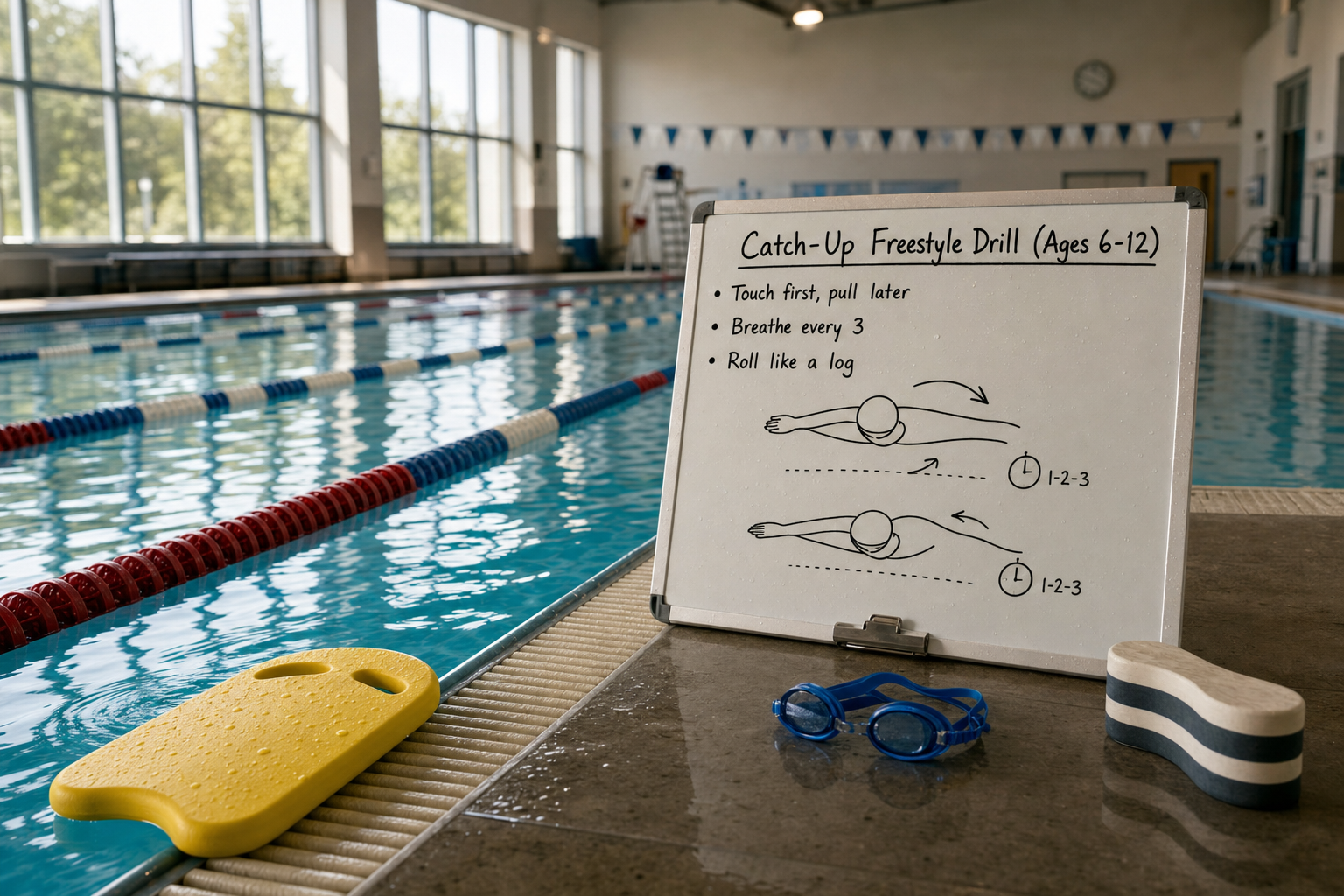
For many 6- to 12-year-olds, freestyle looks rushed. Arms crossover midline, balance is uneven, and breathing is late. The catch-up drill for kids offers a simple fix. By having one hand wait out in front while the other completes its pull and recovers, this freestyle timing drill helps young swimmers slow down just enough to clean up their stroke, improve posture, and time their breath properly without turning practice into a race.
What’s Actually Wrong When Kids Rush Freestyle
Kids often cross over their arms (hand entering past the shoulder line) because they’re trying to go fast. That loss of alignment makes them work harder for less speed. Worse, rushing causes a dropped elbow, weak core engagement, and high drag. When multiple mistakes stack up—crossover, weak rotation, stiff arms—efficiency plummets.
Using a catch-up freestyle drill spotlights three crucial fixes all at once: keeping the lead arm extended, promoting body rotation, and bringing breathing into the right moment of the stroke. Coaches agree: these are foundational before kids ever chase lap times.(icanswimfast.com)
How to Teach the Catch-Up Drill: Step by Step
To make it safe, clear, and effective for 6- to 12-year-olds, follow this progression:
Start with a pool edge demonstration. On land, show what it looks like when one hand stays in front, while the other goes through pull, recovery, then waits for its turn again. This gives a visual reference without pressure.(swimcoachhill.wordpress.com)
Move to the water using either a kickboard or a gentle float held out front. One hand grips ahead, the other strokes at full control. Swap sides so both arms get attention. Breathing every three strokes works well here (not every stroke), so the balance isn’t thrown off.(swimlikeafish.org)
Once extension, balance and timing feel right, graduate into regular catch-up drill (hands touching or meeting), then eventually transition toward full freestyle—with speed—but only after the form is solid.(rillieux-natation.com)
If you want a structured way to help your child progress at home, the 10-Week Plan guides you step by step.
If you need a structured plan, the 10-Week Plan from swimy.org blends catch-up drill with single-arm freestyle, body rotation work, and breathing progressions to build solid timing in stages.
What Cues Parents and Swim Teachers Can Use
When kids are learning, simple physical cues help more than technical jargon:
- “Touch first, pull later” to remind that one hand must wait out front.
- “Elbow high under water” to encourage the high-elbow catch so the pull has power.
- “Rotate with me / roll like a log” to get rotation in shoulders and hips—not just arms.
- “Breathe lightly, head down” so the head doesn’t pop up too early with the breath.
[[ctakid]]
These cues change the feel of the stroke without overwhelming a young swimmer with too many corrections.
Sample Short Sets for Between Lessons
Safety first: always short repeats with full breathing; avoid hypoxic sets. Try sets like:
- 4 × 25 meters catch-up drill, breathing every 3 strokes, rest 20 seconds
- 2 × 25 meters single-arm drill (left), 2 × 25 meters single-arm drill (right)
- 6 × 25 meters mixed catch-up / regular freestyle, focus on maintaining the fix on crossover
These sets let parents request or run them in short lessons or open swim time. They get quick wins without being exhausting.
Common Pitfalls & How to Fix Them
When drilling, it’s easy to trip up. Here are the usual suspects, and how to handle them:
Stiff arms: If kids lock too rigidly, the stroke loses fluidity. Cue “soft elbows, fingertips leading” so the recovering hand stays light and just touches or meets the extended hand rather than slamming down.
Forgetting rotation: When arms wait out front, some kids flatten their upper body to compensate and sink. Watch hips and shoulders twist side to side. Use “roll like a log” or have them feel one hip lift slightly as they move.
Turning the drill into race-Pace swimming: Often happens because kids want to finish fast. Remind them this is teaching time. Set a relaxed tempo and stick to it. If pace starts creeping up, pull back. The drill loses its value when speed outruns control.
How to Know It’s Working
Look and listen from a parent’s perspective. Is your child’s bodyline more horizontal when the arm is out (long and straight)? Is breathing happening early in the stroke cycle—not at the end? Do they seem more composed, less flailing arms? Do you see fewer crossover entries and more clean reaches forward? These are real signs the timing drill is paying off.
Why This Fix Matters Year-Round
This isn’t just for summertime. Whether in indoor pools in colder months or outside when warm, consistent reinforcement builds muscle memory. Young swimmers grow fast—arms get longer, strength shifts, breath control changes. The catch-up freestyle drill for kids helps reset rhythm each season so that growth doesn’t come at the cost of form.
Parents who commit to regularly inserting short drill sets—just a few 10-15 minute segments per week—will see improvements that translate to less effort, more speed, and more fun in the water.
Catch-up freestyle is more than a fix—it’s a foundation. Teach it deliberately, use strong but child-friendly cues, avoid rushing or stiffening, and let progress unfold week by week. In short, timing first, pace later, and your 6- to 12-year-old will swim smoother, straighter, and stronger with far less stress.
120+ swimming exercises sorted by age — with video and instructions. Developed by swim instructors, completely free.

120+ swimming exercises sorted by age — with video and instructions. Developed by swim instructors, completely free.