First Level Move-Up Without Meltdowns: Transitioning from Parent-Baby to Toddler Swim Class
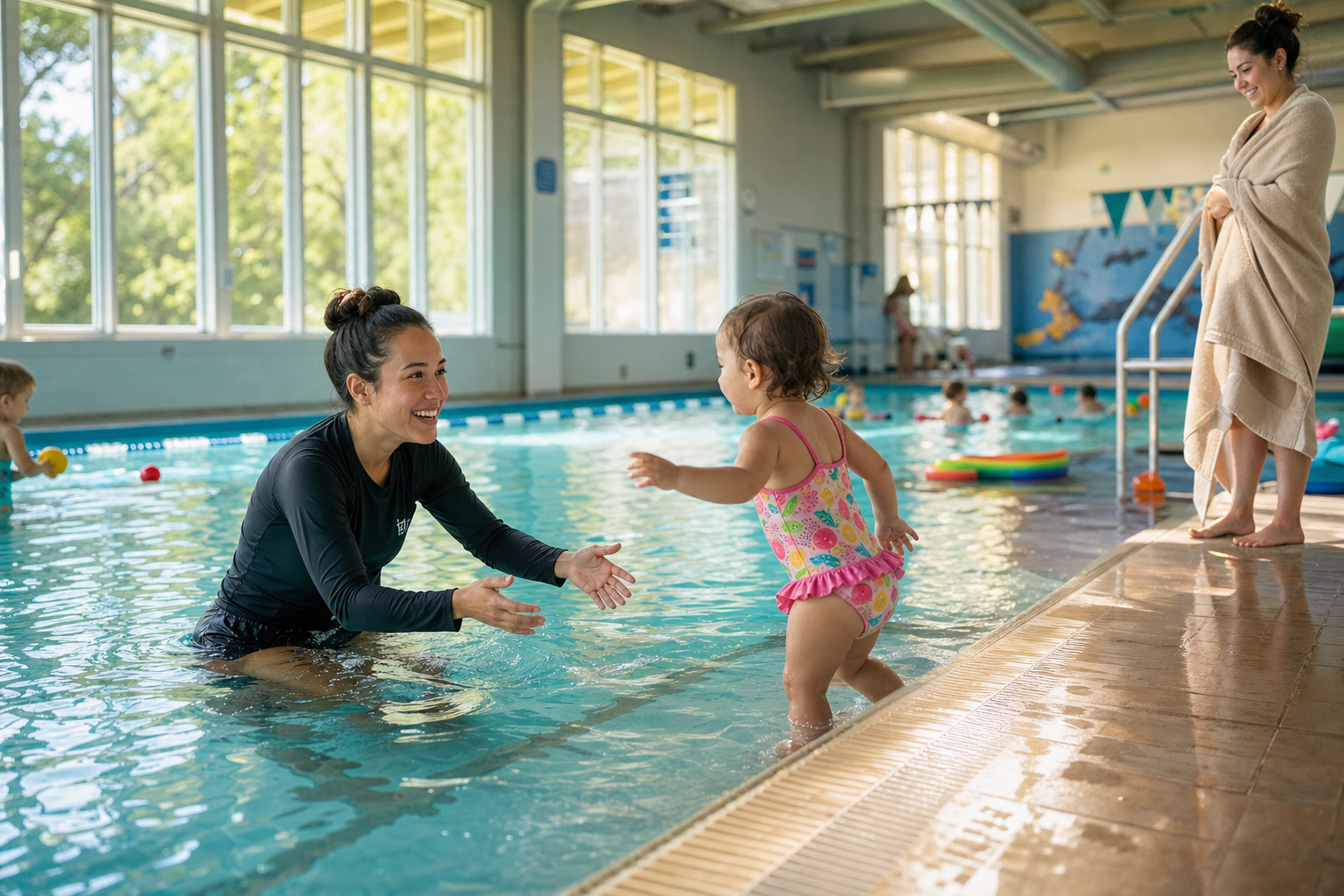
It’s not enough that your child has turned 2, or that the swim school schedules “Toddler Swim Level Move Up” classes. What matters more is reliability, comfort, and the ability to handle change—before meltdowns hit. Read on to find out how to understand readiness, ease the switch from parent‐baby routines, protect your child’s confidence, and make “moving up swim class” a celebration—not a stress.
Understanding Readiness Beyond Age
Age (18–36 months) sets a general range, but “moving up swim class” should depend on a few specific signs. First, your toddler needs emotional comfort—being okay with short separation, or at least being in a class where you watch from the deck rather than staying in the water. Second, they must be listening and following simple instructions like “kick,” “blow bubbles,” or “hold the wall.” Physical readiness shows up in more consistent body control: coordinated kicks, longer floats, ability to glide or roll with support. Those abilities are usually described in Pre-School Frameworks like Swim England’s Discovery Duckling or Duckling level, where the focus shifts from full parent support toward independence in water confidence. (swimming.org)
Also don’t assume readiness just because they’ve completed a parent-baby badge or met age milestones. Coaches often look for consistency across multiple lessons—a child who floats once may not be ready unless they float reliably without clinging. That distinction protects their confidence and safety. (acedolphin.com)
What Actually Changes: Songs, Holds, Teachers & Expectations
When you move from parent-baby or parent-tot classes to toddler swim levels, you’ll notice shifts in structure. Songs and games will still be present—but instead of holding every moment, the teacher may use songs as transitions, letting toddlers get more independent, waiting longer for attention. Holds (cradle holds, hip holds, front or back support) start to reduce; instructors expect toddlers to “float with support,” kick on their own, or travel to the wall. Teachers may change: you might still be in the water initially, but then be asked to stay on deck; ratio of instructor to children often tightens. Lessons may last about 30 minutes to respect attention spans. (swimy.org)
Expect teacher expectations to include basic safety skills: recovering from submersion, turning to reach the wall, surviving brief floats, showing comfort with face wetting. Also, the environment tone may shift—more focus on toddlers’ ability to wait, take turns, or respond to teacher cues rather than depending on parent cues. That’s normal, but it’s a key source of meltdowns if toddlers feel underprepared. (seaotterswim.com)
How Parents Can Prepare in Advance
If you want a structured way to build water confidence at home, the 10-Week Plan guides you step by step.
To protect confidence and avoid meltdowns, you can preview change in small ways. Before the move:
Walk through the pool facility with your child, meet the teacher ahead of the first class, and show them where the new class will happen. Knowing what three cues—locker room, shower, pool deck—look like reduces fear. (attachmentparenting.org)
Set a routine at home that mirrors the class structure. Practice blowing bubbles in the bath, climbing in and out of water together, gliding and floating with support, and following simple commands like “kick together.” Also, use consistent swim days so your child knows what’s coming. (waterwisekids.com)
[[ctababy]]
If the swim school or teacher offers a trial class—or even just observation time—take it. Discuss how much separation is expected, whether songs will change, how holds will evolve. Some schools schedule trial in a group class before removing the parent from the water so you and your child get aligned expectations. (littleflippersswim.com)
One helpful tool many parents lean on is the 10-Week Plan from Swimy.org—it gives week-by-week guidance to build water confidence, preview skill changes, and gradually adjust to toddler swim levels. Use that plan as a bridge so that the first lesson upstairs is no longer a shock. (swimy.org)
Managing the First Weeks: Protecting Confidence During the Switch
When it’s time to move up, expect a bit of wobble and offer reassurance without pushing. If there’s crying, separation anxiety, or resistance with new songs or holds, your role is to stay calm, mirror the confidence you want them to feel, and say things like “I’ll be right here,” “You remember how to float,” “It’s okay to wait for your turn.”
Carve out opportunities between swim lessons—family swim or open water play—with you in the water. It reinforces that water can still be fun, safe, and connected. Celebrate small wins: a float, a wall touch, or catching a ball. Skip comparing levels; instead focus on what your child did today that they didn’t do last week.
Talk with the instructor regularly. Get feedback on what your child is doing well and what they might struggle with—this helps you support at home. For example, if “kick” is in expectation, practice that outside class where stakes are low.
Also, schedule swim lessons not just around your own convenience, but around your child’s energy levels. If they’re going to class right after nap or snack, melting down is far more likely. A settled child enters with confidence. (swimy.org)
Common Pitfalls & How to Avoid Them
One big pitfall is moving up simply because of age. If a child is still anxious, clutching tightly, not following instructions, or not interested in games—it’s too soon. Another mistake is jumping levels without teacher guidance: even if your child “can swim a little,” lack of consistency with skills—especially independently—means they might benefit from staying for a few extra sessions.
Don’t assume “independence in class” means they are safe swimming alone. Even in classes without parents, toddlers need close supervision outside class and reinforcement of safety behaviors around water at home. Misunderstanding safety can lead to risk. (healthychildren.org)
Lastly, avoiding or minimizing meltdowns by removing choice can backfire. Don’t force new class levels if your child strongly resists. Instead, offer small options—maybe they sit with you on deck for a song or two, or give them control over which warm-up toy to use. Choice builds trust and eases transitions.
Final Thoughts
“Parent baby to toddler swim lessons” transitions are much more than just changing classes. The best time to move up is when your child shows emotional comfort, listening and safety behavior, and consistent physical skills—not merely marking a birthday. Preview the new class, reinforce routine, be gentle with expectations, and stay close, both literally and figuratively.
With care, you’ll make that first level move up a stepping stone, not a stumbling block. Confidence, safety, joy—those are the real moves forward.
120+ swimming exercises sorted by age — with video and instructions. Developed by swim instructors, completely free.

120+ swimming exercises sorted by age — with video and instructions. Developed by swim instructors, completely free.