Drone Lifeguards Are Coming: What Parents Should Know
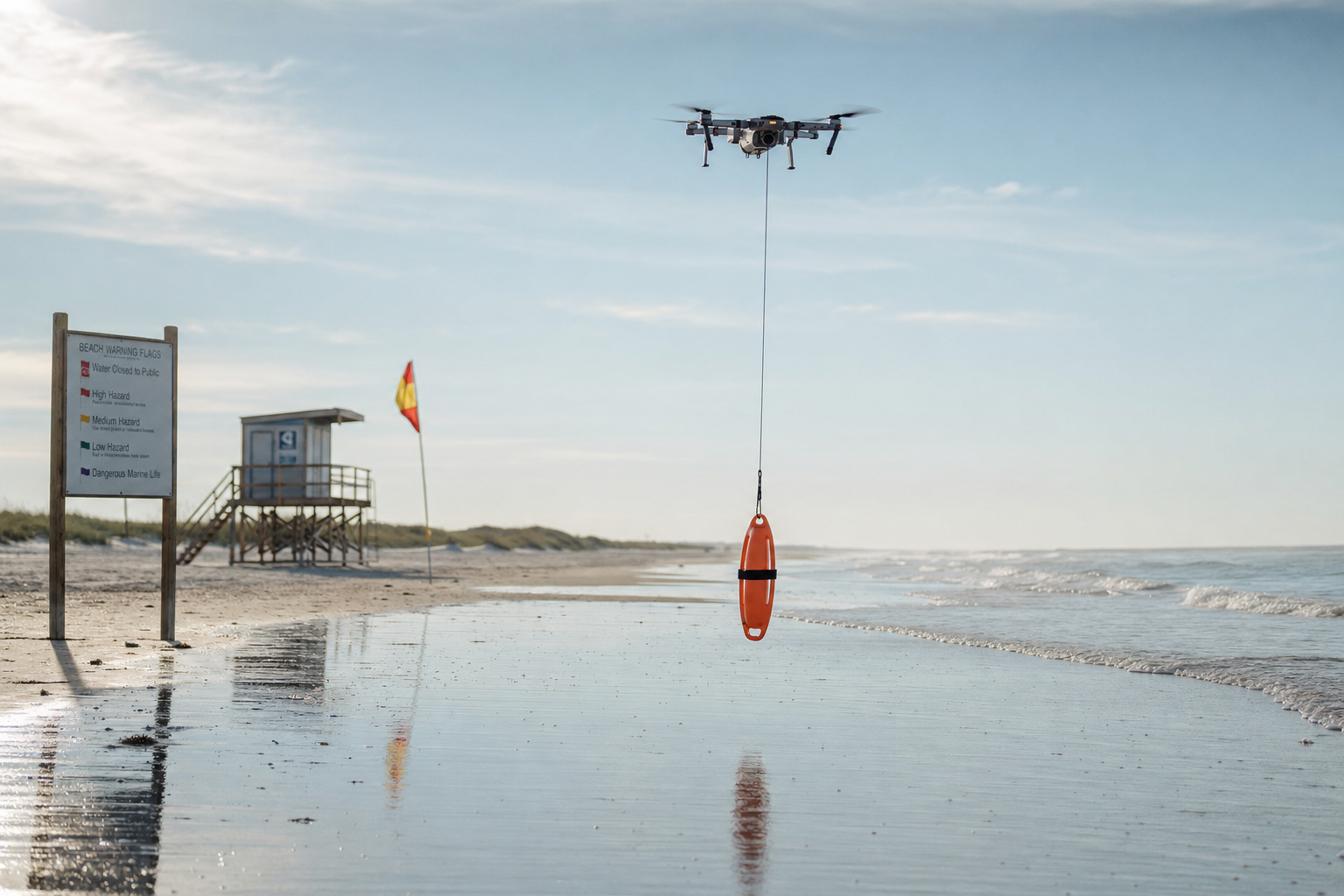
First things first: drones dropping flotation devices are real, and they’re rolling out at beaches in the US already. In 2026, Nassau County tested rescue drones on South Shore beaches that can reach swimmers faster than boats and drop buoys while other help is making its way. This gives swimmers something to cling to in the worst moments. In Sunny Isles Beach in Florida, drones are being trialed by police to drop life-tubes to swimmers in distress during patrol hours. (abc7ny.com)
That sounds amazing—but kids aged 3-12 still need lifeguards and close supervision. Here’s what drone lifeguards can and can’t do, so you can make safer choices at the beach and avoid a false sense of security.
What rescue drones can do
Fast detection, faster floatation
Studies show drones spot people in water up to five to ten times faster than lifeguards on foot. When it comes to providing a flotation device (a buoy or ring), drones have cut rescue time roughly in half—especially when seas are choppy. (journals.sagepub.com)
For example, one experiment reported that using a drone to drop a buoy in moderate sea conditions took about 81 seconds, while lifeguards by traditional methods took 179 seconds. When waves got rough, the gap widened. (pubmed.ncbi.nlm.nih.gov)
Extra eyes in the sky
Besides dropping floatation, drones have helped lifeguards monitor shark activity, spot rip currents, survey large crowds, and watch water conditions from above. In New York, drones flying near Rockaway Beach are now used to drop tubes immediately upon seeing someone in trouble in the water. (abc7ny.com)
On the Polish coastline, water rescue services flew drones hundreds of times mostly for prevention—scanning water, warning swimmers, and gathering data rather than physically rescuing people. (ersj.eu)
Why this matters for kids
Kids aged 3-12 often misjudge waves, struggle in rip currents, or wander beyond where they can touch. If a drone drops something right away, that extra flotation can buy critical seconds until a lifeguard or parent can help. It doesn’t replace you, but it adds a lifeline in emergencies.
If you want a structured way to help your child progress at home, the 10-Week Plan guides you step by step.
What rescue drones cannot do (yet)
Not fully replacing lifeguards or parents
Drones cannot rescue themselves: they can’t pull anyone out of the water—they only give floatation, mark location, or alert human rescuers. You still need trained lifeguards to swim out, use boards, Jet Skis, or boats. And nothing replaces focused supervision. Do not assume that because there may be a drone, supervision is lax. Being in the water with kids needs your full attention.
Limitations due to environment and gear
Wind, waves, sea state, and currents affect where a dropped tube lands. If a drone drops it too high, or wind blows it off course, it may miss the swimmer. Devices need design testing for each beach’s conditions to work well. (associationfordrones.com)
[[ctakid]]
Battery life is also limited—a drone may not fly long enough or in bad weather, like strong winds or storms. Visibility matters: fog or spray makes it hard for cameras to spot people. Plus, not all beaches have undergone trials or installed rescue-drone programs.
What parents should do to keep kids safe
Choose lifeguarded beaches and swim near flags
Always swim at staffed beaches with lifeguards on duty and stay between the red and yellow flags (in Australia) or designated safe-swim zones in the US and UK. Drone presence doesn’t guarantee safety outside those zones.
Don’t assume every beach uses rescue drones
Many beaches do not yet have drone capabilities. Seeing one doesn’t mean it’s active or that flotation drop is available. Always check local rules, signs, or ask a lifeguard.
Teach your child water confidence, not overconfidence
Kids should know that waves, currents, and tides can be unpredictable. Teach them to float or tread water, always swim with a buddy, wear life jackets if needed. Programs like the 10-Week Plan from swimy.org help build strokes and safety skills for school-age children. Introduce water rescue talk—but not fear.
Use drones as an extra safety layer—not a fallback
If drones are available, see them as backup. You’re still responsible: follow lifeguard instructions, stay near the shore if unsure, don’t go beyond what kids can manage. Even with flotation, rescue still requires human involvement.
Are drone lifeguards reliable?
On balance, evidence is promising. A 2024 systematic review found that unmanned aerial vehicles (UAVs) are a “feasible, valuable, and reliable contribution” to identifying drowning or water distress and providing flotation faster. (journals.sagepub.com)
Trials in Sunny Isles Beach and Nantucket confirm real-world capabilities: drones there have dropped flotation devices in simulations or limited rescues. In Nantucket, a drone owned by the harbormaster can fly up to a mile offshore to provide flotation to someone struggling before help arrives. (ack.net)
Still, reliability depends on many factors: trained operators, clear protocols, regular equipment maintenance, local approval and regulation, weather, and accurate placement of flotation.
Final thoughts: what parents need to remember
Drone lifeguards are not a replacement for vigilance. They are promising tools that can make the water safer, but only when used alongside strong parental supervision, lifeguard presence, and swimming in marine patrol zones. While rescue drones may drop a buoy, they don’t swim out with your child, monitor honesty about danger, and can’t change the ocean.
Make sure when you head to the beach this season, especially with children aged 3-12, to pick lifeguarded areas and swim near flagged zones. Use drones (where available) as extra protection—not a green light for risk. Your eyes, rules, and attention make the biggest difference.
120+ swimming exercises sorted by age — with video and instructions. Developed by swim instructors, completely free.

120+ swimming exercises sorted by age — with video and instructions. Developed by swim instructors, completely free.