Fix Your Child’s Freestyle Kick in 15 Minutes: A Parent-Friendly Micro-Session
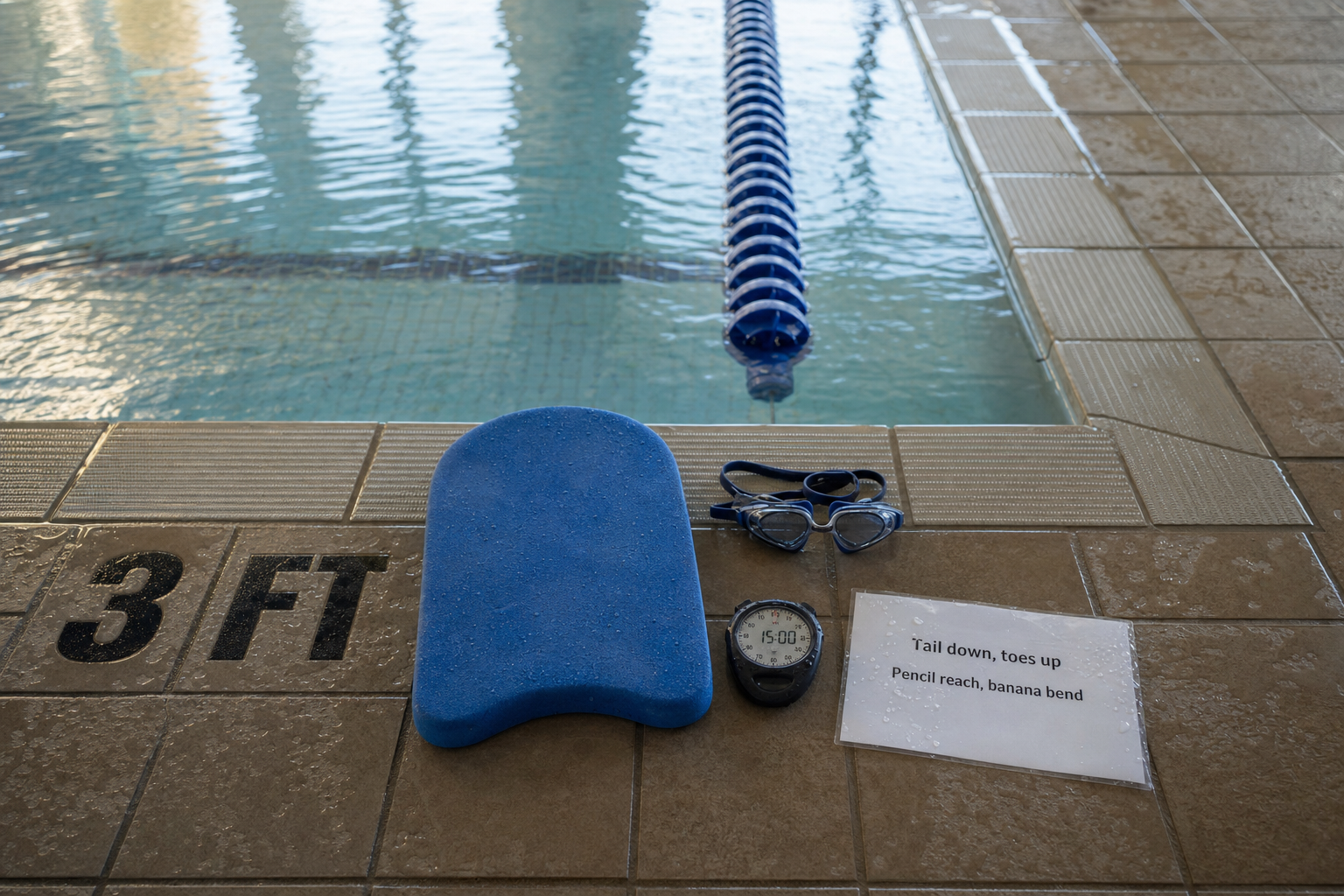
Even if you only have fifteen minutes at the pool, you can make major changes in your child’s freestyle kick. Common errors like bent knees, bicycle kicks, or toes pointing downward slow them down, drag their bodies under, and waste their energy. This guide gives you two simple land cues and three pool drills to use with children aged 5-12. Kids gain speed and better body position. Parents learn to spot each issue and deliver one clear cue at a time. Use shallow water with open lane space, and never allow prolonged breath-holding.
Spotting the Mistakes: What to Look For
Before getting into drills, you need to know what errors to watch out for. The three most common kick issues are: knees bending too much (“bicycle kick”), toes hanging down stiffly, and kick power coming from the knees rather than the hips. If you see knees popping above the water or legs flailing like pedals, or feet slapping downwards like stiff flippers, these are warning signs. Experts note that kicking over-bent at the knees, beyond about 65-75 degrees, seriously reduces speed and drives knees toward the surface. (theraceclub.com) Relaxed ankles with pointed toes and initiating kick from the hip produce better propulsion. (justswim.com.sg)
Two Land Cues You Can Use Immediately
“Reach like a pencil, bend like a banana”
Imagine the child’s leg is a banana: naturally curved at the knee just a little. Not floppy, but not sharply bent like trying to pedal a bicycle. Tell them that the kick starts at the hip; the ankle is relaxed and toes point backward. These mental images help them feel what a good flutter kick should do. (justswim.com.sg)“Tail down, toes up”
Use “tail” to refer to their hips (bottom) and “toes” to remind them of ankle position. The idea is to keep the body long and horizontal: hips slightly elevated, knees low, toes slicing through the water, not pointing down. This cue helps fix toes-down issues and improves balance. (justswim.com.sg)
Use one cue at a time. Say it before the drill. Stop the drill, correct, repeat. Never correct too many things at once.
Three Pool Drills to Correct the Kick
Here are three effective pool drills you can use in a 15-minute micro-session. These drills target bent knees, bicycling kicks, and toes down. Parents should supervise closely.
If you want a structured way to help your child progress at home, the 10-Week Plan guides you step by step.
Drill 1: Seated Splash Kicks
Have the child sit at the pool edge or on a shallow stair so their legs are submerged, hands holding the edge. Cue: “Big splash, little bend.” They kick up and down, try to make splashes but without dragging knees high or toes flopping. Use “reach like a pencil, bend a banana” here. Five kicks for each leg, alternate, do for 1-2 minutes. Great for seeing hip-driven motion without worrying about breathing or arm movements.
Drill 2: Wall Kick – Vertical/Streamline Push-Off
In shallow water, child holds wall with hands in front or uses kickboard if needed. Push off in streamline: arms overhead, whole body tight, toes pointed. Kick from the hip. Optionally try vertical kick or on side after streamline push. Keep knees under water surface. Focus on keeping toes back and ankles loose. This drill shows whether toes are pointing down or if knees are overly bent. Follow up with swim segments to integrate improvement.
Drill 3: Side Kick with Rotation
Once the child can do the streamline and wall kick, try kicking on the side. One arm out in front, head resting lightly on shoulder, other arm down. Emphasise core stability so the hips stay aligned, not tilting up or down. Kick from the hip, with relaxed ankle. This drill reveals exactly when toes drop or knees bend too much—visible from deck. Helps balance, improves toes and body position. (icanswimfast.com)
[[ctakid]]
Bringing It All Together Safely
After drills, have the child swim a short freestyle length focusing only on the one cue you used. Say “tail down, toes up” or “reach like a pencil” before they start. Keep swim short—about 3-5 meters. Rest. Repeat once. This builds strength and awareness without overwhelm.
Safety notes: always stay in shallow water so the child can stand if needed. Never let them hold breath for long underwater. Use lane space where no one bumps into them. Avoid prolonged reliance on kickboards or fins; these tools are helpful for short bursts, but overuse causes kids to lean on equipment, lose core and ankle mobility. (swimy.org)
For parents wanting a more structured progression, you might explore the 10-Week Plan from swimy.org. It helps build core strength, ankle flexibility, and integrates kick drills over time so children retain improvements. Incorporating this micro-session into such a plan will deepen benefit while keeping it manageable.
Why Correcting the Kick Matters for Kids
A better freestyle kick improves body position, reduces drag, and gives more propulsion so children swim faster with less effort. It helps them stay more horizontal so breathing is easier, arms pull doesn’t have to counteract sinking hips, and the whole stroke feels smoother. Also, fixing errors early is easier than retraining bad habits later. Parents often notice improvements in just a few sessions by using focussed cues and short drills. This builds confidence and joy in the water.
Summary Cheat Sheet: What to Do in 15 Minutes
Spend first 3 minutes spotting the kick errors. Use one land cue. Then drill for 5 minutes (Seated Splash Kicks), another 5 minutes (Wall Kick / Streamline), final 5 minutes (Side Kick + short freestyle swim). Only one cue all session. Encourage high hips, relaxed ankles, toes pointed back. Avoid overusing kickboard or fins except for brief reminders. With consistent mini-sessions, the improvements solidify. By practicing twice a week, your child should gain a measurably better freestyle kick in just a few weeks.
With these parent-friendly steps, you can “fix swim kick” issues fast. The key is clarity, focus, and lots of fun. The water can be their playground and their lesson.
120+ swimming exercises sorted by age — with video and instructions. Developed by swim instructors, completely free.

120+ swimming exercises sorted by age — with video and instructions. Developed by swim instructors, completely free.