Friend’s Pool Safety Tour Before Your Toddler Swims
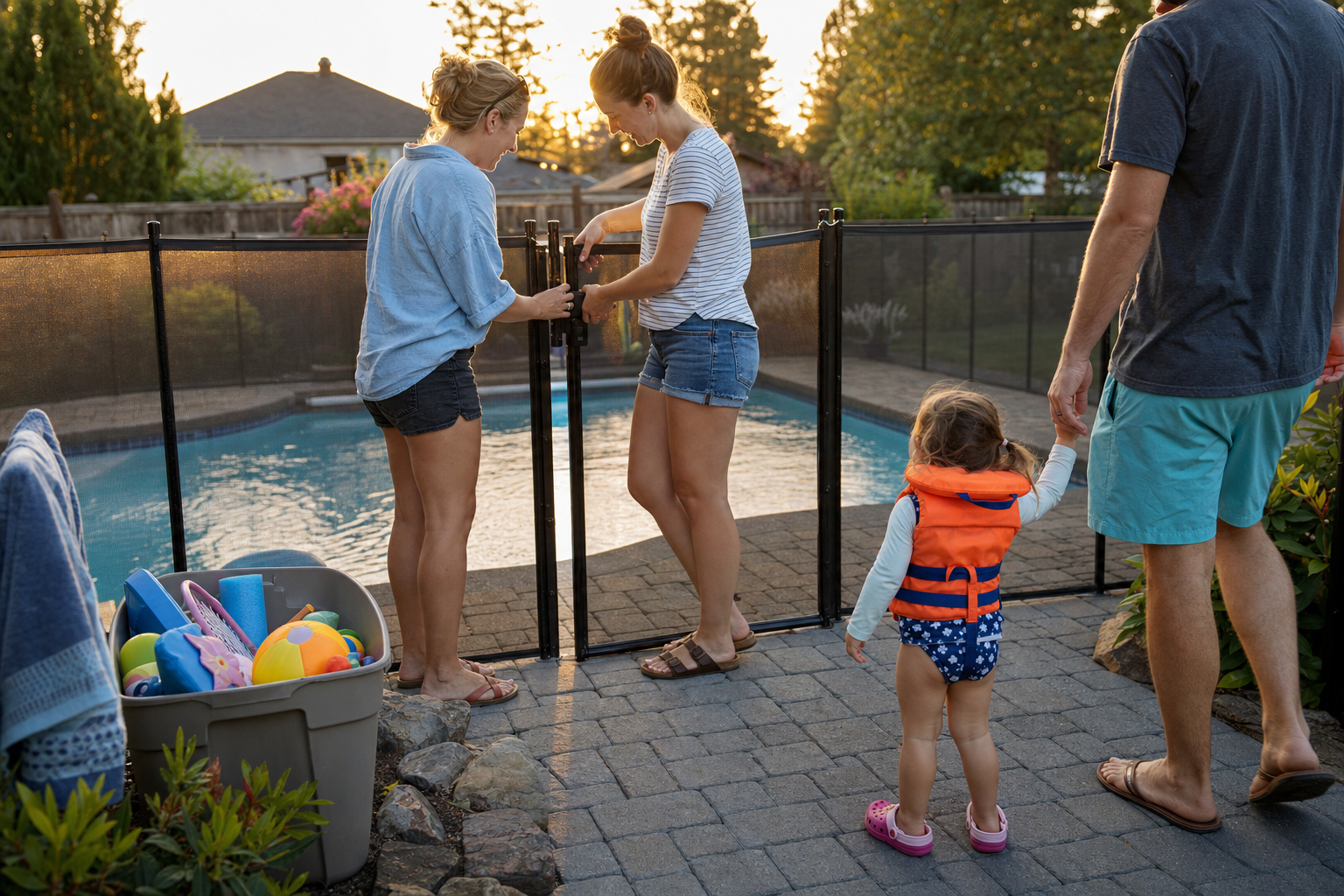
You’re visiting a friend or relative who has a pool, and your mobile baby or toddler (crawling or recently walking, up to 36 months) is excited (or would be excited). Before letting them near the water, run through this safety script. It helps you spot hazards—on gates, steps, drains, toys, furniture, doggy doors—and make sure adult supervision is clear—all without sounding paranoid.
What to Check Right Away
First, ask to do a quick walk-around together. Use the following checklist in conversation. It’s less about accusing and more about caring.
Barriers and Gate Safety
“Hey, do you mind if I check the pool gate with you?” Notice if there is a fence completely surrounding the pool, separating it from the house and yard. It should be non-climbable, at least four feet high, with vertical slats spaced so a toddler can’t squeeze through (no more than about 4 inches apart) and no furniture or planters nearby that a child could use to climb over. The gate should self-latch and self-close; the latch ideally 54 inches above ground so it’s out of reach. These are key recommendations from the American Academy of Pediatrics and U.S. Consumer Product Safety Commission. (healthychildren.org) (nationwidechildrens.org)
If the house wall or sliding door forms part of the pool barrier, confirm that door locks work and alarms are installed. Doggy doors count too: leaving one that leads directly outside could enable a curious crawler to escape. (cpsc.gov)
Steps, Drains, Toys, Furniture
“Can we test a few things just to be sure?” Check pool entry: are the steps stable and easy to climb for small legs? Are there handrails within reach? Are drain covers secure, not broken, meets safety standards (especially “anti-entrapment” type)? Pool vacuum or filter drains must be compliant. (poolsafely.gov)
Inside and nearby: tidy up floating toys, inflatable pool rings, everything attractive to a toddler. Remove them when pool’s not in use—temptations to crawl or reach are real. Also move furniture away from the fence so toddlers can’t use it to climb over.
Adult Supervision: Who, What, When
“Who’ll be watching the baby in and near the pool?” Identify one adult as the “Water Watcher”—only tasked with keeping eyes and hands on the child, no phones, socializing, or distractions. For infants and toddlers, use “touch supervision”—that means within arm’s reach always. Never assume you know your friends' home pool is safer than a public one: stats show many drownings happen at a friend or relative’s house. (healthychildren.org)
[[ctababy]]
If you want a structured way to build water confidence at home, the 10-Week Plan guides you step by step.
Also talk roles: who calls for help, who grabs towels or CPR guide? If there’s a lifejacket that fits your toddler, great. If not, ask whether they have one or if you should bring yours.
Soft Script: How to Bring It Up Without Awkwardness
“Hey, just because I know my toddler moves fast, would you mind if I check your pool safety stuff for a minute? I want to make sure there are no sneaky gaps or temptations.” Framing it as concern—not judgment—goes a long way. If the host seems unsure or defensive, offer what you've learned, like “I remember learning about this through the Pool Safely guidelines or from HealthyChildren.org, they say letting children wander through doggy doors or unfenced gates is risky.”
More Tools for the Job
Mid-toddler years are perfect for building basic water skills—swim lessons help reduce risk, but they’re not a replacement for supervision and barriers. (cdc.gov)
One great resource is the 10-Week Plan from swimy.org, which helps builds swim confidence safely, week by week—it’s especially useful if swim ability and water awareness are part of your safety setup. Incorporating that can make you feel more prepared.
Also, ensure you’ve got up-to-date CPR knowledge. If your mind ever drifts or your phone buzzes, you’ll want to be ready to act.
If Things Aren’t Safe—What To Do
If the fence is low or the gate latch broken, say kindly: “Would it be okay to keep the gate closed and locked unless someone is watching the toddler directly?” If floating toys are everywhere, offer to gather them. If supervision is split or too casual, politely ask for a water watcher schedule: “Could one of us take turns being your dedicated observer? That way I’m not stressed, and baby gets full attention.”
You can always suggest postponing the swim time until hazards are addressed. Let your host know you’d really love for your toddler to swim, but feel better when all the safety checks are good. Most hosts understand when framed this way.
Why All This Matters
Children ages 1 to 4 are most at risk of drowning, especially in backyard pools of friends or family where supervision, fencing, or safety features might be lacking. (cdc.gov) Evidence shows that four-sided fences (that completely isolate pools) cut drowning incidents for young children by more than half compared to weaker or partial barriers. (publications.aap.org)
Drains with loose or faulty covers, toys left near the edge, furniture used to climb over fences, open doggy doors—these are all often overlooked, but each one raises risk. And while swim lessons and lifejackets help, the absolute essentials are barriers, touch supervision, an assigned watcher, and knowing CPR.
Visiting a house with a pool is fun, but toddlers learn fast and aren’t aware of danger. Using these checks and scripts before the splash ensures fewer hidden hazards and more peace of mind. Your child gets safer, you feel more calm, and the swim feels joyful instead of worrying.
120+ swimming exercises sorted by age — with video and instructions. Developed by swim instructors, completely free.

120+ swimming exercises sorted by age — with video and instructions. Developed by swim instructors, completely free.