Group vs Private Baby Swim Lessons: A Parent’s Decision Guide
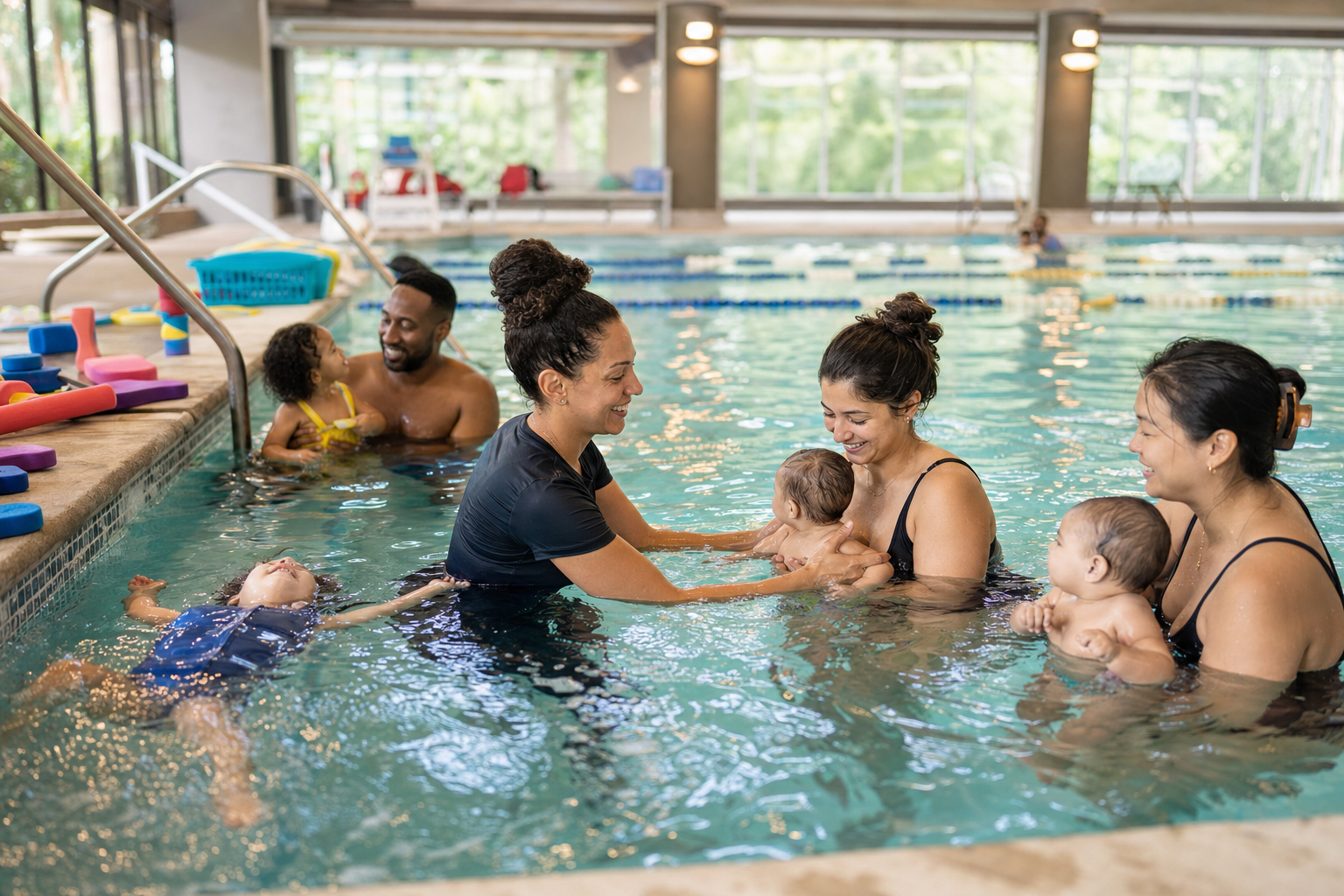
Every parent wonders what format—group, semi-private, or private—will help their infant or toddler learn to swim most safely and effectively. Let’s dive into how class size, instructor attention, social exposure, age, safety guidelines, and cost affect the experience—so you can match the lesson format to your child’s temperament, age (6–36 months usually), and your family’s needs.
What the Experts Say About Starting Age and Safety
Formal swim lessons typically begin around age 1 because that’s when infants tend to have enough head control and coordination. According to HealthyChildren.org (run by the American Academy of Pediatrics, AAP), there’s no strong evidence that swim programs for babies under 12 months reduce drowning risk, though they may help with comfort in water and bonding. (healthychildren.org) Babies aged 6–12 months can sometimes learn reflexive floats, but not independent swimming. (healthychildren.org)
Younger than one year? Parent-and-baby water play classes—where a caregiver is in the water with the child—are great for water acclimation but shouldn’t be expected to develop swimming independence or full safety skills. Always ask if the instructor is certified, if water temperature is properly warm (around 87-94°F), and whether you’ll have touch supervision. (coachslava.com)
Main Formats: Group, Semi-Private, and Private
Parent-and-Baby / Group Lessons
These typically include several babies, each with a caregiver in the water. Ratios often run 1 instructor to 4-6 children (plus caregivers) in toddler classes, or 6-1 when babies are very young (6-18 months). AVAC Swim School, for example, operates Parent Tot classes from 4 to 36 months with a 6:1 student-to-teacher ratio and caregiver participation.
Pros include affordability, social exposure for both parent and child, structured routines, singing and games, and help learning from peer modeling. On the flip side, your baby gets less individual instruction; instructors have to divide their attention, and some babies are overwhelmed by noise or sensory input. If you pick group classes, check whether caregivers are allowed in the water and ask about infant swim lesson ratio to understand how much attention your child will really get. (backtobasicsswim.ca)
Semi-Private Lessons (2:1 Ratio)
Semi-private lessons balance personalized attention with peer interaction. You usually have two children (siblings or friends) with one instructor. This format gives more immediate feedback than group classes, helps shy or easily distracted babies when they see someone else doing something, and tends to be more affordable than full private sessions. Royal Fitness and SwimJim both offer these formats for infants and toddlers aged 6 months and older. (royalfit.com)
If neither child is yet “water safe,” the instructor may treat the session as split private—each child gets focused time. If children differ greatly in ability, semi-private classes may shift toward resembling group settings. (swimphi.com)
Private Lessons (1:1 Instruction)
These are one instructor focused entirely on your child. For infants and toddlers, private lessons mean more flexibility, faster progress in safety skills, and adjustments to your child’s fears, mood, and developmental readiness. Private instruction is ideal if your baby is especially anxious, sensory-sensitive, or simply not learning at pace in group settings. (inspiredswim.com)
If you want a structured way to build water confidence at home, the 10-Week Plan guides you step by step.
That said, cost is significantly higher, and there’s less social interaction. Also, even private lessons don’t “drown proof” a baby—infants still need constant adult supervision outside class. The instructor’s quality matters a lot: certified in pediatrics water safety, consistent across sessions, warm pool, etc. (inspiredswim.com)
[[ctababy]]
Comparing What Matters Most
Instructor Attention & Learning Speed
In private lessons, your baby gets 100% of instructor time each session. Semi-private offers maybe 40-60% individual attention; group lessons divide time so your baby might receive only 5-7 minutes of direct interaction in a 30-minute class. That means private lessons often reach fundamentals—like floating, breath control, submersion skills—faster. (inspiredswim.com)
Class Size / Infant Swim Lesson Ratio
For ages 6-36 months, good group class ratios are usually 4-6 babies per instructor, plus caregivers. Semi-private usually 2:1, private is 1:1. For babies under 12 months, programs often require a caregiver in water, and much smaller groups, sometimes even 4 to 1 or 6 to 1 including parents. Tight ratio means more safety, more personalized support.
Social Exposure & Temperament
If your child is social, curious, and responsive to other kids, group classes can be motivating: seeing peers splashing can encourage your baby to try new things. For shy or anxious children, the pressure of laptops waiting their turn or group attention may hinder progress. Semi-private and private allow nurturing at your child’s pace. Be sure to observe a class first to see how your child reacts. (babyotterswimschool.com)
Cost Considerations
Group lessons tend to cost $15-$30 per session at community or YMCA pools, or $35-$55 for swim school group classes. Private lessons are often $65-$100+ per lesson. But since private lessons can achieve basic safety skills in fewer sessions, the overall cost difference over time may not be huge. Many families adopt a hybrid approach: start private, transition into groups as skills and confidence improve. (waterwisekids.com)
Caregiver Participation & Expectations
You’ll often see caregiver-in-water requirements for babies under around 36 months. These classes expect you to be in the pool to help support floating, comfort, and safety. Be sure you know whether participation is in the water or just on deck—and whether caregivers are trained to assist or need to follow instructor cues. Also, avoid expecting that baby classes produce independent swimming: even toddlers won’t swim alone until around age 4-5. (healthychildren.org)
Tools for Planning Progress
If you’re starting from scratch or want to track incremental development, you might follow something like the 10-Week Plan from swimy.org, which lays out consistent lessons and skill milestones suited to infants or toddlers. Fit lesson frequency, rest periods, and instructor feedback around your child’s comfort zone. Growth is gradual—and consistency matters more than intensity.
What to Watch Out For: Pitfalls and Roadblocks
Don’t decide only by price. A cheap group class with poor ratio, inexperienced instructors, or cold water might cost more in stress and slower progress. Also, classes that over promise survival or “drown proofing” are red flags. Clarify what your baby is realistically achieving.
Check for caregiver requirements. Parent-child involvement is key for younger babies—it supports learning and safety. If you’re uncomfortable or can’t participate, private lessons may be the safer choice.
Lastly, set realistic expectations. Babies are learning water comfort, not independence. It may take many lessons—and years more—to swim unaided.
How to Choose What Works Best for Your Child
If your baby is under 12 months: aim for parent-and-baby or water play classes with caregivers participating, warm pool, low ratio, and gentle pacing. Private or semi-private works if your child is anxious or needs focused attention.
If your toddler is 1-3 years: parent-child or group classes can work well if child is comfortable in water. If toddler shows fear, sensory overload, or learning slowly, invest in private or semi-private.
If you want quicker progress (e.g., for pool access, safety, or upcoming travel), or if you have multiple children, or you value flexibility, private lessons give more control. But combo formats—private to start, transitioning to group—can balance cost, socialization, and skill building.
Every baby is different. Matching swim lesson format—whether parent and baby group classes, semi-private, or one-on-one private—to your child’s temperament, age, and safety needs matters more than any particular style. With the right class size, instructor attention, caregiver involvement, and realistic expectations, your child can gain confidence, water safety, and joy in learning—one splash at a time.
120+ swimming exercises sorted by age — with video and instructions. Developed by swim instructors, completely free.

120+ swimming exercises sorted by age — with video and instructions. Developed by swim instructors, completely free.