Homeschool Swim PE: A Simple, Safe Plan (US–UK–AU)
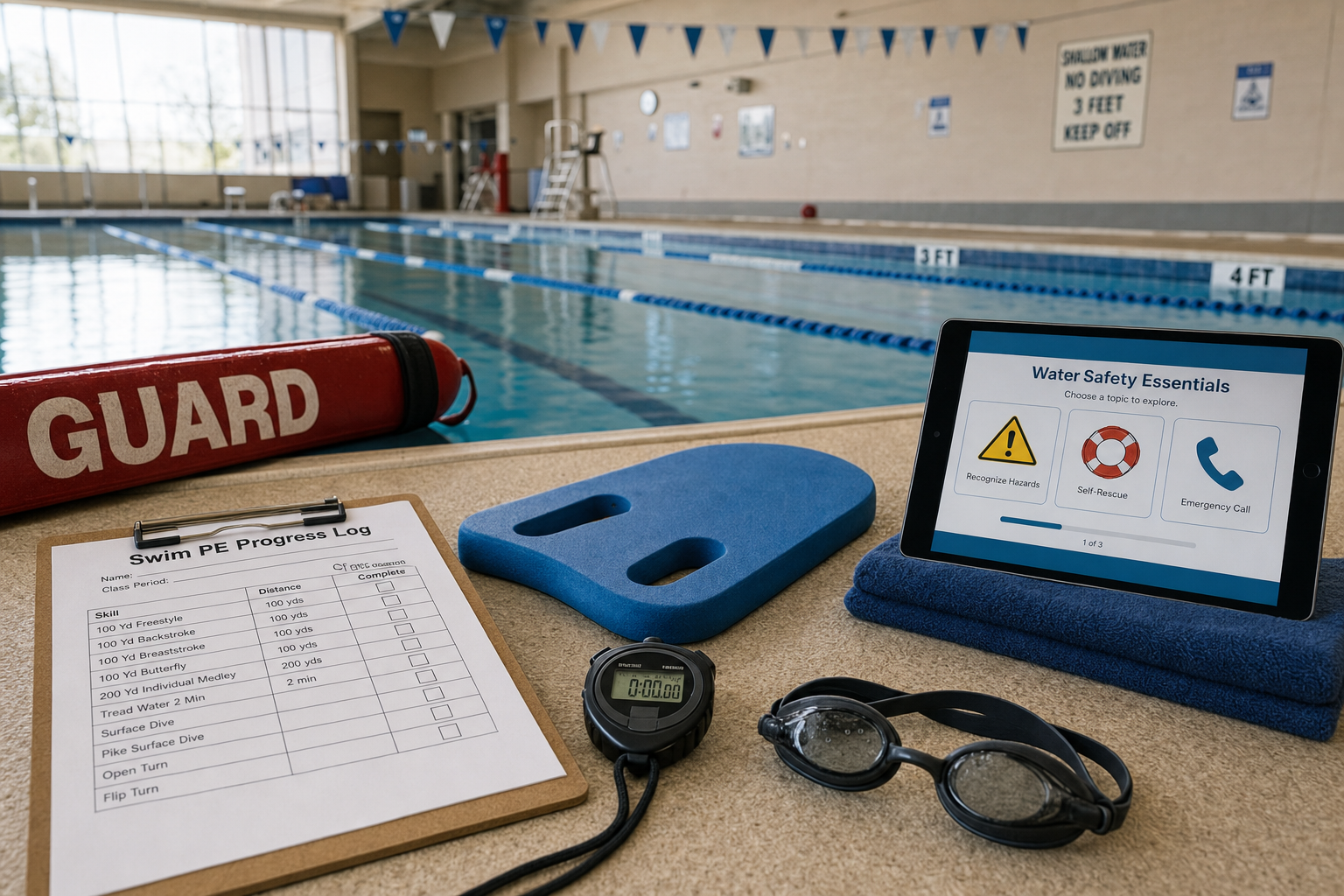
Here’s a proven roadmap to set up a meaningful homeschooling swimming-PE program for kids aged 5-12—one that includes weekly lessons, swim practice, water-safety modules, progress logs, local benchmarks, and qualified instructors.
What “Legit” Swim-PE Looks Like
Start with goals, not just time in the water. Weekly lesson + practice swim means structured teaching and independent practice. Water-safety modules provide critical knowledge (how to self-rescue, call for help, dangers around water). Easy progress logs let you track strides—stroke skill, distance, confidence. Align goals with local benchmarks: in England by end of primary school (age 11) every child should be able to swim competently at least 25 metres, use a range of strokes, and perform safe self-rescue. (swimming.org) In Australia states like Victoria expect a similar standard via the Water Safety Certificate by end of primary—continuous swimming, survival skills, and rescue basics. (www2.education.vic.gov.au) In the US, although homeschool PE rules vary widely by state, it’s wise to match or exceed your state’s school PE swimming or physical education standards.
Building the Weekly Pathway
Here's how to structure each week during every school term:
Swim Lesson + Practice Swim
Choose one lesson with a certified swim instructor (private swim school or pool teacher) focusing on technique, strokes, stamina. On another day, schedule practice swim: let your child swim laps, work on drills, or just enjoy brush-ups on skills they’ve learned.
Water-Safety Modules
Intersperse online or classroom-style modules covering drowning prevention, safe entry & exit, recognising hazards, emergency procedure. In Australia, for example, the “Swim and Survive Knowledge Modules” let children complete nine engaging interactive modules with clear learning outcomes aligned to the national curriculum. (learn.swimandsurvive.com.au)
[[ctakid]]
Tracking Progress & Documentation
Keep a log: date, instructor name, skill focus (stroke, endurance, safety), swim distance, water confidence (shallow, deep water). Use a simple chart or digital tracker. Save certificates and module completions. If you're doing homeschool assessments, these artifacts show you’ve met local curriculum-aligned benchmarks (like the UK’s requirement to swim 25 m by end of primary school). (swimming.org)
If you want a structured way to help your child progress at home, the 10-Week Plan guides you step by step.
One helpful resource: Swimy.org offers a well-designed “10-Week Plan” that combines swim lessons, safety modules, and practice logs. Use it as a template to map out skills week by week.
Aligning with Local Benchmarks & Requirements
England / UK
By end of Key Stage 2 (age 11, finish primary school), the national curriculum mandates children must swim 25 metres competently, use several strokes (front crawl, backstroke, breaststroke), and perform safe self-rescue in different water situations. (swimming.org) Those benchmarks are non-negotiable if you want your child’s PE to align with school expectations or assessments.
Australia
States and territories require schools to teach water safety and swimming through Health and Physical Education curricula. Programs like Victoria’s and Queensland’s set standards of strokes, water confidence, survival sequences, rescue skills. (education.qld.gov.au)
United States
Homeschool physical education in the US generally isn’t governed by a uniform federal standard. Curriculum requirements, instructor qualifications, assessment and record keeping vary by state. (ed.gov) For swim PE, follow your state’s public school standards; many require or recommend options similar to what UK and AUS schools demand.
Ensuring Safety & Instructor Quality
Always swim at venues with lifeguards on duty. During lessons and practice swims, a “parent Water-Watcher” (adult designated to watch at all times) should supervise. Dive only when water depth and instructor credentials are verified. Avoid free swim sessions without structure or goals.
Verify instructors: in the UK, look for Swim England certification or equivalent stroke and water-safety credentials. In Australia, instructors should meet AUSTSWIM or Royal Life Saving qualifications. In the US, make sure your teacher has CPR, lifeguard, or swimming teacher credentials recognized by national bodies.
Common Pitfalls to Avoid
First, don’t settle for “just free-swim.” If kids swim without goals, they may miss milestones like distance, stroke variety, self-rescue skills. Without documentation—logs, certificates, module completions—you’ll struggle to prove progress or claim benchmarks (important in UK and AUS, and prudent for US homeschooling portfolios). Ignoring local curriculum expectations leads to gaps: if your child cannot swim 25 m by age 11 in England, you’ll be below standard. If you ignore rescue skills or water safety content, you’ll miss part of what schools are required—and what keeps kids safe.
Sample 4-Term Plan for Ages 5-12
Term 1: Focus on water comfort, floating, basic strokes, light safety modules (home water safety, recognising hazards). Term 2: Stroke development (front crawl, backstroke), swimming 10–15 metres, practice session each week, emergency response modules. Term 3: Increase distance, introduce breaststroke, survival swimming (treading, floating, exit safety), log swimming vs non-swimming rescue. Term 4: Refine strokes, aim for 25 m benchmark (UK/AUS), test safe self-rescue, review progress log, set goals for next year.
Swimming is more than PE: it's a life skill. Putting safety, qualified teaching, benchmark goals, and documentation at the core of your homeschool swim PE plan ensures children don’t just get in the water—they gain confidence, competence, and safety that will last a lifetime.
120+ swimming exercises sorted by age — with video and instructions. Developed by swim instructors, completely free.

120+ swimming exercises sorted by age — with video and instructions. Developed by swim instructors, completely free.