How to Stop Your Toddler From Running Back to the Pool After Swim Class
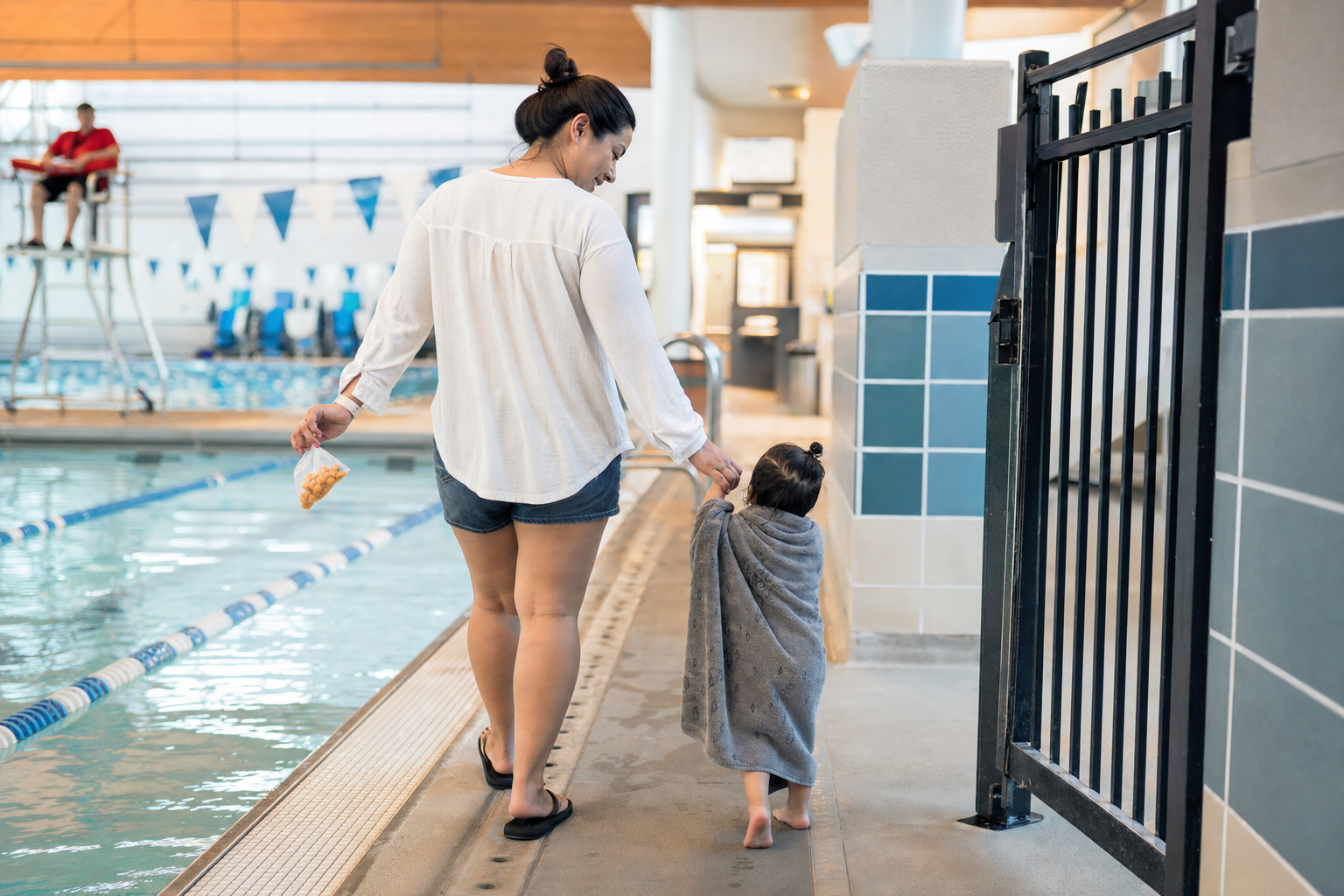
When your toddler races toward the pool while you’re packing towels, THAT moment is the riskiest. After class, the water fun is over—but toddlers aged 12-36 months, especially confident walkers or runners, may dart back before you realize. An exit routine can save precious seconds and keep the rule clear: swim only with permission and an adult. Here’s how to build a simple, powerful ritual that works.
Why the Risk Peaks After Class
Toddlers aren’t built for delayed reactions. Once the splash session ends and you shift into change-out mode, their curiosity pulls them toward the pool. According to the American Academy of Pediatrics, children ages 1-4 face the highest drowning risk because they move fast, don’t understand danger, and might escape adult watch even under close supervision.(healthychildren.org) Even though swim lessons help, they don’t replace constant, vigilant supervision.(publications.aap.org)
“After swim time is over, shut and lock doors that give access to water” features explicitly in guidelines from the CDC—they warn against relaxing supervision as soon as towels go on.(cdc.gov) For parents, that lapse—just when grasping wet feet, dressing up, gathering snacks—becomes the most dangerous moment.
The Exit Routine to Prevent Re-Entry
Here’s an exit routine you can teach your toddler immediately after swim class. It reinforces safety, builds consistency, and reduces impulsive dashes back toward water.
Step 1: Verbal Cue + Physical Touch
Develop a short phrase you use every time you're heading out: maybe “Pool done, come with me.” You reach down, grab their hand, and lead them away. The physical connection reassures them. Use this routine every single time, even when it seems not needed. Over time, toddlers associate that cue with leaving water behind.
Step 2: Redirect Interest Immediately
Just as you say the exit cue, offer something non-water related that’s enough to distract: a snack, a dry toy, or a warm robe right next to the exit. Take away any tempting toy you used during class before you even step into the locker room. Removing attractors means less pull back to the water. HealthyChildren.org stresses removing water-tempting toys and maintaining physical barriers (fences, gates) so toddlers can’t return to water unsupervised.(healthychildren.org)
If you want a structured way to build water confidence at home, the 10-Week Plan guides you step by step.
Step 3: Maintain Touch Supervision Until Behind Barrier
Don’t loosen the grip until you’re behind a fence, gate, or closed door. “Touch supervision”—staying within arm’s reach—is required for infants, toddlers, or weak swimmers whenever they’re in or near water.(healthychildren.org) Even when dry, don’t assume towels equal safety. Many near misses happen when parents believe towels or changing clothes remove danger. They don’t.
Reinforcing Permission and Consistency
[[ctababy]]
Children learn through repetition and routine. If you let exceptions slide—“Just one quick splash”—you weaken the exit rule. Consistency is what teaches toddlers: you must ask first; you will wait for an adult.
Try role-playing at home. Let your child practice exiting a pretend pool. Use the same exit phrase. Praise them when they do it right. That joint practice builds understanding and reinforces the habit in fun ways.
If your toddler is in swim classes with structured programs, pick ones that also include parent education about water safety. Some swimming systems, like the “10-Week Plan” by swimy.org, offer structured swim-teaching that families can follow together to build skills safely over time.(swimy.org)
Where Exit Routines Fail (and How to Fix It)
Even when you think everything’s under control, pitfalls pop up.
One common failure: assuming supervision ends when towels go on or clothes are close by. The AAP warns that many drownings happen during “non-swim times”—when water isn’t expected or classes are over.(cdc.gov) If your guard is down, toddlers notice and move.
Another issue: forgetting to block access to the pool physically. Fences, locked gates, closed doors—these are layers of protection that children can’t get past without effort.(healthychildren.org) Without those, even strong routines can’t fully prevent re-entry.
Finally, leaving tempting toys within sight near the pool or letting them carry pool toys during exit gives opportunities for grabs and dashes. Make sure those toys are removed well before you walk away.
Real-World Example: Our Family’s Exit Habit
We started our exit routine when my daughter was 18 months and kept trying to chase her older sibling back into the pool. At first I said “pool’s done,” but blocked her view of pool edge only after she was almost there. Then we added a twist: snack waiting on the bench and a warm towel draped over my arm. Now the moment we say “pool done, let’s go,” she grabs towel or snack, holds my hand, and heads inside. It took two weeks of consistency, and lots of PRAISE—but it works.
Safety Caveats to Remember
No exit routine replaces active supervision until your child is fully and safely away from water. Even the best routine fails if you’re distracted—phone, chatting, showers. Always watch them until you are behind a secure barrier. Remove all dangling toys that could call a toddler back toward pool. Even when they seem bored or cold, they are still drawn to water.
Also, swim skills are essential, but they don’t make toddlers water-safe on their own. The American Academy of Pediatrics makes it clear: swim lessons, even water-competency, do not remove the need for constant supervision near water at all ages.(publications.aap.org)
Teaching little ones to exit swim time safely is worthwhile work. With consistent cues, firm permission rules, and barriers in place, toddlers learn that swim time ends with an adult’s signal—and that the safe place isn’t the water unless you say so. That simple routine may be the difference between panic by the pool and calm safety at home.
120+ swimming exercises sorted by age — with video and instructions. Developed by swim instructors, completely free.

120+ swimming exercises sorted by age — with video and instructions. Developed by swim instructors, completely free.