How to Pick the Best Swim Instructor for Kids: Fast Parent Guide
You want your child aged 3-12 to learn swimming safely, steadily, with real progress—and no waste. Here’s how to vet swim instructors and programs quickly by checking the right certifications, observing lessons, and asking the right questions. Read this now so you can sign up before spring/summer rush.
What Certifications Really Matter
When looking for the best swim instructor for kids, focus on credentials that ensure quality teaching and safety.
If you're in the US, the American Red Cross Water Safety Instructor (WSI) certification is gold standard. A WSI course requires age 16+, strong swimming ability, CPR/AED training, and hands‐on skills in teaching and emergency response. It covers multiple levels—from preschool to older children—and includes evaluation of actual lessons. (redcross.org)
The YMCA Swim Instructor certification often builds on or complements Red Cross WSI. YMCA instructors typically must complete swim instructor training, CPR, background checks, and stay current with standards. Many YMCA groups follow Red Cross learn-to-swim curriculum in their group lessons. (ymcaswimminganddiving.org)
For Australia, AUSTSWIM Teacher of Swimming and Water Safety is the essential qualification. It’s nationally recognized, includes in-water and theory training, and demands ongoing renewal every three years. Teachers must hold CPR certification and meet professional development and safety standards. (austswim.com.au)
Comparisons like WSI vs YMCA certification boil down to who handles safety, lesson planning and the structure. If an instructor has one of these credentials, that’s a strong start.
What to Check in Lessons: Safety, Ratios, Tracking
Right after credentials, inspect how lessons are run. The safety and consistency here shape your child’s experience.
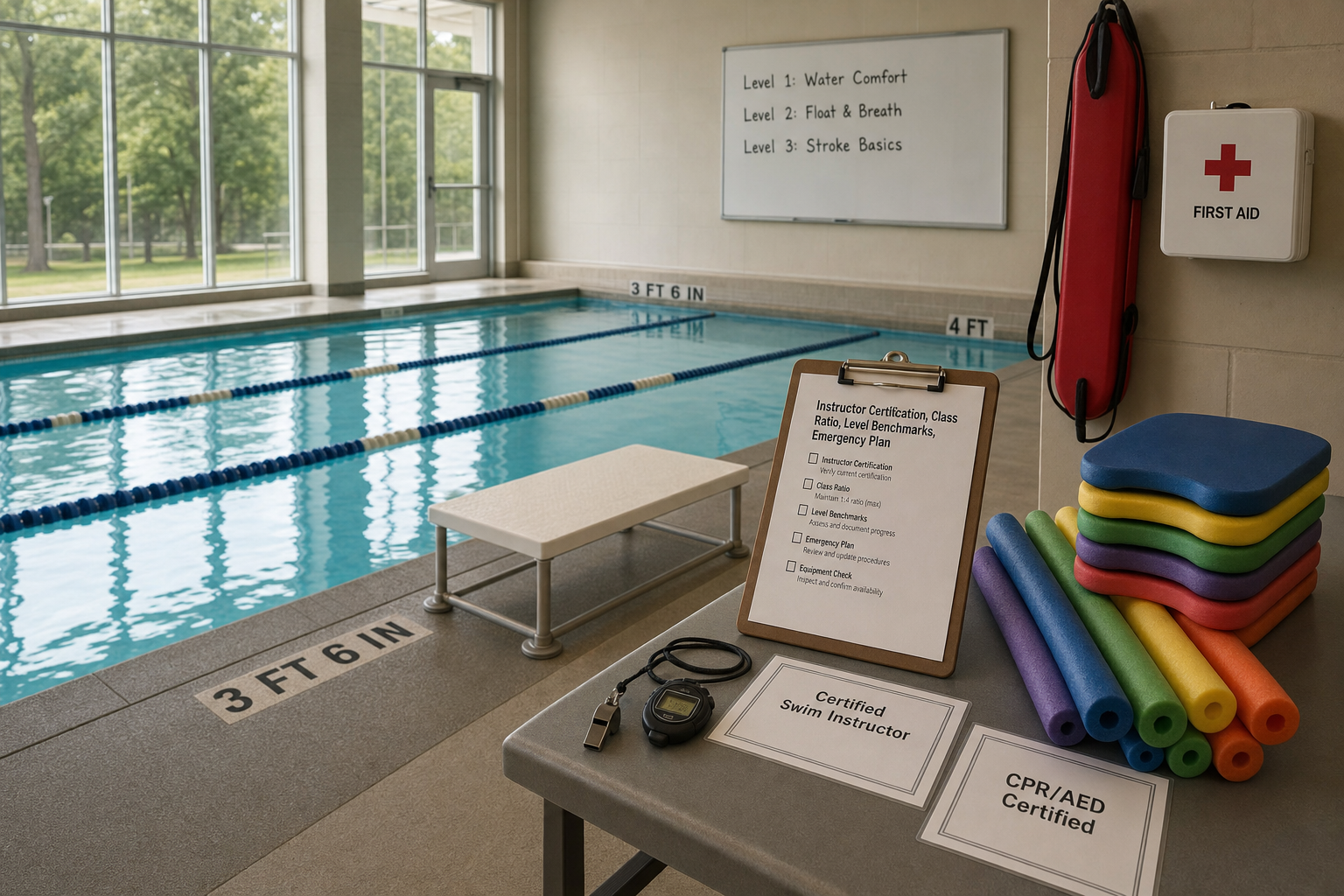
Check whether the instructor and swim school do background checks, have a written emergency action plan and use lifeguards or assistants if needed. Safety gear at poolside—a first aid kit, reach poles, flotation devices—matters. Watch how the instructor handles slips or crying kids. If panic ensues, stop considering them.
Class size (student-to-teacher ratio) is critical. Private or semi-private lessons give more focused attention; group lessons should maintain small groups so no child is lost in the crowd. In many YMCA or Red Cross programs for ages 3-5 that’s usually about six children per instructor.
Progress tracking includes observing defined benchmarks. Ask whether the program uses a structured curriculum with measurable levels—skills like floating, breathing, stroke basics—and whether the same instructor stays with the child through levels. Programs that just promise “confidence in the water” without clear skill goals are riskier.
Here’s a tip: look for swim schools that offer seasonal curriculum rolling into something like a 10-Week Plan to build skills steadily. For example, some online programs build in duration and skill-based structure so your child shows visible progress across weeks. One popular framework is Swimy’s 10-Week Plan which helps you see what skills should develop each week over a swim season. https://www.swimy.org/10-week-plan
This kind of curriculum is exactly what programs like Red Cross WSI courses build upon—including teaching candidate proficiency across learn-to-swim Levels 1-6 and doing taught preschool aquatics levels. (redcross.org)
[[ctakid]]
Questions to Ask & Red Flags to Avoid
To cut through marketing hype, come armed with questions. What follows are natural questions and red flags every parent should know.
Ask: “Can I see your certification copies—WSI, YMCA, or AUSTSWIM Teacher of Swimming and Water Safety?” Grammar aside, seeing the certificate ensures their legitimacy. Ask if it’s current. An expired credential is as good as none.
Ask: “How many children will be in the class, and what is the student-to-instructor ratio?” If it’s high (e.g. more than 8 in a group for ages 5-7), that’s a red flag—it’s hard for an instructor to give proper attention.
Ask: “What are the benchmarks for each lesson level?” If you hear vague phrases like “comfort in water” without referencing things like float skills, breath control, or strokes, that’s a warning. Ask for a sample of the goal for Level 3 from the program.
Ask: “Do you track progress with the same instructor, and do you offer lesson re-evaluations?” Kids learn better when instructors build on prior work. Frequent instructor changes reduce consistency.
Another question: “How do you ensure safety? What’s your emergency plan and background-check policy?” Also ask about lifeguards or assistants present.
Red flags include choosing only by price. A very cheap instructor might cut corners on safety, ratios, or instructor training. Poor communication, unclear lesson objectives, or instructors unwilling to show credentials are all bad signs. Overly large class sizes—especially for younger kids—often mean less supervision.
Private vs Group: Which Fits Your Child?
One important decision is whether to go for private, semi-private or group swim lessons. The right format depends on your child’s personality, confidence, and goals.
If your child is shy, behind where peers are, or you want faster progress, private or semi-private lessons give one-on-one attention, more repeat practice, and faster adjustment of style. They may cost more but often deliver stronger results and safer, more consistent teaching.
Group lessons are cheaper and great for social learning, but effective only if class sizes are small, instructor qualifications are strong, and you can observe classes. A group class with a well-certified WSI or YMCA instructor, with a ratio of 1:6 or 1:8 depending on the age, can still be very good.
Many parents combine both: group lessons for skills like stroke basics, followed by private coaching for refining or catching up.
What Certifications Tell You: WSI vs YMCA
Certifications tell you about training depth. A Red Cross WSI teaches you how to run lessons, handle emergencies, and apply safety rules. YMCA instructors often receive internal training and may also hold the WSI or equivalent, so check exactly which certifications the instructor has.
WSI vs YMCA certification: WSI is widely recognized across many organizations. YMCA’s certification is often tied to their curriculum and facilities. If an instructor says “YMCA certified,” ask if they also have WSI or if they take Red Cross lessons. Sometimes YMCA certification is enough; other times the extra WSI brings safety and consistency benefits.
AUSTSWIM in Australia is similar standard: rigorous training, recognized nationwide, valid for three years and requiring CPR, emergency response, and lesson-planning skills. If you're in AU, that is the benchmark. (austswim.com.au)
Wrapping Up: Prioritize Quality Over All Else
Choosing the right swim instructor for your child ages 3-12 means balancing cost, consistency, and credibility. Hire someone who is certified and current, with strong safety practices, small classes, clear benchmarks and consistent feedback. Avoid the allure of lowest price or vague promises. With lessons springing up now ahead of summer, use these tips to avoid regrets—and help your child thrive in the water.
120+ swimming exercises sorted by age — with video and instructions. Developed by swim instructors, completely free.

120+ swimming exercises sorted by age — with video and instructions. Developed by swim instructors, completely free.