Hybrid Swim Lessons: Mix Private + Group for Faster Gains in Kids (Ages 4–12)
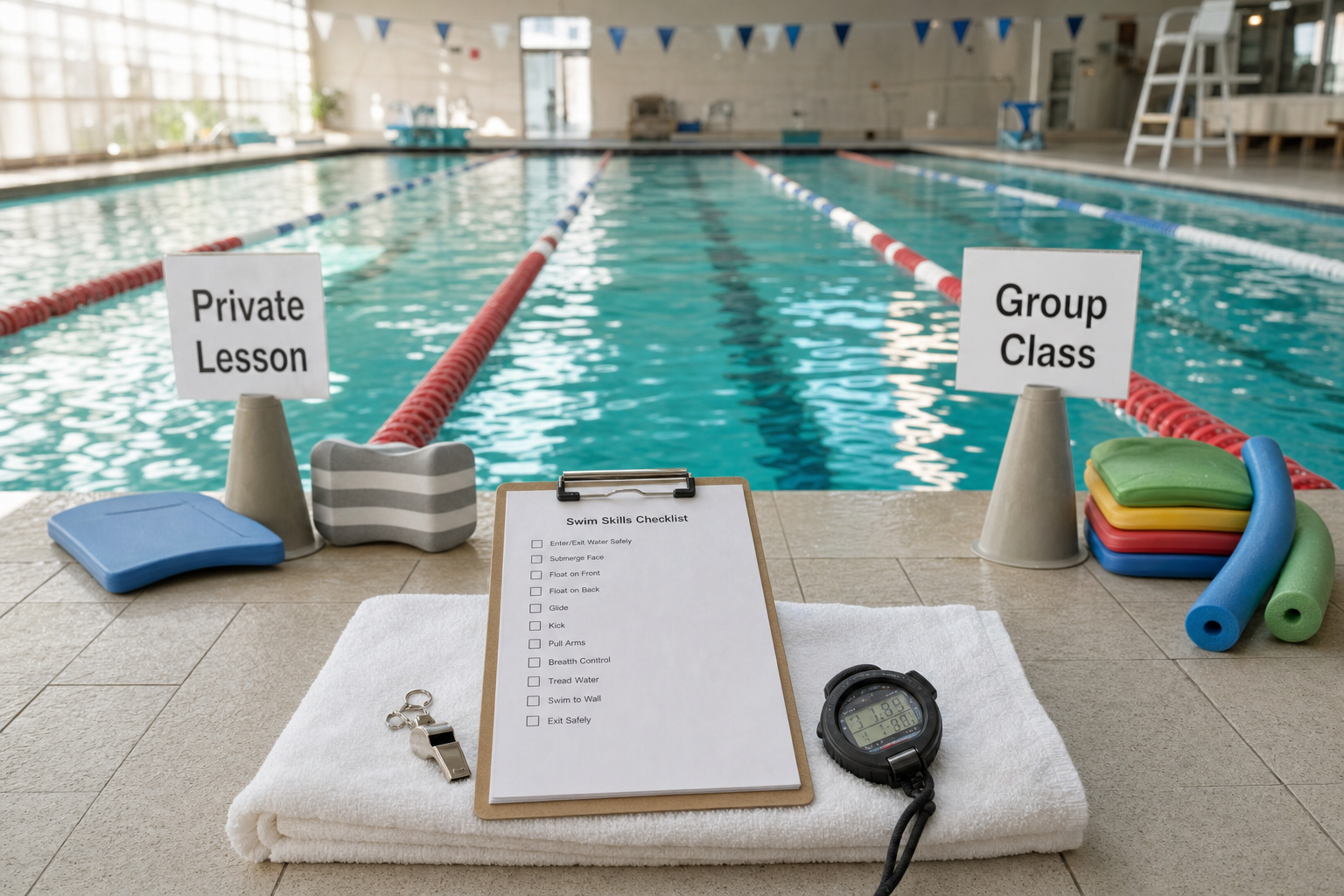
Every parent wants fast progress in swim lessons for their 4- to 12-year-old—but also wants to get value for money. A hybrid plan—starting with some private lessons, then moving into group sessions—often gives the best balance. Here’s how to make it work, what schedule suits most kids, which goals match this mix, and how to track real progress without burning through your wallet. And yes: safety and consistency always come first.
Private vs Group Swim Lessons Kids: What Really Changes at the Start
Private lessons are one-on-one, tailor-made for your child. If your kid is anxious, fearful of water, or stuck because technique or breathing is hard, private lessons let the instructor adjust pace, correct form immediately, and calm fears. As one guide points out, private lessons “move the needle faster than another summer of group classes” for kids not swimming independently by age 6.(teachme.to)
Group lessons cost less per class, offer peer motivation, and give kids chances to observe others doing what they're learning. For socially confident children, the group setting helps normalise challenges (floating, breath-holding etc.) and reduce anxiety.(tprd.org) Semi-private (2-3 kids) sits in the middle—some individual attention but with social benefits.(waterwisekids.com)
Best Schedule for Kids Swim Lessons: How Many Private, How Many Group?
A hybrid schedule often works like this: begin with 2-3 private lessons to get your child comfortable in the water, learn basic skills like floating, kicking, back-float, breathing. Once those basics are solid, shift into 4-6 group sessions so they can lock in skills, practise with others, and get confidence. TeachMe.To, a swim-lesson guide, suggests private or semi-private blocks especially for younger kids (around 4-6) who aren’t yet independent in water.(teachme.to)
If progress slows in group classes—or your child falls behind classmates—drop in 1 private or 1 semi-private lesson every few weeks to fix specific technique issues. Good hybrid plans use cycles. One practical planning tool is the “10-Week Plan” from swimy.org, which maps private lessons early on and group lessons later for steady progress. Use this plan to plan ahead and budget your time. (Here’s their 10-Week Plan).https://www.swimy.org/10-week-plan
Try to align the schedule with seasonal peaks. Parents often sign up before summer or just before school terms begin. Starting your hybrid block a few weeks ahead of these ramps gives your child enough time to build confidence and leave room for group reinforcement.
Which Goals Suit a Hybrid Plan and When to Use Each Format
Some goals especially benefit from hybrids:
- If you want your child to swim independently (e.g. swim the pool’s width/backstroke safety) by summer. Early private lessons ensure basics, group classes reinforce.
- If the child has water anxiety or lacks comfort—private builds trust, letting group work on representation and normalisation.
- If you need specific stroke mechanics or breathing techniques tuned (diving starts, flip turns, freestyle breathing) private or semi-private lessons are very helpful.
- If social confidence, endurance and water safety in real settings matter—group classes give variety and challenge in a social context.
If your child is already confident, many parents might start with group, then use private sessions only when hitting plateaus or mastering competition skills.
[[ctakid]]
How to Measure Progress Without Overspending
You want real markers, not just “they seem better.” Look for these:
- Skill checklist: floating independently, gliding, getting face in the water, breathing rhythm, back floating. If the instructor uses this, and documents which skills your child achieves, you’ll see what's improving week by week.(healthychildren.org)
- Objective measures: Can your child swim several meters without stopping? Can they float and recover? Can they repeatedly kick correctly at wall? These benchmarks reduce risk of spending private lessons just to polish minor details.
- Frequency matters: Studies show that attending more often (e.g. two sessions weekly) accelerates gains more than shifting formats (group → private) without steady attendance.(findswimmingpools.com)
- Keep the same instructor for a block: switching coach every week hurts progress. Your child needs consistent feedback style and rapport. Changing coaches too often means repeating basics. Also arrange lessons where instructors are certified: trained in water safety, first aid, teaching school-age children.(healthychildren.org)
Pitfalls to Avoid
Stacking too many private lessons without letting your child get unsupervised “in-water” time or peer exposure limits learning. Lessons should build up skills, but practice—kickboard time, family swim, pool play—is where kids absorb those skills. If every lesson is private with no group exposure, you may overinvest for slow social and confidence growth.
Another misstep is switching coaches every week. Lack of continuity makes feedback inconsistent, slows improvement, and can confuse the child. Always aim for block scheduling (e.g. same coach across a 4-week span) so that your child knows what to expect.
Also safety must never vary between formats: both private and group lessons need certified instructors, lifeguards, consistent safety rules, clear emergency procedures. Sometimes private lessons happen at home or tiny pools—check the credentials and standards.(healthychildren.org)
Putting It All Together
Here’s a sample hybrid timeline for a typical 8-year-old who’s somewhat comfortable but still building strokes:
Weeks 1-4: Two private lessons per week for weeks 1-2 to build comfort and form. Weeks 3-4 drop to 1 private + 1 group per week to begin peer exposure.
Weeks 5-8: Full group lessons, twice a week. Add one semi-private lesson in week 6 if technique (e.g. breathing) needs fine tuning.
Weeks 9-10: Evaluate using skill checklist. If plateau, insert one private session in week 9. Celebrate achievements—and plan your next block.
A hybrid schedule—private to start, group to build—gives many children fast gains, solid locking-in of water confidence, and more cost-efficiency than pure private. Choose goals, track skills, avoid coach switching and too many privates without water-time. With certified staff and consistent safety, your child can have fun, learn fast, and swim confidently before seasons peak.
120+ swimming exercises sorted by age — with video and instructions. Developed by swim instructors, completely free.

120+ swimming exercises sorted by age — with video and instructions. Developed by swim instructors, completely free.