Layers of Protection at Home Pools: A 5-Line Defense Every Parent Needs
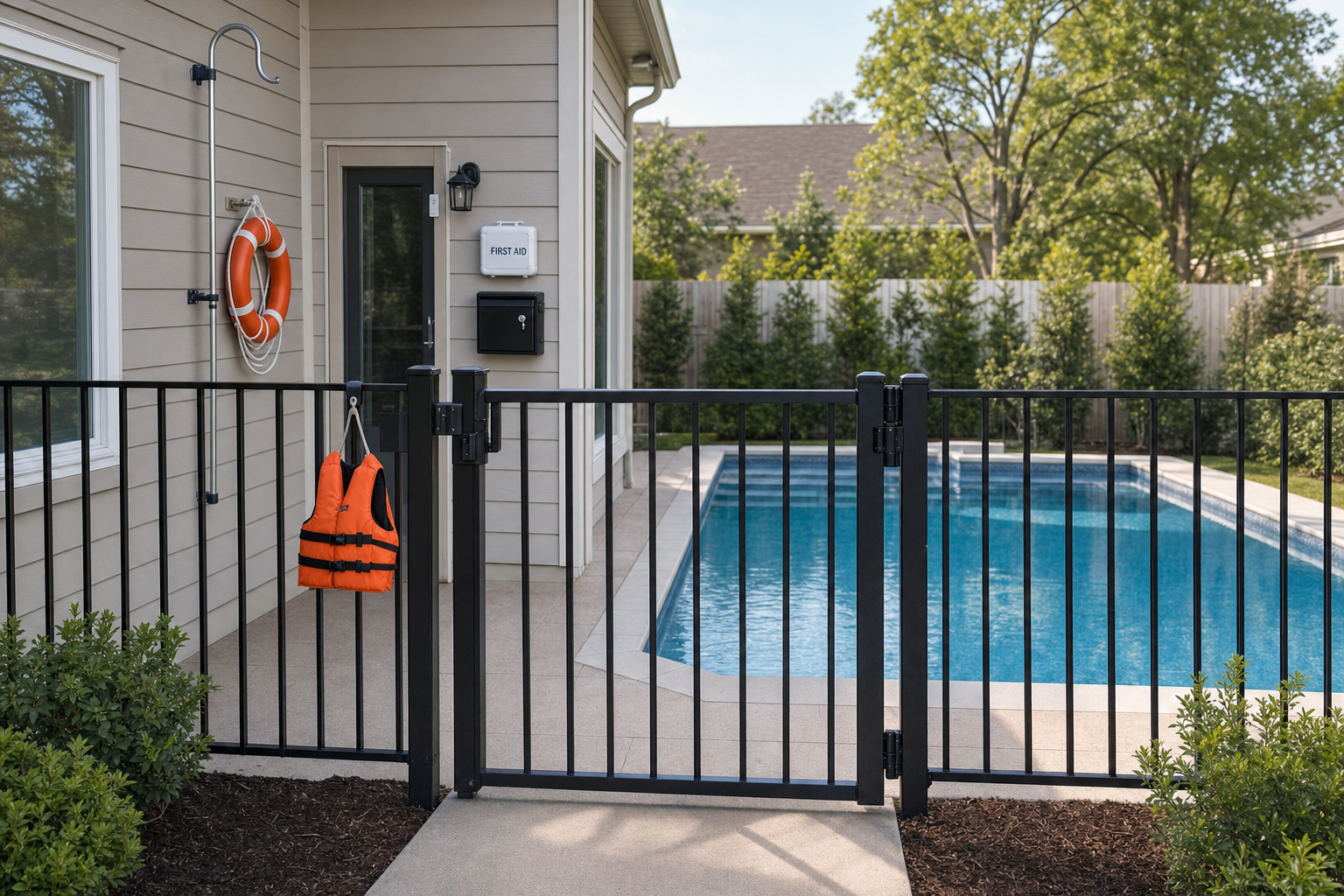
You don’t need to wait for a tragedy to make your home pool safer. For school-aged children (3-12 years), single safety measures—like swim lessons or surveillance cameras—aren’t enough on their own. These five layers work together as a strong safety net. Use this home pool safety checklist to make sure no single failure puts your child at risk.
1. Barrier: Four-Sided Fencing with Self-Closing, Self-Latching Gates
A full barrier that completely isolates the pool area from both the house and neighborhood is your first line of defense. The American Academy of Pediatrics and the U.S. Consumer Product Safety Commission (CPSC) emphasize that four-sided fencing with self-closing, self-latching gates dramatically reduces unsupervised access for children. Pools with only a three-sided fence (using the house as one side) increase risk nearly twofold compared to full isolation fencing. (publications.aap.org) A proper fence should be at least four feet high, non-climbable, and have no footholds or gaps a child could squeeze through. (stacks.cdc.gov) Always check local building codes—they may require even higher fences or specific materials.
2. Alarms and Door/Surface Security
Even with a strong fence, moments when doors are open or surfaces are easily accessed can let danger creep in. Experts recommend installing alarms on doors and windows that lead to the pool, and considering surface or gate alarms. (stacks.cdc.gov) These alarms should be loud, resettable, and ideally, heard from inside your home. Pool alarms and power safety covers are useful additions, but they do not replace properly fenced gates and door alarms. Use these alarms as backup alerts—not your primary line of protection. (publications.aap.org)
3. Supervision: The Non-Negotiable, Active Watch
For kids aged 3-12, nothing replaces a sober, devoted adult watching the water. The CDC, CPSC, and pediatric experts stress constant, competent supervision, especially since many incidents happen when children slip out of sight for just minutes. (cdc.gov) Set up a “Water Watcher” system, rotate responsibility, and avoid distractions like phones or alcohol. Even if your child has strong swim skills, they can still drown without active supervision. (publications.aap.org)
4. Water Competency & Life Jackets
Water competency means more than swim lessons—it involves being comfortable in different depths, being able to float, tread water, enter and exit the pool safely, and having basic skills to help oneself in trouble. The American Academy of Pediatrics lists water competency and life jacket use as proven layers of protection. (publications.aap.org) Also, life jackets approved by recognized authorities (like the U.S. Coast Guard) are essential for weak swimmers. Floaties or water wings can shift or slip off and offer a false sense of security. (cdc.gov) For a structured path, look into the 10-Week Plan from swimy.org to build water competency for both child and supervising adult. https://www.swimy.org/10-week-plan
5. Emergency Preparation: CPR, Rescue Tools, and Practice
No matter how many safety layers you use, emergencies can still happen. You need to be ready. Keep rescue equipment—such as throw rings, poles, a working phone, and a first aid kit—right by the pool. Ensure caregivers, babysitters, and family members know where these tools are and how to use them. Learn CPR and refresh your skills regularly. Pediatric studies show that prompt rescue and resuscitation significantly improve outcomes in drowning incidents. (publications.aap.org) Create an emergency action plan: who calls 911, who retrieves tools, who helps the child. Run drills so everyone knows their role.
[[ctakid]]
Putting It All Together: Your Home Pool Safety Checklist
Turn these layers into a living checklist you revisit every spring and summer. Check off each item—don’t assume that because you passed last year, you're still safe today.
Barrier: Is there a fence on all four sides? Are gates self-closing and self-latching? Remove any climbable objects near the fence.
Alarms: Do all doors and windows opening to the pool have audible alarms? Are pool/gate alarms working? Test regularly.
Supervision: Is there always a dedicated adult supervising when kids are in or near water? Are distractions minimized?
Competency & Life Jackets: Have swim lessons started or continued? Are approved life jackets used for weaker swimmers? Are floatation toys misleading you or child?
Emergency Prep: Are rescue tools and a phone within reach of the pool? Do all caregivers know CPR? Do emergency protocols exist and get practiced?
Common Pitfalls and How to Avoid Them
Relying on swim skills alone is risky: many drownings occur when children who “can swim” encounter an unexpected depth change or tire out. (publications.aap.org) Alarms or cameras can’t replace supervision; they can fail, be ignored, or not detect every hazard. Floaties and water wings might feel comforting but aren’t safety guarantees. Barriers become useless if gates are propped open or damaged. Life jackets must fit properly and be used every time. Finally, no plan helps if no one practices it—CPR knowledge and rescue tools are only lifesaving if you’re ready to act fast.
Why Layers Work Better Than Single Solutions
Each layer—fence, alarms, supervision, skills, emergency readiness—addresses different failure points. If one fails (e.g., someone forgets to close a gate), the next layer back (alarm, life jacket, supervision) still offers protection. Experts agree: drowning is too fast and quiet for any one prevention measure. Reports from the CPSC show that in most child submersion incidents, there was no permission to be in the water, or the child was unsupervised, highlighting how gaps in supervision and barriers set the stage for tragedy. (pmc.ncbi.nlm.nih.gov)
Schools out, summer’s here—it's the time when pool accidents spike. Make your home pool a safe place by using this five-line defense every time your kids are near water. Walk through the home pool safety checklist before you invite anyone in. Layer protection together, so no single slip, forgotten gate, or momentary lapse can cost a life.
120+ swimming exercises sorted by age — with video and instructions. Developed by swim instructors, completely free.

120+ swimming exercises sorted by age — with video and instructions. Developed by swim instructors, completely free.