Lengths, Laps & Yards: Teach Kids to Count Swim Distance
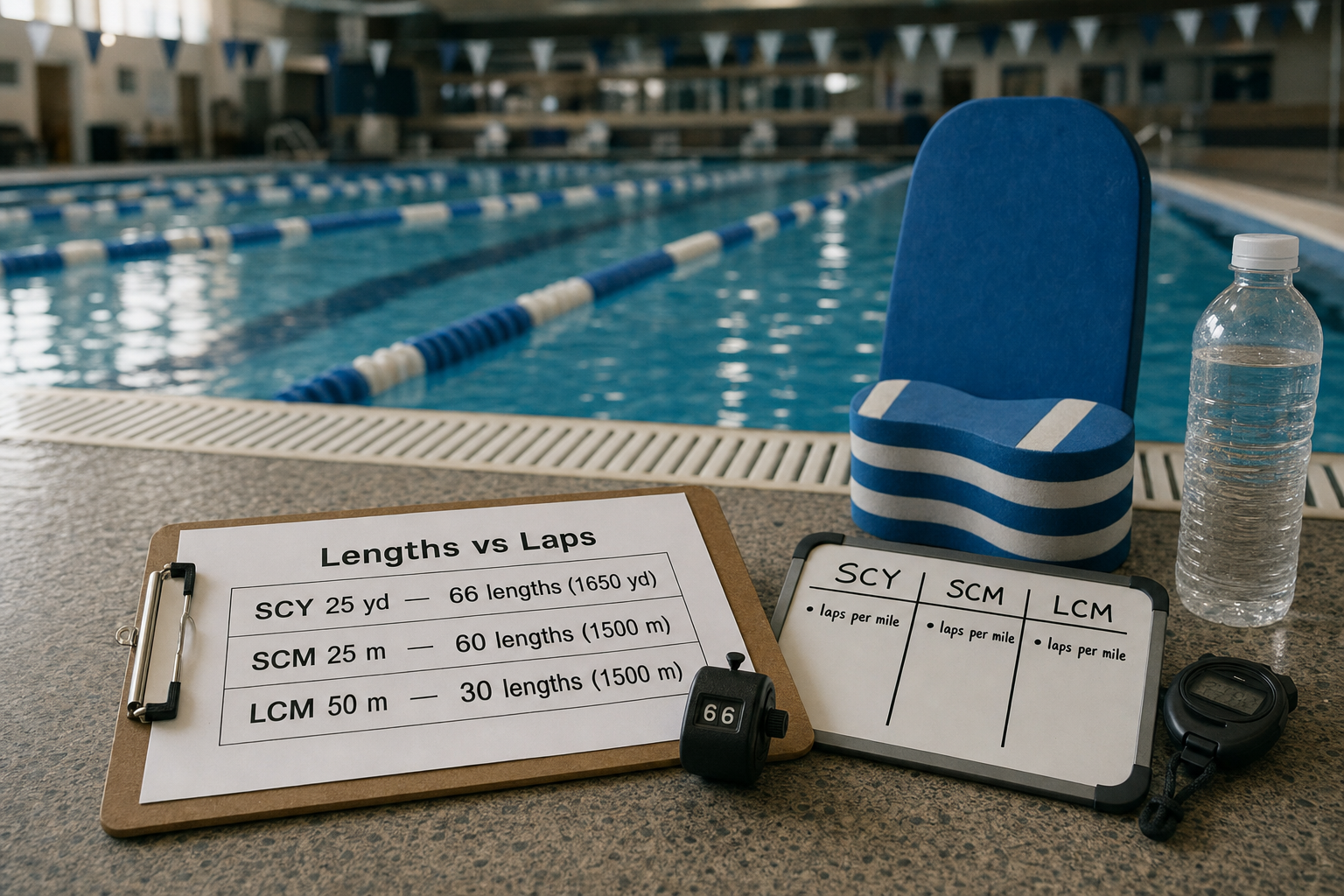
“How many laps is a mile kids?” That question comes up a lot as children start swimming more seriously. The answer depends on pool size and definitions. Let’s clear up the “lengths vs laps” confusion, show how to track distance in 25-yard, 25-meter, and 50-meter pools, suggest age-appropriate distance targets for children ages 6-12 (with help for younger ones), and offer simple conversions parents can use. Team this with realistic goal setting, and you’ll have something kids can count—and parents can understand.
What Are Lengths and Laps? What Does Pool Format Mean? (SCY, SCM, LCM Explained)
In competitive swimming, one length is a swim from one wall to the other. One lap usually means one length in those settings. However, many people use “lap” to mean down-and-back (two lengths), which causes confusion. Always check how your swim program uses the terms.
Pool formats are critical to understand. In the U.S., SCY stands for Short Course Yards—a pool length of 25 yards. Outside the U.S., or in certain international competitions, pools are often 25 meters (SCM: short course meters) or 50 meters (LCM: long course meters), which is the Olympic standard. (swimtimecalculator.com) This SCY vs LCM explained distinction matters because times and distances in 25-yard pools (SCY) will be shorter, and turnaround speed (push-off walls) will make swimmers seem faster than in LCM pools. (goswimfast.com)
How Many Laps in a Mile, in Common Pool Types
Here’s how many laps or lengths make a mile, depending on pool size. These numbers use the “swimmer’s mile” (1,650 yards) vs true mile (~1,609 meters), and metric mile (1,500 meters):
- In a 25-yard pool (SCY), a mile (1,650 yards) is about 66 lengths—if counting each wall to wall swim as a length. The true mile of 1,760 yards is about 70 laps (lengths) in that pool. (swimoutlet.com)
- In a 25-meter pool (SCM), a metric mile of 1,500 meters is exactly 60 lengths. For the true mile (1,609 m), it’s about 64 lengths. (swimoutlet.com)
- In a 50-meter pool (LCM), 30 lengths make a metric mile (1,500 m), while the true mile at 1,609 meters is around 32 lengths. (swimoutlet.com)
If kids or parents are chasing a “mile,” make sure they agree whether they mean the 1,500-meter standard or a true mile. Also check what a lap means in that program.
Age-Appropriate Distance Targets & Goal Setting (Ages 3-12)
Real goals to set: Swimming 100 yards/meters with good technique; then 200 yards/meters; then perhaps chasing a swim team benchmark like USA Swimming’s motivational times (e.g. 200 free or 500 free at age 10-12) without overtraining. Using charts from your local swim club or national organization helps. Some kids respond to following a structured plan like the “10-Week Plan” from swimy.org designed to build endurance and confidence progressively. https://www.swimy.org/10-week-plan models this approach well—spacing out distance and rest to avoid overuse and burnout.
For school-age kids (6-12), setting realistic goals solidifies engagement and builds stamina. Younger swimmers still learning strokes should focus on form and shorter swims first. Here’s what natural progression looks like:
[[ctakid]]
At ages 3-5, children begin to swim short front crawl—perhaps 10-25 yards/meters—or stay in play/swim safety lessons that emphasize water competency. By age 5-6, many learn basic strokes like front crawl and breaststroke. By age 6-8, with regular lessons, swimmers often build up to 50-yard or meter continuous swims, and by 9-12 they can aim for 100 or more lengths in practice, depending on frequency and stroke development. School swimming guidelines in the UK expect swimming at least 25 meters continuously by primary school age. (studylib.net)
Encourage kids to track swimming in terms of lengths or laps rather than miles early on. This helps measure progress in small, tangible steps—50 lengths one week, 60 the next, or shorter-longer sets.
Simple Conversions Parents Should Know
To support these goals, parents should understand how to convert between yards and meters, and between different pool formats. A yard is 0.9144 meters. So 100 yards is about 91 meters. Swim-time conversion charts for times in SCY vs LCM or SCM are available from USA Swimming and other professional sources. (swimtimecalculator.com)
If your child swims 200 yards in SCY, it’s about 183 meters. If you want to compare that to swimming 200 m LCM, the SCY swim will be faster (shorter distance + more turns). So don’t be alarmed if times in LCM look slower—that’s expected. Always compare like with like when tracking times or setting qualifying goals. (swimtrackapp.com)
Avoiding Pitfalls: Safety, Consistency, & Rest
Chasing big distances too early or trying to rack up laps without regard for stroke quality can lead to poor form or injury. Kids ages 6-12 should build up volume gradually—no need to do a “mile” swim until technique, strength, and swim frequency support it (often around age 10-12 depending on training).
Don’t mix yards and meters when your child keeps track—it causes confusion. If your pool is 25 yards, use yards; if 50 meters, use meters. Keep rest intervals and hydration in mind. Even in strong swimmers, fatigue leads to sloppy strokes and swallowing water. Adults should stay close (for younger ones), and supervision is essential always. Also, quality is most important—better to swim 20 clean strokes than 100 sloppy ones.
What Kids & Parents Can Do Today
Pick the pool format you have access to (SCY, SCM, or LCM). Make sure the child can count lengths reliably and that a “lap” means exactly what you agree. Set small achievable targets: swim 25 lengths in 25-yard pool, then 40, then 60, increasing gradually. Encourage tracking by lengths rather than setting a “mile” goal until later. Compare times only within the same pool format. Keep swim sessions fun and focused on improvement, not just totals.
By understanding SCY vs LCM explained, using simple conversions, and choosing age-appropriate swim distance targets, children build confidence, strength, and healthy habits—all year round. Swim smart, track progress, rest well, and let the joy of swimming grow naturally.
120+ swimming exercises sorted by age — with video and instructions. Developed by swim instructors, completely free.

120+ swimming exercises sorted by age — with video and instructions. Developed by swim instructors, completely free.