Low-Vision Baby Swim Cues: Helping 6-36 Month-Olds Trust and Navigate the Pool
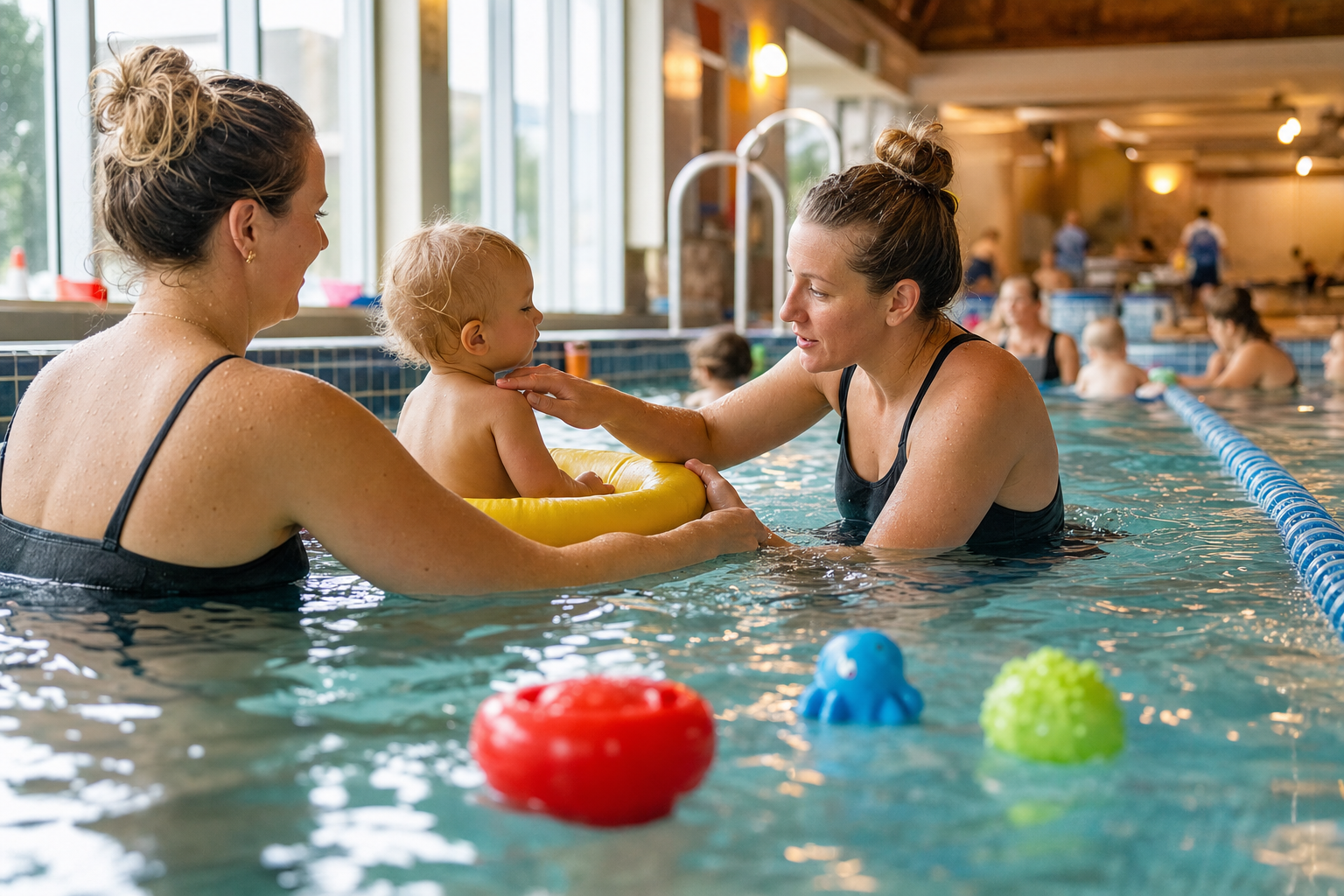
When your visually impaired baby or toddler enters the pool, the lack of clear visual input can make them feel unsure, startled, or even unsafe. But there are powerful cues—touch, sound, contrast, and predictable positioning—that help build confidence, trust, and orientation in the water. This guide lays out what parents and instructors can do to adapt parent-and-baby swim routines, especially for “special needs baby swim” or “adapted swim lessons baby,” so your little one learns safely and joyfully.
What Happened Just Before Should Always Be Clear: Transitions and Orientation
Transitions—stepping into a pool, doing a roll, leaving the water—are when disorientation often creeps in. To help a “swimming visually impaired toddler,” parents and instructors should give clear verbal cues: say what’s going to happen in simple words (“We’re going to pick up your foot”), then combine with a “touch cue”—a gentle tap or a wrap around the waist or shoulders indicating what movement is coming. Experts advise letting the baby feel each movement by tactile modeling, where the child touches your arm to understand the motion you’re asking for. This makes learning physical actions far more accessible than relying only on showing what to do. (aphconnectcenter.org)
Touch cues become even more crucial when vision is limited. Programs like Swim Angelfish’s Adaptive Swim Whisperers® method identify “interpreting touch” as a common challenge for visually impaired swimmers. The recommendation is always to pair touch with verbal cues and to warn the child before touching them. This prepares them, so a hand or arm placed to support them doesn’t feel like a surprise. (swimangelfish.com)
Sensory Anchors: Sound, Contrast, Consistency
Sound is one of your child’s strongest guides when vision isn’t helpful. Using voice cues—like welcoming tones, counting strokes, clapping at edges, or even a bell—helps define space. For instance, if approaching the pool wall, an instructor’s voice or a bell can mark the approach so the toddler knows where to reach out. As part of adapted aquatics instruction, these auditory markers help orient “special needs baby swim” students in the pool. (aphconnectcenter.org)
Contrast makes a huge difference, too. Bright-colored floatation aids, toys that float on surface, or the pool floor and edges demarcated with high-contrast lines give visual low-vision toddlers information they can use. It’s not enough to rely on subtle pastel floats in water; make them bold. The APH ConnectCenter recommends that your swim lesson include tactile and contrasting pool edge markers, and visual contrasts in swim gear and toys. (aphconnectcenter.org)
If you want a structured way to build water confidence at home, the 10-Week Plan guides you step by step.
Consistent routines round out this sensory scaffolding. Orienting the child to where things are—changing rooms, ladders, steps—and how the lesson will flow gives them predictability. First Steps: A handbook for teaching visually impaired children emphasizes that predictable routines and verbal explanations help infants and toddlers build trust and understand their world. Repetition solidifies spatial awareness so transitions feel safer. (files.eric.ed.gov)
[[ctababy]]
Practical Adjustments in Lessons for Ages 6-36 Months
For babies and toddlers, adaptive swim lessons baby-style mean pacing slowly, allowing time to touch things, hear what will happen, and feel each motion. Do one-on-one sessions whenever possible, so instructor attention can shift to cues and responses specific to your child. With group classes, choose instructors who understand special needs, or those who are trained in adaptive swim or swim therapy approaches. (weaquatics.com)
Use tactile modeling whenever teaching stroke motions or turns. Let the child feel you performing the motion—whether it’s arm reach, roll to back, or kicking. Bring activities close. For example, you could let your child feel a kickboard or noodle before expecting them to push off with one. External movement fragmentation (breaking a movement into parts) helps toddlers chunk skills so they can learn one piece at a time. Sanctioned research suggests that task analysis works well for children who are visually impaired. (sites.aph.org)
Also, reflect what the child actually controls. Some toddlers prefer back floats so face stays clear of water. Others might feel secure being held against the chest with your hand under theirs. These preferences matter. Let them lead when possible, and grow skills at their own pace, building toward greater freedom. Swim Angelfish stresses adapting lessons to follow engagement and comfort rather than forcing standard sequences. (swimangelfish.com)
Sign Up Smart: Questions to Ask and Best Practices
Before you enroll, ask whether the swim school has adaptive aquatics experience with visually impaired babies or toddlers. What kind of training do instructors have? Ask if they use strategies like tactile modeling, alternative communication, contrast, sound or touch cues. Request smaller group sizes or private lessons if needed. When possible, have any medical or therapy input for complex or multiple needs.
A structured pathway or plan helps track progress. While many parents follow general swim school curricula, for children needing extra sensory support, a guided program like the 10-Week Plan from Swimy.org gives you tailored weekly goals—introducing consistent cues, contrasting equipment, and building trust with sound, touch and position. You can adjust the pace to suit your child’s comfort, and review with instructors weekly.
Safety and Trust First
Don’t rush. Keep all transitions slow—walking into the pool, submerging feet, face washes, exiting. Always announce changes, give verbal and touch cues, allow the baby to acclimate. For babies who have complex health or sensory needs, medical professionals or therapists should be involved in the decision-making.
Trust doesn’t come overnight. Everyday things—your calm voice, predictable routines, letting them feel float aids themselves—build security. And always let the baby communicate what feels okay or not; sometimes silence, squirming or widening of eyes all tell you something you need to see.
When done well, parent-and-baby swim routines in special needs and adapted swim lessons baby settings become more than learning to swim—they become ways your visually impaired child learns to trust water, trusts adults, and trusts themselves. The cues you set now carry into swimming safety, body awareness, and joy for life.
120+ swimming exercises sorted by age — with video and instructions. Developed by swim instructors, completely free.

120+ swimming exercises sorted by age — with video and instructions. Developed by swim instructors, completely free.