No-Kickboard Kick Games for Ages 3–7: Build Body Position and Flutter Strength Through Play
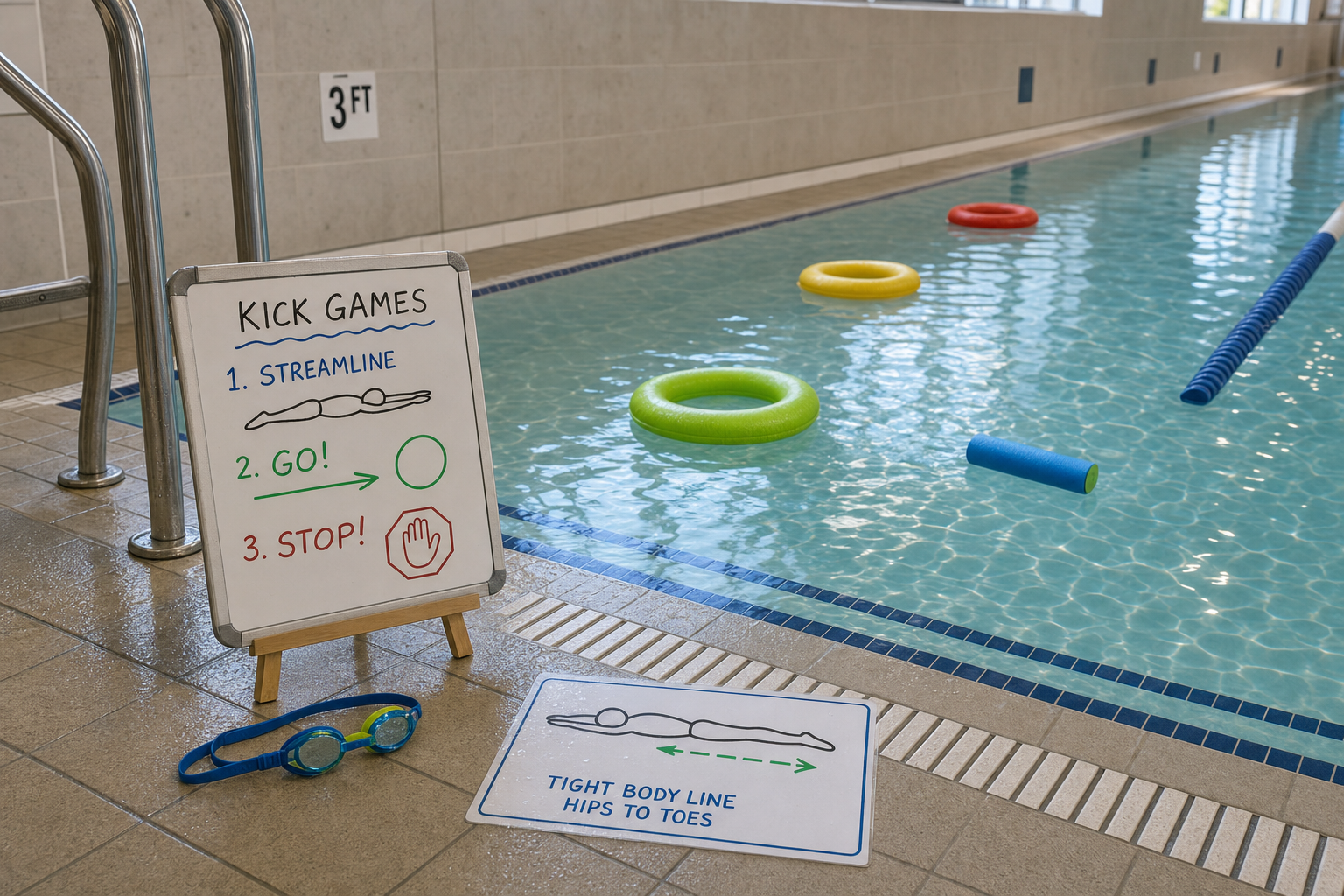
Kids ages 3–7 can build flutter kick strength, excellent body position, and streamline skills—all without a kickboard. Walls and streamlines give them stability and speed, while short games make learning feel like fun, not a chore. Let’s get into how to avoid common pitfalls and play 10 quick games that work year-round, keeping sessions short, safe, and full of joy.
Technique First: What Matters Most
To get faster kicks without shoulder strain, focus on three essentials: maintaining a strong streamline body, powering the kick from hips (not knees), and keeping feet and ankles loose. When streamlining off the wall, children should hold their hands overhead, ears tucked, body flat, face in water. This is where momentum starts. Kicks should come from the hips, with only a slight knee bend. Let toes point; avoid letting feet flop down. Watch for heads popping up or hips sinking—those kill speed and add strain. Experts agree these are common areas of weakness for young swimmers. (swimhub.com.sg)
Safety is paramount: no long breath-holds. Always 1:1 water watcher during games. Use walls and shallow water so children can stand if needed. Sessions should last 5-15 minutes—short bursts with full focus.
How Walls & Streamline Make Play Powerful
Walls provide instant feedback. When a child pushes off and assumes streamline, they see how their body moves when it’s long and straight. Streamline automatically tucks the head, lifts hips, aligns toes, and engages core. Adding flutter kick in streamline is like turning pause mode into go mode without strain. This setup reduces shoulder work, because arms stay overhead locked in place or just guiding the body off the wall.
Many exercises, including those from Swimy.org, show that even without gear, you can develop strong flutter kicks. One preparatory exercise has young learners lying flat on a swim mat and lifting straight legs alternately from hips; straightness of legs and relaxed ankles there often correlates with better in-water kick. (swimy.org)
Also, structured plans—like the Swimy.org 10-Week Plan—build skills in manageable steps: first focus on streamline and exhalation, then add flutter kick in shallow glide games, then refine form with visual feedback. This steady progression makes learning feel like play, not drill. (swimy.org)
Common Pitfalls to Avoid
Before playing games, be aware of traps that can slow progress or cause strain:
If you want a structured way to help your child progress at home, the 10-Week Plan guides you step by step.
‐ Bent knees or “bicycle kicks” instead of kicks originating at the hips. If knees are too bent, the legs create drag. (swimy.org)
‐ Feet hanging beneath hips. Hips sink, feet lag, head lifts to compensate. Must keep body flat, legs near the surface. (swimatlas.com)
‐ Head popping up or lifting chin; chin should tuck, eyes down. Head should stay in line with spine. (en.wikipedia.org)
[[ctakid]]
10 Quick No-Kickboard Kick Games
These take about 5-10 minutes each. Use shallow water off the wall and scale up as skills improve.
Torpedo Glide & Kick: Push off wall in streamline, glide like a torpedo. Gradually add flutter kick only after body is stable.
Bubble Train: Child holds streamline against wall, kicks on stomach, blowing bubbles—steady exhalation builds comfort.
Wall Push-&-Freeze: Off wall push, flutter kick for 3 seconds, freeze—hold streamline, head between the arms, toes pointed.
Red-Light Green-Light Streamline: On “Green Light” they swim off wall using flutter kicks with streamline, on “Red Light” freeze in a long body line.
Simon Says Stingray: Incorporate cues like “Simon says hide face,” “Simon says hips up,” “Simon says long toes,” etc., combined with flutter kicking off wall.
Ring Reach Glide: Set floating ring just past gliding distance. Child pushes off, glides, then kicks steadily to reach ring, arms overhead.
Treasure Diver: Toss soft toy or ring; child starts with streamline push off, then gentle flutter kick to dive down and retrieve, keeping body line.
Mirror Me Splash-Free Kick: Parent or instructor sliding in water shows correct kick; child imitates, emphasizing small fast kicks, no big splashes.
Animal Flow Kick: Pretend to be torpedoes, stingrays, dolphins, or sharks—kids make these motions off wall, keeping streamlines and kicks subtle but powerful.
Streamline Race to the Wall: Two children push off side by side in streamline. First to wall wins—but must maintain body line. Judge technique, not just speed.
Putting It Together: Session Flow
Start with 1–2 min warm-up: easy floats, blowing bubbles, lay streamlines. Then pick 2-3 games above, rotating between kicks off wall, underwater work, and breathe control. Rest between games liberally. End with reflection. Parents can watch body lines: hips up? toes pointed? knees bent? Maybe film short video to show the child (kids love to see themselves).
Why These Games Work Year-Round
You don’t need summer sunshine. Indoor pools, swimming classes, school gym pools—streamline and wall kick work perfectly in any season. These games build motor memory, kick power, body balance, and confidence that carry over to all strokes. When children naturally kick better, they swim faster with less shoulder effort—and that stays with them.
Sophisticated Players: What to Aim For Next
Once straighter streamlines and stronger kicks off walls are routine, add variation. Try flutter kicks on back, kicking while rotating sides, alternating fast/slow tempo. Introduce more distance or mild resistance (like water drag toys) without compromising posture. Always return to streamline technique after pushing limits.
Final Thoughts
Great kick drills don’t need boards or big equipment. Walls + streamlines + imaginative games = stronger flutter kick, better body position, happy kids. Keep games short, focus clear, avoid pitfalls like bent knees or dropped hips, always use a 1:1 watch in water, never allow long breath-holds. Play, repeat, build over time. Use tools like the 10-Week Plan from Swimy.org to pace learning. You’ll see kids ages 3-7 kicking faster, swimming smoother, and enjoying every splash.
120+ swimming exercises sorted by age — with video and instructions. Developed by swim instructors, completely free.

120+ swimming exercises sorted by age — with video and instructions. Developed by swim instructors, completely free.