Observe Without Coaching Poolside: Parents’ Guide to Toddler Swim Lessons
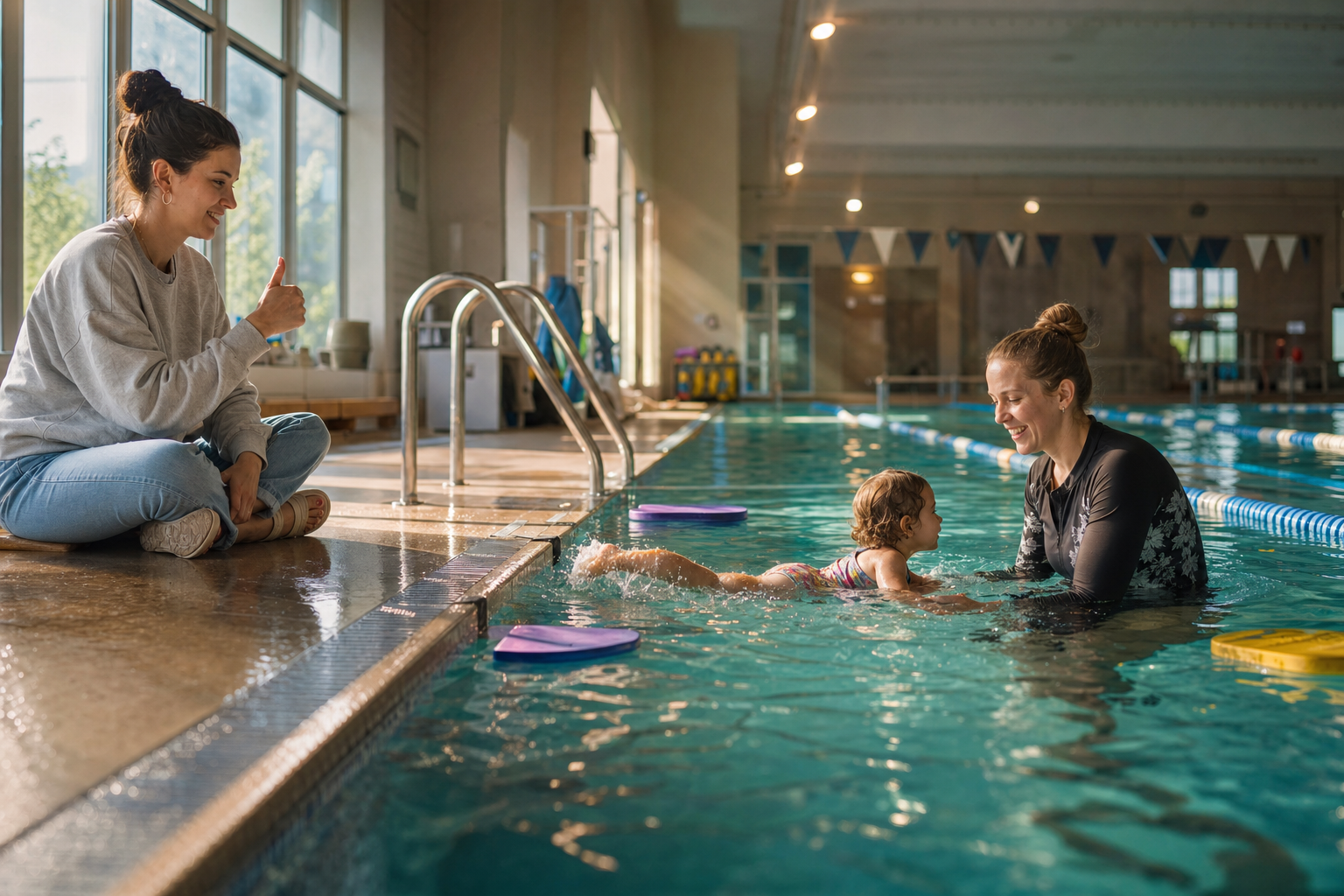
If you’ve ever sat at the edge of a swim lesson and felt impatient to jump in with pointers, this guide is for you. When toddlers aged 24-36 months transition from parent-in classes to independent ones, your role shifts. “Parents watching swim lessons” is powerful—but only when you watch with purpose.
Why staying quiet and observant helps your toddler thrive
Toddlers gain clarity and confidence when instructions come from one trusted voice: the instructor’s. If parents shout extra cues like “chin up,” “kick harder,” or “arms straight,” toddlers hear mixed messages. That split focus can confuse them, slow progress, and even frustrate them. Research supports that accurate swim lessons with qualified instructors and clear curriculum help children ages 1-4 reduce drowning risk by nearly 88% (usaswimming.org).
At that 24-36-month age, young swimmers are still building coordination and trust. Listen, observe, and let the instructor guide. You’ll see where your child struggles—then give praise for courage, listening, or trying something new. Your encouragement builds confidence much more than constant correction ever will.
When “should I coach during swim class” becomes important
You might wonder: is there ever a time to step in? Yes—but with caution. Coaching during class usually causes more harm than good unless the instructor invites your help. Think of swim class like a play with a director. Your toddler takes directions from the instructor. If you whisper your own, you dilute both the teacher’s cues and your child’s ability to follow them.
Instead, reserve your input for moments like the instructor asking parents to join or demonstrating a move together. During class, your best contribution is to watch, protect, and cheer.
What to save for after the lesson
After swim class, during the debrief or drive home, is the perfect time to talk about what worked. You could say things like “I saw you keep your head in the water like Miss Kay showed you,” or “You tried hard with your kick.” Use three steps: What they did well, what the instructor said to try next, and how you saw that effort. That kind of feedback reinforces lesson goals without distracting during class.
Also ask your toddler about what felt easy and what felt tricky. Sometimes they’ll tell you more about fear or confusion than you expect. Their own words give clues on how you can help at home—maybe letting them practice kicking in a shallow shallow pool under supervision or floating games.
If you want a structured way to build water confidence at home, the 10-Week Plan guides you step by step.
Where to place yourself: watch, praise, protect
When you watch swim lessons, use a designated parent viewing area or deck. Seeing from a slight distance keeps the child’s attention on the instructor and prevents conflicting cues. It also allows you to praise from afar—smiles, thumbs up, or claps after success—so your child still hears your approval without hearing your instructions.
Protecting your child always comes first. Even though “parents observing swim lessons” is different from supervising open swim, you remain responsible. Stay close, attentive, avoid distractions, and be ready to help if needed. The American Academy of Pediatrics emphasizes that caregivers of toddlers must provide “touch supervision”—within arm’s length—for safety, even during lessons (healthychildren.org).
[[ctababy]]
The transition from parent-in to independent swim class
Most swim programs expect that by ages two to three, children begin moving from parent-in combined classes to ones where the teacher leads independently. USA Swimming points out that providers usually do not require parents in the water beyond the toddler years and strongly encourage that parents observe from outside the pool (usaswimming.org).
If your child is at this stage, watching without coaching helps build trust in the instructor. It gives the child room to listen to new directions, try solo effort, and internalize cues.
How to choose a swim program that supports this balance
A strong learn-to-swim program for this age has several features: small class sizes (ideally one instructor for every four toddlers), qualified and trained teachers, and transparent goals. Parents should be told what skills are being worked on each week so their praise at home aligns with the lesson’s goals. The USSSA Infant-Toddler Guidelines suggest that caregivers must be educated about the instructor’s process, understand the goals, and know expectations for progress and safety (usswimschools.org).
Also, programs that provide structured plans for parents between classes, like the 10-Week Plan from a reputable swim organization, give useful ideas on home practice and debriefing without intruding on class time. Incorporating such a plan helps you know what to watch for and how to support after the lesson.
Common pitfalls and how to avoid them
One common mistake is giving conflicting cues: you tell your child “chin down” just as the instructor says “chin up.” That confusion can undermine confidence, making the toddler unsure whose voice to trust. Another pitfall is over-correction—you correct every move and may inadvertently cause self-consciousness rather than learning. Rest assured, instructors are trained to spot the bigger picture: form, timing, breath control, water comfort—not perfection.
To avoid contradicting the instructor, learn their cues and language. If you’re unsure, ask at the end of class. That way you’re aligned. Also avoid watching from too close or entering the water unless invited—they teach from a pool deck perspective. Your role is observer, cheerleader, safety guardian—not coach.
Bottom line: confident toddlers, confident parents
By sitting back, watching carefully, and praising wisely, you help your toddler build swim skills, water confidence, and trust in their teacher. When you stay quiet during lessons, you let them focus without confusion. Save coaching for afterward, follow the lesson’s language, and always stay alert for safety. Your shift from hands-on to hands-off is a gift—to both your child’s development and your own parenting practice.
120+ swimming exercises sorted by age — with video and instructions. Developed by swim instructors, completely free.

120+ swimming exercises sorted by age — with video and instructions. Developed by swim instructors, completely free.