Permission Patrol: The Pre-Entry Water Safety Game Kids Remember
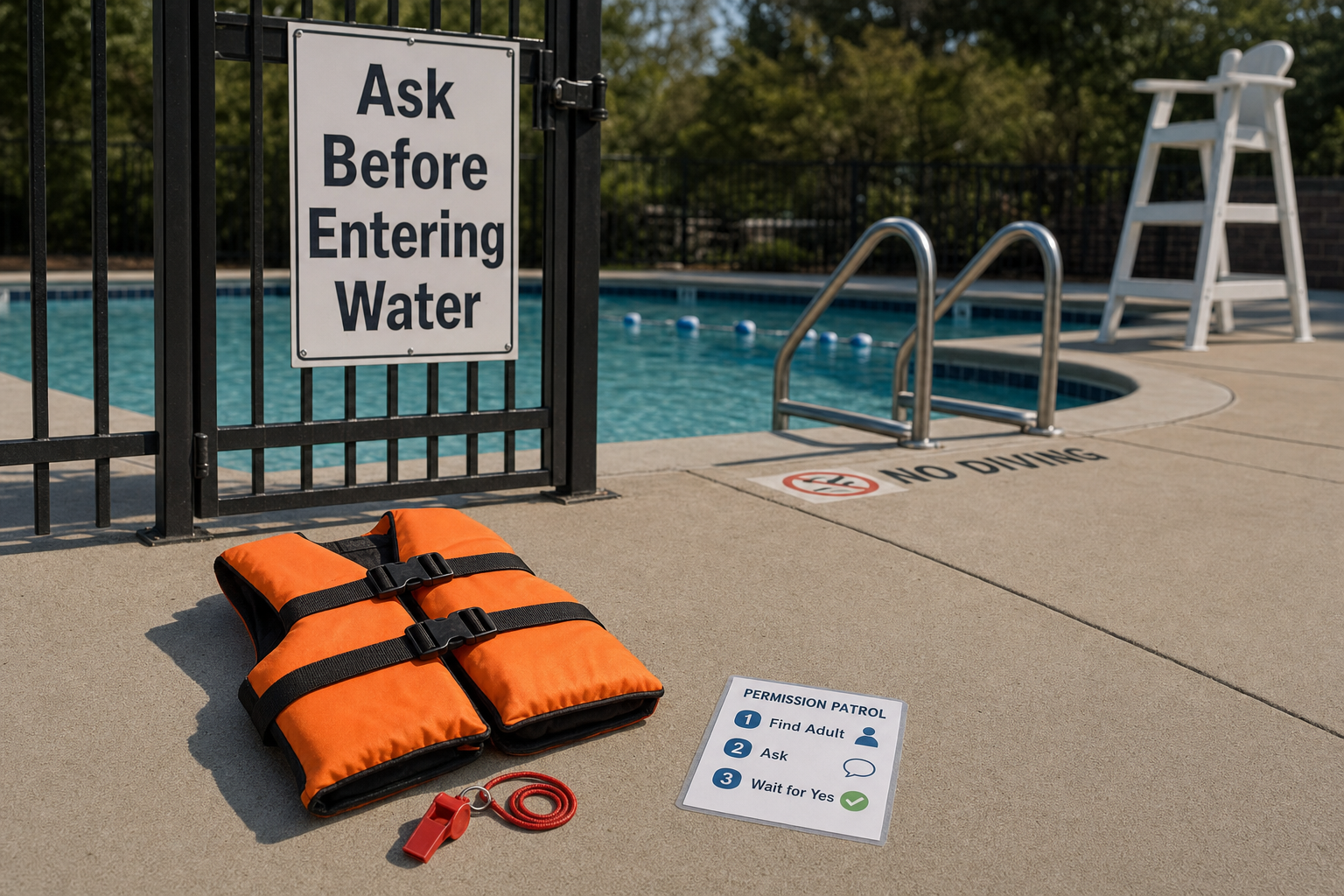
When is a child allowed to enter the water? Not until they’ve completed a simple, three-step ritual. This “permission to enter water rule” turns a safety guideline into something fun: kids spot a trusted adult, ask clearly, wait for permission—and only then celebrate with a safe entry. It’s simple, memorable, and it reinforces constant supervision and life-jacket safety at pools, lakes, or hotels.
Why the “Let Me Ask” Game Matters Now
Children ages 3-8 are always learning rules through action, not lectures. According to the American Academy of Pediatrics, one of the most common factors in swimming-pool drownings is that a child did not have permission to be in the water. Among fatal and non-fatal incidents, they found in over 80% of cases, children were without permission or were swimming alone. Close, constant, and attentive supervision remains absolutely crucial.(publications.aap.org)
Also, life jackets are essential especially in natural water where currents, depth and hazards pose greater risk. Experts at the National Park Service and the U.S. National Water Safety Action Plan emphasize that children should wear properly fitted, certified life-jackets whenever they’re in or near open water—lakes, rivers, oceans.(nps.gov)
How Permission Patrol Works: The 3-Minute Pre-Swim Routine
You can start this routine on the very first swim day of any season—and repeat it until it becomes second nature.
First minute: the child scans for a trusted adult. Parent, lifeguard, teacher—whoever is supervising. They learn to point them out by name.
Second minute: child asks clearly, “May I enter the water?” or “Is it okay to go in now?” The adult responds. No vague answers; a firm “Yes” or “Not yet”.
Third minute: child waits for the “Yes.” When the answer comes, they enter safely—feet first, wearing their life-jacket if in natural water, and under adult supervision. The arrival of permission earns praise—maybe a high five, or the ritual scream of “Safe Entry!”
Older siblings can act as leaders—helping younger ones spot adults and model the question. Over multiple swim lessons, pools, or lake visits, this pre-swim routine becomes the anchor for the permission to enter water rule.
Making It Stick: Tips to Avoid Common Pitfalls
If you want a structured way to help your child progress at home, the 10-Week Plan guides you step by step.
One challenge is that cues can fade after week one. To prevent that, set cues the same way every time—perhaps a whistle blow, counting down from three, or a bell. Make sure everyone in the family or group knows the cue, so kids don’t drift back into assuming permission without asking.
Another tricky area is confusing OK for shallow or wading water with OK for deep water. Even when kids are just wading, the water can deepen suddenly, or currents may pull them. Establish clear rules: one “Yes” applies only to the specific situation—wading, shallow pool, or full swim. If water depth changes, the child must ask again.
[[ctakid]]
Life-jacket use must be non-negotiable in natural water. As CDC and National Park Service guidelines show, a U.S. Coast Guard–approved life-jacket significantly reduces drowning risk when children swim in lakes or rivers.(cdc.gov)
Integrating Lessons & Swim Training
If your child is taking swim classes or becoming water competent, this game fits in naturally. Parents and instructors can include the permission ritual in curriculum materials. For example, swim schools often use water safety games where kids practice “Ask Your Adult” moments as part of their learning.(marlinswimacademy.com)
One great resource to follow while making this ritual habitual is the 10-Week Plan at swimy.org. This structured program weaves safety rules, including asking for permission, into the build-up of skills that help children feel secure entering water while under supervision.
Where & When to Use Permission Patrol
This game applies everywhere: at public swimming pools, hotel pools, backyard pools, beaches, rivers, lakes—any water entry point. It’s ideal at the first lesson of any swim term. Repeating the game before every swim outing—rather than assuming kids remember—makes permission part of the routine.
You can start as early as age 3. Older children benefit too—as leaders and enforcers of the rule. It strengthens their responsibility and helps younger siblings form good habits.
Season doesn’t matter—indoors in winter or outdoors in summer, natural water or chlorine pools. The permission to enter water rule is timeless and adaptable.
Safety Outcomes You’ll See
Weariness from rules often fades into confidence when kids clearly know who to ask and what “Yes” means. Close, constant adult supervision coupled with life-jacket use dramatically lowers risk. The Prevention of Drowning technical report finds that when supervision lapses or children enter water without permission, risk of drowning spikes.(publications.aap.org)
Families report that the Permission Patrol ritual reduces arguments (“I thought it was OK!”), prevents surprises at edges, and creates smoother transitions between play, swim, and rest. It helps parents stay focused too—acting as a cue to check that life-jackets are fastened, adult eyes are on the water, and supervision is active.
Turn the permission to enter water rule from vague policy into a playful ritual. Let kids practice spotting a trusted adult, asking clearly, waiting for yes—and then secure entry. As you reinforce the rule, maintain cues, avoid mixing shallow and deep permissions, use proper life-jackets, and never let supervision lapse. This simple game builds water safety habits you’ll actually remember long after week one.
120+ swimming exercises sorted by age — with video and instructions. Developed by swim instructors, completely free.

120+ swimming exercises sorted by age — with video and instructions. Developed by swim instructors, completely free.