Play vs Drill: How Great Swim Lessons Balance Fun and Skills for Ages 3–7
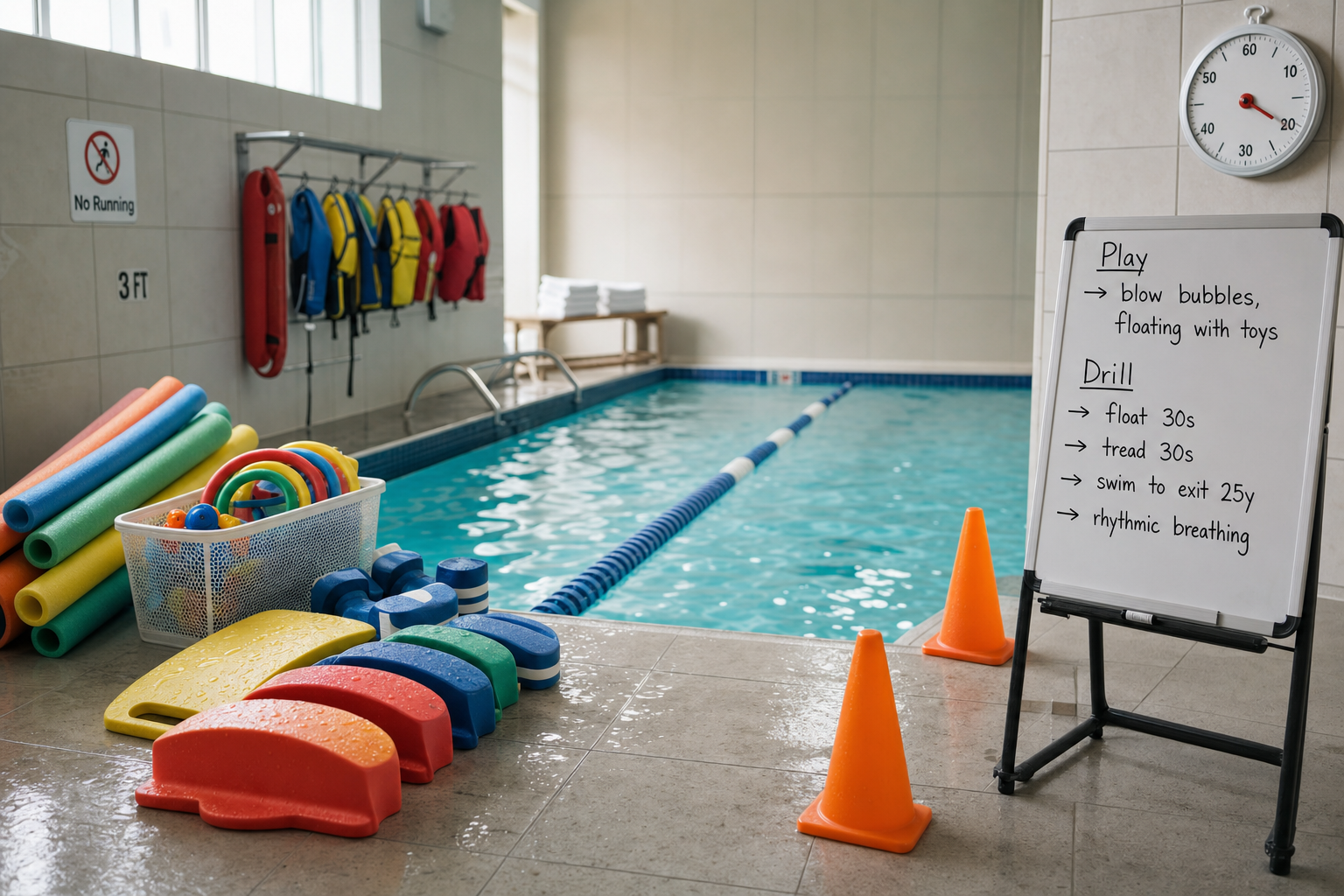
For parents with kids aged 3 to 7, the question isn’t whether swim lessons should be fun—they must be. The real question is how lessons can balance play-based activities with structured skill targets so children stay engaged and truly learn to swim safely.
What Do Quality Lessons Do First
Great swim lessons at ages 3–7 weave together two things: water competency and joyful learning. Water competency is the full set of skills that help a child not only swim, but survive in unexpected situations. Parents should expect their child to learn abilities like entering water safely, floating, controlling breath, moving to an exit and leaving without support. These are the benchmarks set by programs like the Red Cross, which clearly define water competency as more than happy splashes. (publications.aap.org)
The American Academy of Pediatrics (AAP) just updated its drowning prevention guidance. It stresses multiple layers of protection—swim lessons are one, but not the only, way to prevent drowning. Supervision must be attentive and constant; other safety measures like pool fencing, life jackets, and rescue/CPR skills are essential parts. (healthychildren.org) Lessons should build survival skills gradually, matching a child’s maturity and physical readiness. (publications.aap.org)
How Play and Drill Fit Together
Pure play has its place: splashing to overcome fear, blowing bubbles to practice breath control, floating with toys to develop balance and buoyancy. But without structured drills—skill ladders, repetition, clear cues—progress stalls. Drills refine stroke technique, strengthen kicking, teach rhythmic breathing. The research is clear: for ages 3–5, lessons should lean heavily into playful, exploratory learning, helping children feel at home in the water before introducing rigid drills. For ages 6–7, skills must broaden—structured stroke development, endurance, and true water competency. (journals.plos.org)
When swim schools offer a predictable progression—clear levels or stages that mix games and skills—it gives children a roadmap. That’s why many parents are impressed with programs modeled around formal plans like the 10-Week Plan that systematically move kids through basic skills, safety drills, and increasing independence. Having such a plan helps you see what your child should be able to do week by week and makes it harder for them (or you) to get stuck at one level. (redcross.org)
If you want a structured way to help your child progress at home, the 10-Week Plan guides you step by step.
What Parents Should Watch For
If you're considering swim lessons for your 3-7 year old, here are the key signs of a high-quality program.
- Water-competency goals: Ask whether instructors follow a published sequence (like the Red Cross or Swim England stages) that includes things like floating, treading water, exit strategies. (watersafetyusa.org)
- Clear skill targets and cues: Good classes explain what “Level 1” or “Stage 4” means—what kids must do rather than vague notions like “move to the next level.” Look for benchmarks like “tread water for 30 seconds,” or “swim 25 yards to exit.” (swimming.org)
- Safe instructor ratios: Young beginners need much more attention. For 3-6 year olds a ratio of 1 instructor to 4 or 6 students is ideal. Older or more advanced groups can stretch to 1:10 only if many students are already swimming comfortably. (waterwisekids.com)
- Behavioral & emotional cues: The teacher knows how to calm fear, not force submersion. They give breaks, support children who are struggling emotionally, and don’t rush drills if water confidence isn’t there. Play-based learning helps with this early on. (journals.plos.org)
[[ctakid]]
What to Ask Before You Enroll
Before term-signups or spring peak season, take time to compare programs. Ask what instructors are certified, whether you can see the curriculum or skills chart, and how progression is handled. Inquire about class size, safety policies, how emergencies are handled, and how much feedback you’ll receive so you can help practice at home. (findswimmingpools.com)
Make sure the program offers water competency—not just swim ability. Confirm that teachers are trained in what the latest AAP policy recommends: close, constant, attentive, and competent supervision. Ask how often they assess skills like floats, treading water, exit swimming. Ask what happens if your child misses classes or needs extra support. (publications.aap.org)
Balancing during Term Sign-Ups and Spring Peaks
Pre-term and spring are big windows when swim schools fill up. Waiting lists grow. That’s when parents have to be extra selective. Don’t choose “availability” over “quality.” The right program might be further away or cost more, but mixing play-based lessons with drills will yield real growth. Spring is also when outdoor swims begin, so water competency becomes doubly important: safe exits, endurance, and open-water behavior can’t be ignored. Use spring deadlines to lock in programs that meet the criteria above.
Kids aged 3-7 benefit tuitionly when they stay consistent: swimming weekly, building on what they learned. Regardless of season, a program that offers a clear roadmap—play to build comfort, drills to build competence—is worth waiting for.
Final Word: What Makes Lessons Great
Great lessons at ages 3 to 7 don’t just feel fun—they are meaningful. They balance the joy of exploration with the reality of water safety. They follow sequences like the Red Cross Learn-to-Swim or Swim England stages. They set clear benchmarks, keep instructor ratios low, and supervise carefully. A lesson where the child is still scared of putting their face in—or can’t float or get to the edge—after many weeks is a red flag.
Parents: demand transparency. Ask what your child should be able to do by level or stage. Watch whether those targets are met. And know that while “play” starts the journey—and keeps things joyful—“drill” ensures safety and survival. When lessons blend both well, your child makes steady progress, stays engaged, and you feel confident. This is what best swim lessons 3–7 should look like.
120+ swimming exercises sorted by age — with video and instructions. Developed by swim instructors, completely free.

120+ swimming exercises sorted by age — with video and instructions. Developed by swim instructors, completely free.