Read Pool Depth and No Diving Markers Together: Deck Walk Safety for Kids 3–12
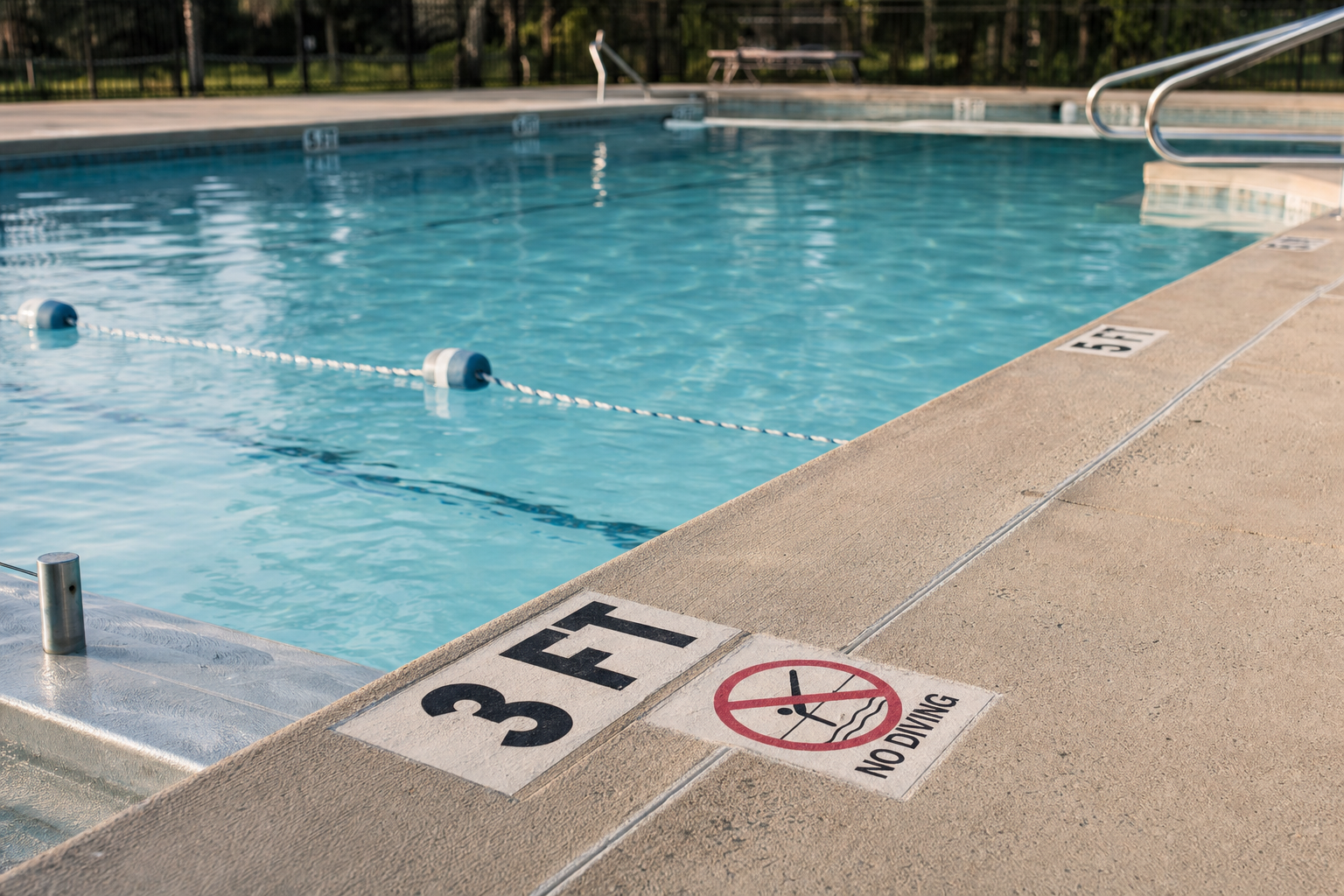
Right now, walk with me to the pool, deck to waterline. Let’s make this two-minute deck walk a habit with your child. First, read the depth markers. Spot slope “drop-offs.” Then match safe entries to your child’s ability. These steps help prevent shallow-water head or neck injuries.
What Are Pool Depth Markers, and What Do They Mean?
Depth markers are permanent signs or tiles on the pool wall and deck that tell how deep the water is in feet and inches. According to the U.S. CDC’s 2024 Model Aquatic Health Code (MAHC), depths of 5 feet (1.5 meters) or shallower must have deck depth markers labeled clearly, with lettering at least 4 inches high and in contrasting colors.(cdc.gov) These markers tell you where the shallow end ends and where deeper water begins.
You might assume the depth marker equals how deep the water is right up to the brim—but that’s often not true. The waterline is usually lower. For example, in above-ground pools, water is typically 4 to 6 inches below the top rail so skimmers work properly.(beatbot.com) That means a marker that says “4 ft” may be over water that’s actually closer to 3 ft 6 in or 3 ft 10 in deep. Always check where the water level actually sits.
Why “No Diving” Signs Are in the Rules
Every pool area where the water is 5 feet deep or shallower must post “NO DIVING” warnings near depth markers on the deck.(cdc.gov) The markers should include the “No Diving” text or universal symbol. These warnings must go no more than 25 feet apart around the pool’s shallow perimeter.(cdc.gov)
The reason: diving into shallow water leads to serious head, neck, and spinal injuries. The rule helps kids (and adults) clearly see where diving is prohibited. For children aged 3-12, who may not judge distance well or know pool safety rules by memory, this visual clarity is vital.
More than depth and signage, the official guidance says never dive in water that is 5 feet (1.5 meters) or less deep. That includes above-ground pools, regardless of their wall height. Those pools are not built for diving—even when the measurements suggest more depth.(beatbot.com)
Two-Minute Deck Walk: How to Teach Safety with Your Child
Here’s how to turn pool time into safety training without drama:
First minute: Face each depth marker together. Say what it reads (“3 ft, 6 in”, “5 ft”). Check where the waterline actually is. Then move to where the slope begins. Spot the break in floor slope—where flat bottom becomes steeper, or safe shallow to deeper water. Often, there’s a line or rope (ropes with floats over slope breaks are required in many pools) marking that change.(cdc.gov)
Second minute: Ask your child what they think is safe. Can they walk in feet first there? Or sit at the edge and slide in by feet? Teach that whenever they’re not sure, always enter feet first. Full of confidence, not risk. Model it yourself: a slow, feet-first entry, not head first.
[[ctakid]]
You might also consider doing a structured swim training plan. For example, the 10-Week Plan at swimy.org helps kids build both confidence and skills in water. Doing depth awareness as part of such a plan reinforces safety alongside stroke technique and water comfort.
Safe Entry: Matching Entry Style to Ability
Here are thresholds and suggestions for kids aged 3-12:
If they can only stand comfortably with feet touching floor: entry by steps, ladder, or sitting at edge sliding in by feet. No risk, totally safe.
If they can swim and tread water well, and depth is more than 5 feet (1.5 m): feet-first jump or plunge may be safe—but only in pools specifically designed for diving or with oversight. The CDC guidance says that 5 feet of water is the dividing line; shallower than that, no diving allowed.(cdc.gov)
For head-first diving from deck or boards, many authority figures (like the American Red Cross) recommend a minimum of 9 feet depth.(cdc.gov) Unless you’re at a facility built to standard for diving boards and platforms, assume anything shallower than 9 feet is unsafe for that kind of dive.
Common Pitfalls Parents Should Watch
One: trusting advertised depth markers without checking the actual water level. As mentioned, above-ground pools often have water several inches below the top. If a wall says “4 ft” but water is 6 inches down, you really have more like “3 ft 6 in” available. That gap changes what entries are safe.
Two: assuming shallow-end markers guarantee safety for diving or large jumps. Even at 6 feet, diving from a deck may still be unsafe depending on the pool architecture and bottom slope. Always check whether the pool’s rules or signage allow diving in that section.
Three: ignoring “No Diving” markers thinking they don’t apply. These are there for a reason—they are enforceable in many state codes. For example, Ohio law requires every shallow area of a public pool to have “No Diving” signs spaced at intervals not more than 25 feet.(codes.ohio.gov)
Four: above-ground pools. They are never safe for diving. Even if they have a deep center, their structure, wall stability, and water volume usually don’t meet safe diving thresholds.(beatbot.com)
Putting It All Together: Your Safety Mindset
Every swim day, make that two-minute walk standard. Read depth markers, spot slopes, check where waterline sits. Talk with your child about what’s safe—for example, “Here the pool says ‘5 ft’, but water is four-and-a-half-feet. That means no diving, only feet first here.” Reinforce feet-first entry. Celebrate safe choices.
This mindset trains depth awareness, strengthens understanding of pool depth markers meaning, teaches when and where “no diving sign rules” apply, and ensures safe pool entry for kids.
Make safety normal. It might feel like overkill at first, but your child will grow into a smart swimmer, one who never risks shallow-water head or neck injury unnecessarily.
Remember: Safety isn’t about fearing the water—it’s about respecting it, learning it, and swimming with confidence.
120+ swimming exercises sorted by age — with video and instructions. Developed by swim instructors, completely free.

120+ swimming exercises sorted by age — with video and instructions. Developed by swim instructors, completely free.