Retention Ponds Aren’t Pools: Teach Kids to Steer Clear
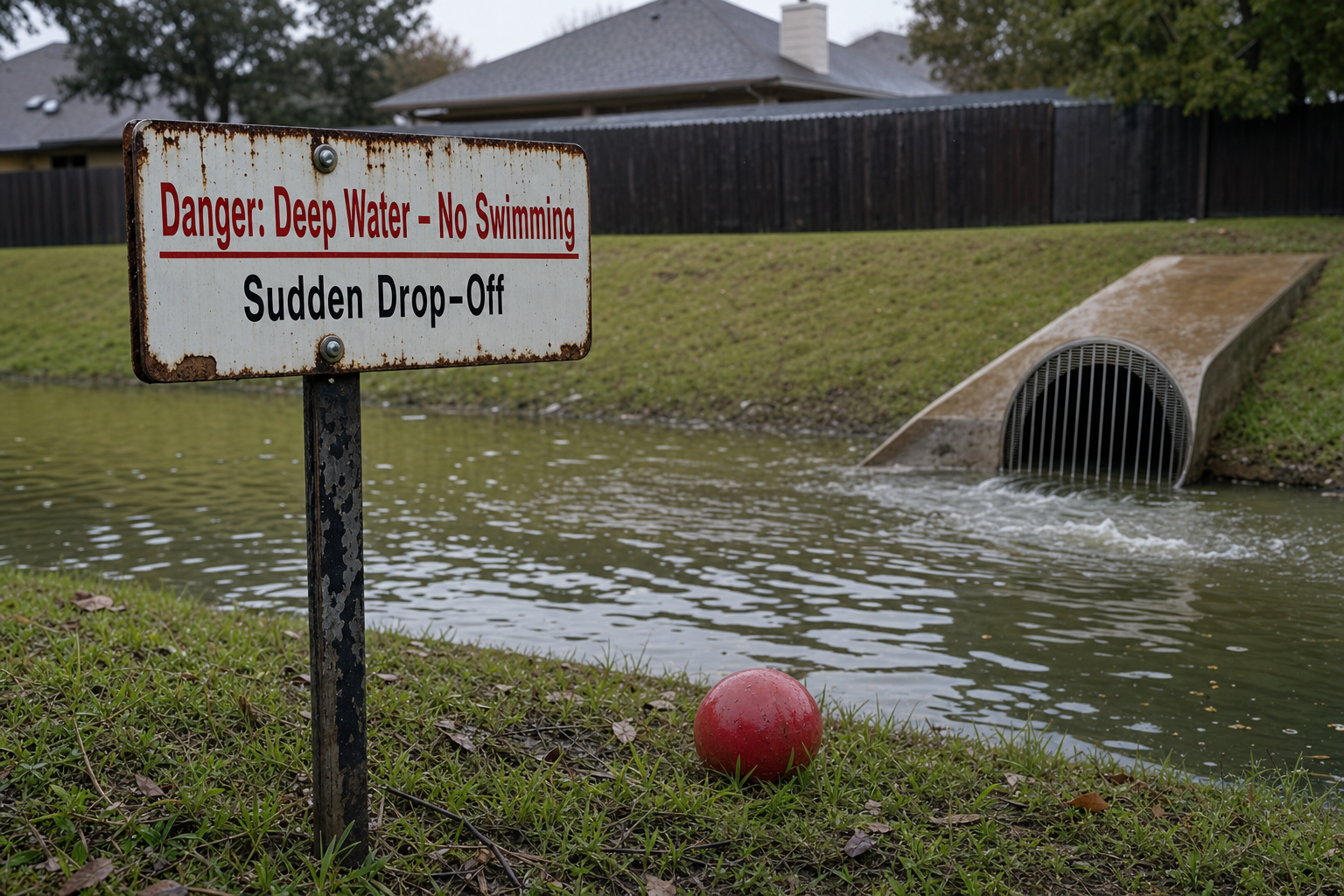
Kids love a pond that looks like a lake or backyard pool: still water, grassy banks, maybe a duck or two. But stormwater and retention ponds (also called detention ponds or farm ponds) are not swimming spots. From sudden drop-offs to hidden suction pipes and dirty water, these ponds hide dangers that many parents don’t always spot. Below you’ll learn what those hazards are, how to teach your child (ages 3-12) to treat these ponds like roads—look, avoid, tell—and how to talk to your neighborhood about signs and safety.
Why Stormwater and Farm Ponds Look Inviting—but Aren’t Safe
You may see a calm body of water in your local park, farm, or new housing area and think it’s natural. Stormwater ponds are engineered to collect runoff from streets, driveways, and lawns. Retention ponds hold a permanent pool of water; detention ponds only hold water temporarily after rain—but both can seem deceptively calm.(epa.gov)
Shallow edges may suddenly plunge to deep water, and banks are often steep, muddy or lined with slick clay. It’s very hard for a child who slips in to climb out again. Hidden pipes and culverts beneath the water create suction that can pull swimmers under. These ponds collect sludge, sediment, and pollution like oil, pesticides, and bacteria. Water looks murky for a reason—and isn’t safe to swim in.(lakecountyin.gov)
Seasonality makes risk worse. After heavy rainfall—especially in spring through fall—the pond fills fast. Outflow pipes suck in water; velocities increase. Signs, gates, or barriers may be under water or obscured. That’s when tragic accidents happen.(swfwmd.state.fl.us)
What Research Reveals About Children & Drowning in Ponds
A large study of causes of child drownings in retention ponds in the United States (2004–2020) found that 265 deaths occurred in these ponds. Of these, about 60% were children aged 1 to 4. In over half of cases supervision was lacking or absent. Most ponds involved had no fences or warning signs.(pmc.ncbi.nlm.nih.gov)
Farm ponds are even more neglected. Many incidents happen when children wander close to soft banks, or step into water that looks shallow only to slip into deep holes. Even experienced swimmers struggle when water is cold, or visibility is zero.(stacks.cdc.gov)
How to Teach Kids: Treat Ponds Like Roads—Look, Avoid, Tell
Think of a retention pond like a road: you wouldn’t cross one without looking or going where grown-ups say it’s okay. Same with ponds. Teach your children three rules: look, avoid, and tell.
- Look: See a pond? Stop before you get close. Notice edge, water’s color, slope, pipes, or fences. If you can’t see through the water or see any out-pipe, assume danger.
- Avoid: Don’t go near the edge. Never play, climb, or lean over. If a toy or ball falls in, leave it. Don’t try to fetch it yourself.
- Tell: Always tell an adult. Let someone know where the pond is, if you're curious, worried, or see something unsafe.
If you want a structured way to help your child progress at home, the 10-Week Plan guides you step by step.
Parents should practice this with stories, role-play, or walks: “What would you do if your toy rolled into that pond?” No retrieving on your own is a must.
Also, enrolling children in basic water safety skills—even if it’s not swimming lessons in ponds—helps with floating, staying calm in water, and understanding they are not ready to swim in unsafe places. Some programmes like the 10-Week Plan at swimy.org build water confidence and skills so children understand their limits before encountering real danger.
[[ctakid]]
Safety: What Parents and Neighborhoods Can Do Right Now
Your child’s safety depends not just on what they know, but what your neighborhood does. Watch for signs and fences near water, especially in parks, new developments, farm areas. Ask these questions: Are there warning signs saying “No Swimming”? Are edges fenced or at least blocked? Are the banks shallow near the entry points? Are pipes visible and covered?(lakecountyin.gov)
Parents should always supervise young children. For ages 3-7 this means within arm’s reach when outdoors near water. Avoid distractions. Even children who can swim can be overwhelmed by cold water, strong currents, or mud.
Teach rescue rules too: throw rescue only—use a rope, a floatation device, or something long. Do not enter the water to save another person. Many adults drown trying.
Communities, HOAs, and councils can pressure for safety standards. Local ordinances can require fencing, signage, gentle side slopes (8:1 or shallower), pipe guards, buffer zones near schools or playgrounds.(legalclarity.org)
What to Look for in Signage & Barriers
Clear signage must spell out “No Swimming,” “Danger: Deep Water,” or “Sudden Drop-Off.” Signs should be weatherproof, visible from the most common paths. Fences or barriers should physically block access. Gates should self-close and self-lock if possible. Bank slopes need to be easy to exit for someone who accidentally gets in. Outlets and inlet pipes should have grates or guards.(lakecountyin.gov)
Parents can talk with neighbours, landowners, or local government to raise awareness. Send suggestions about installing more obvious signs or extra fencing. Share studies and data with your school or community group to build support.
When Risks Spike: Heavy Rain, Spring-Fall, Extreme Weather
After a storm, retention ponds fill up quickly. Counties often release water downstream through pipes, creating strong currents just under the surface. Slick banks become more slippery. Murky water hides whatever is underneath. Children are especially vulnerable when they can’t see the dangers.(citeseerx.ist.psu.edu)
Don’t let increased risks during spring-fall lull you into complacency. Even in warm months, water temperatures drop under shade or from inflow, making cramps possible. Stormwater often carries chemicals, runoff, germs, and even algae blooms at warm temperatures that harm skin or pose illness risk if swallowed.(swfwmd.state.fl.us)
Final Thoughts: Keeping Your Child Safe
Retention ponds are everywhere in suburbs, farms, and parklands—but they are not safe for swimming. Treat them like roads: you look before you cross, you avoid unsafe zones, you tell an adult. Teach your kids these rules early. Equip your neighborhood with proper signs and barriers. Watch edges closely. And always supervise. If a toy falls in, leave it and tell an adult. When in doubt, stay back and stay safe. Retention pond safety for kids isn’t just a slogan—it’s protection that saves lives.
120+ swimming exercises sorted by age — with video and instructions. Developed by swim instructors, completely free.

120+ swimming exercises sorted by age — with video and instructions. Developed by swim instructors, completely free.