Rocket Tag: Streamline Push-Off Game Kids Actually Love
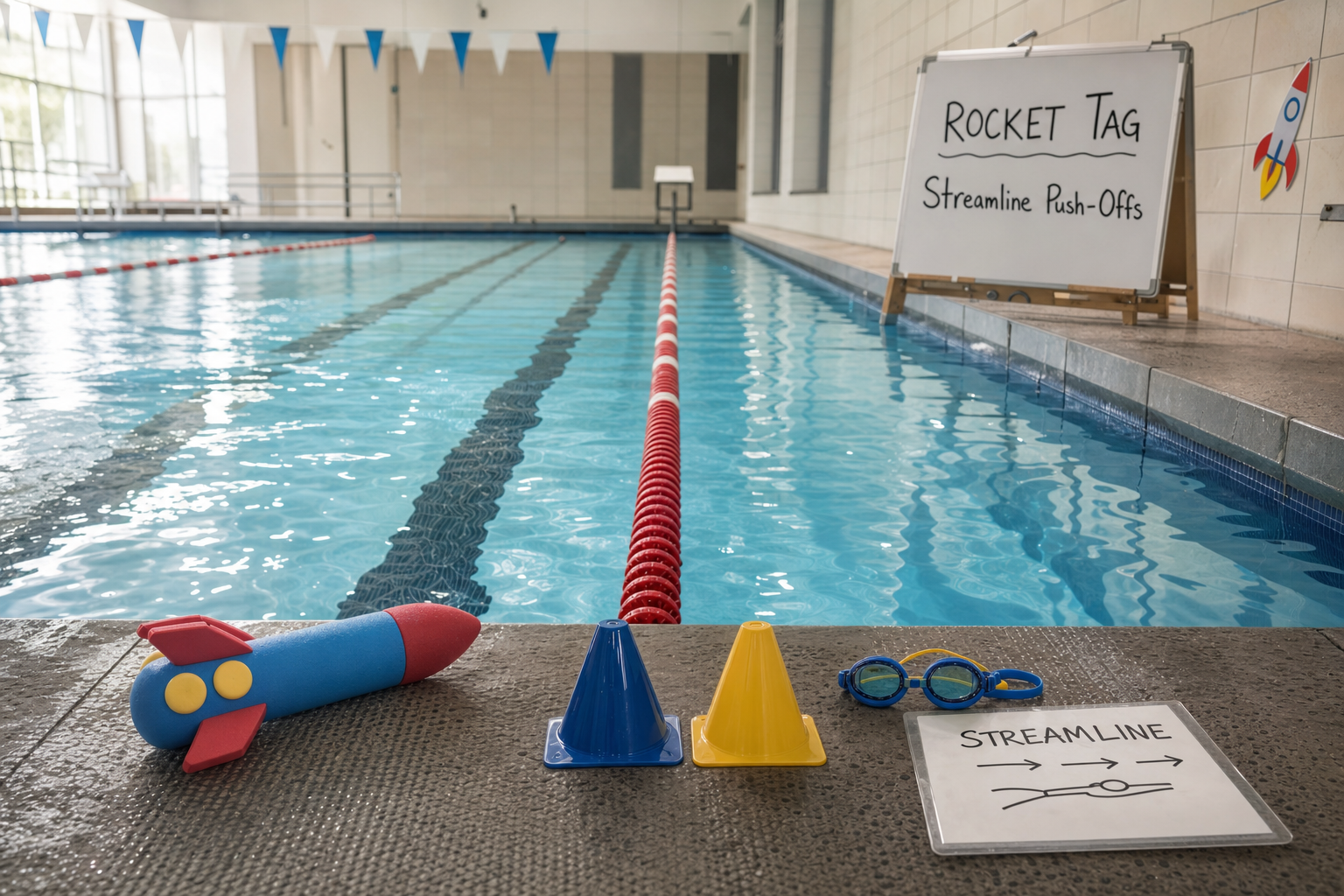
Imagine this: at the side of the pool, one child pushes off the wall like a rocket, arms tight overhead, body straight and torpedo-fast. The others can only chase once they’ve matched that streamline push-off. That’s Rocket Tag—a game that makes kids age 5-10 feel why good push-offs make them faster. It builds real swimming skills while being playful, engaging, and perfect for early confidence.
What Rocket Tag Teaches—and Why Streamline Matters
Streamline is not just form—it’s speed you already have. When kids learn to push off in a tight streamline (arms locked overhead, head tucked between arms, body straight and legs together), they cut water resistance massively. Coaches call the streamline the “sport’s shape” and one of the most powerful tools in swim training. Off every wall, every start and every turn depends on it. (parentedge.com) These push-offs give free momentum, and Rocket Tag turns that into a game. Children feel the rocket pull, then understand deeply how loose knees, arms apart, or heads poking up kill speed.
With Rocket Tag, kids learn to anticipate that glide phase. They see their teammates chase only after matching the push-off. It builds body awareness, core control, balance in the water. Plus, as they try to hold streamline longer and tighter, their legs stay together, toes pointed—those are the details that turn good push-offs into excellent ones. (parentedge.com)
How to Play Rocket Tag Safely
To get the game working—and ensure safety—set clear rules from the start. Always play in shallow water where kids can stand securely. You need either a lifeguard or a supervising coach/adult who understands child swim safety. Absolutely no breath-holding or hyperventilating is allowed—long underwater holds can lead to dangerous blackout situations. (cdc.gov)
Space matters. Set aside enough room for at least one body length between players. Let kids have room to glide without bumping into walls or each other. Also establish a “streamline standard” so everyone knows the rules: locked arms overhead (hands stacked, thumbs locked), elbows squeeze ears, head tucked, toes pointed. Teach it on deck first—dryland holds are helpful so they can feel what the body line should be. (waterwisekids.com)
Running the Game: Steps & Coaching Cues
Start by dividing one child as the rocket. Rocket pushes off the wall in full streamline, glides as far as possible. Once that movement ends, others chase—but only after they produce identical streamline push-offs. This ramps up focus on real difference: good push = earlier start and faster chase.
If you want a structured way to help your child progress at home, the 10-Week Plan guides you step by step.
Coaching cues are vital: remind kids “rockets don’t have floppy knees,” “arms squeeze ears,” “eyes down, face in the water.” When someone cheats—heads up, knees loose, arms apart—pause and show correct version. Let them compare push-offs: one good rocket, one with errors. Kids often self-correct after seeing the difference.
Timing: keep rounds short (2-3 minutes each), rotate the role of the rocket so all get chances. End with a reflection: ask what felt fast, what felt slow. Even simple feedback helps seal in the benefit of streamline.
[[ctakid]]
Making Rocket Tag Part of a Skill-Building Plan
Rocket Tag works best as one piece in a larger framework. Skills like streamline, push-offs, flutter kicks—that’s part of a structured swim curriculum. For example, there’s the “10-Week Plan” by Swimy.org which builds core swim skills in manageable steps. It starts with streamline and exhalation, then adds flutter kick, glide games, breathing, turns. (swimy.org) Use Rocket Tag at weeks 1-3 for streamline push-offs, then return periodically to reinforce.
Adding other drills: hula hoop streamlines through hoops, glide-races to targets, or mirror-partner work imitating proper body alignment. (swimminglessonsideas.com) Between these, dryland body awareness helps: single-leg balances, arms overhead standing tall, feeling spine alignment. (waterwisekids.com)
Common Mistakes & How to Fix Them
Kids often push off with loose knees (like a bicycle kick), heads up looking forward, or arms too wide apart. All these increase drag and nullify the streamline. To correct loose knees, use the “boiling water” trick—have them see or feel how straight legs make bubbles behind their body. (parentedge.com) If heads pop up, cue: “eyes down, chin toward chest.” Arms apart? Practice stacking hands over head on deck first, hold it, then bring into water.
Also avoid breath-holding games. Even exhaling underwater is enough. The goal is comfort, not forcing long underwater time. Supervision must be active and close at hand—arm’s length for young or weak swimmers. Covering all this ensures Rocket Tag is fun and safe.
When & Why to Introduce Rocket Tag
Rocket Tag shines when kids are just starting swim lessons or joining a team; early buy-in makes all the difference. Ages 5-10 are perfect—they have enough coordination to feel what working streamline is, and yet are still enthusiastic about games. Whether indoor pool in winter (UK, northern US) or summer term (Australia), games like Rocket Tag help sustain motivation before stroke refinement begins.
Streamline ab initio (from the start) saves years of bad habits. Investing a few sessions early in streamline push-offs means future laps, turns, starts all get faster without more effort. Parents watching progress tend to notice shorter times off walls, smoother strokes, happier swim practices.
Rocket Tag transforms streamline from abstract instruction into visceral experience. Kids see, feel, and compete over who makes a better push, a tighter core, a straighter line. Parents understand that underneath the laughs and splashes is core training—alignment, speed, body control. Pick a shallow pool, set strict safety rules (no breath holds, space, supervision), teach the shape, model the motion. Rocket Tag delivers skill and joy—streamline becomes not just something kids do, but something they love to show off.
120+ swimming exercises sorted by age — with video and instructions. Developed by swim instructors, completely free.

120+ swimming exercises sorted by age — with video and instructions. Developed by swim instructors, completely free.