School Swim Accommodations: IEP/504 Guide for Ages 6–12
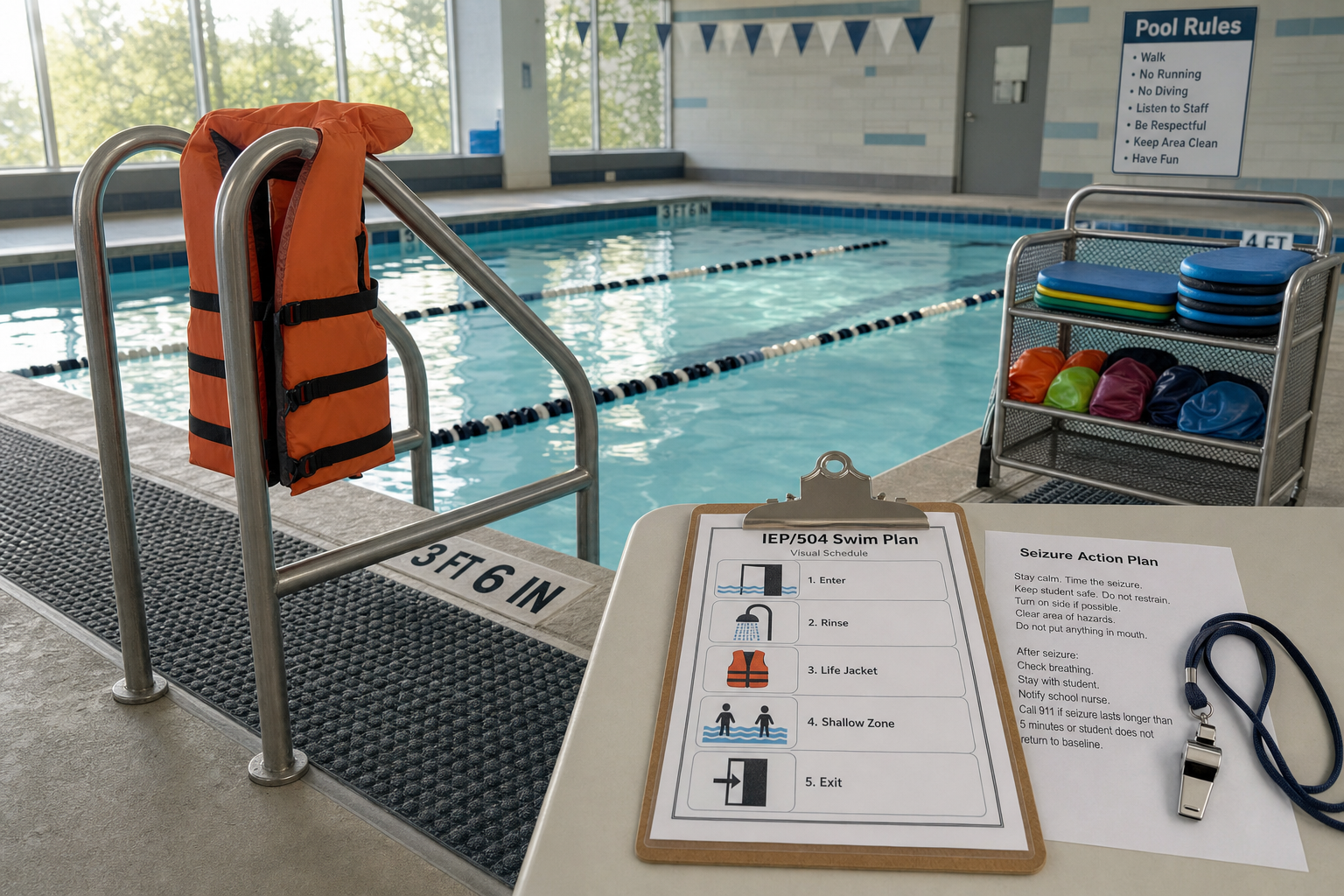
To make sure your child has safe, meaningful access to swim class or water safety lessons, the IEP or 504 plan must include clear swim-specific goals, strong accommodations, and communication supports aligned to their exact needs—whether they have ADHD, autism, low vision, epilepsy or something else. Here’s how to build those supports in, with examples, pitfalls to avoid, and tips on working with medical teams and schools.
What Belongs in IEP or 504 Plans for Swimming & Water Safety
Start with these components: measurable goals, supervision levels, equipment aids, communication & sensory support, and medical input.
Crafting Measurable Swim and Water Safety Goals
Rather than vague goals like “improve swimming,” you want statements like “By end of school year, Sam will enter shallow pool feet-first after the adult ‘go’ signal, stay within waist-deep zone, and exit safely in 4 out of 5 trials as scored by adapted PE staff.” Use rubrics or checklists that match what you want to see, with baseline data. You might pull from goal banks that list items such as listing pool rules, entering water safely, using life-vests, or performing basic floats. (padlet-uploads.storage.googleapis.com)
Including Physician Input & Health Plans
If your child has epilepsy, a low vision condition, or a medical diagnosis, get written guidance from a doctor. For example for epilepsy: swim in shallow water, supervision with a trained adult, seizure action plan, and ensuring lifeguards are aware of the plan. (seattlechildrens.org) Low vision needs might include high-contrast lane markers, tactile surfaces at pool edges, or verbal cues from instructors. ADHD or sensory differences may need shorter instructions, visual schedules, or filtered lighting.
Example Accommodations by Disability Profile
Here are what good swim accommodations look like for different needs. These are examples to adapt to your student.
ADHD
Provide frequent breaks; keep tasks short; maintain clear, consistent routines (enter water, exit, change); verbal and visual prompts. For example, have a teacher stay close during transitions to change or shower.
Autism
Use social stories or visual schedules about pool rules. Allow familiarization with pool before full class. Reduce sensory overload in environment (quiet times, low noise, private area to decompress). Consider one-on-one help or smaller class size.
Low Vision
Ensure high visibility gear (bright swim caps, contrasting color swim gear); use tactile markers; instructions given verbally as well as visually; spot adult or peer buddy.
Epilepsy
Incorporate doctor’s seizure action plan; ensure continuous touch supervision or sight supervision depending on risk; life jacket availability; avoid swimming in deep water unsupervised; ensure at least one staff member trained in seizure first aid. (epilepsy.com)
Swim-Class Goals & Accommodations: Sample Language
Here are pieces to pull or adapt for your child’s IEP/504 plan. You can also look for structured swim programs to inform what you ask. For example, the 10-Week Plan from Swimy.org lays out swim & water safety baseline, skill building, supervision and communication supports. You can reference it when you need something actionable at your meeting: https://www.swimy.org/10-week-plan
[[ctakid]]
Goal example for ages 6-12: “During weekly swim class, Mia will float unassisted for 10 seconds in chest-deep water in 3/4 trials, with verbal encouragement only, by the end of trimester.”
Another goal: “Johnny, with low vision, will respond to auditory cues (whistle, verbal direction) within 3 seconds when lifeguards or teachers call his name in the pool area in 4/5 observed sessions.”
Accommodations wording: “Provide visual schedule with picture cues before entering pool; gloves on grab bars for walks; adult within arm’s reach during bathroom, shower, and pool entry; use of life jacket as needed.”
Coordinating with Schools, Pools & Staff
To make sure swim class supports work in practice, you’ll need to coordinate among all involved.
Work with Medical Professionals & Get Written Plans
Get your child’s physician to write what level of supervision is required, medical limits, and any special equipment. Submit this to school health, adapted PE, and the swim instructor. For epilepsy, a written seizure action plan is essential. (aap.org)
Know Local & School Policies
School districts vary in policy. Chicago Public Schools, for example, requires aquatic staff to review a student’s IEP/504 plan to see what accommodations are needed for pool use, and designate adults (like paras) for such activities. (cps.edu) Elsewhere, school or district policy under IDEA and Section 504 mandates equal participation unless it fundamentally alters the program. (ed.gov)
Train Staff and Avoid Assumptions
Ensure swim teachers, lifeguards, PE teachers, and paras get training on the accommodations (e.g. seizure first aid, sensory overload, communication needs). Don’t assume that pool lifeguards replace the supports in the IEP or 504 plan—they’re not substitutes.
Pitfalls to Avoid
Some common traps trip parents and schools up.
- Sticking with vague goals like “will do better in swim class” with no measurement or baseline.
- Assuming staff know accommodations without explicit plan language and training.
- Not specifying where the accommodations apply (class, field trips, before/after school).
- Leaving out supervision—media show lifeguards, but often IEPs need dedicated adult support closer than general supervision.
- Omitting communication supports or sensory supports for autism or low vision.
Putting It All Together: Steps for Parents
- Gather medical documentation and observations: baseline swim skill, supervision needs, sensory or vision issues.
- Draft swim-specific goals: measurable, tied to observable behaviors and data.
- List accommodations clearly: which supports, when, who provides.
- Bring local policy (district, state) and legal guidance from IDEA or Section 504.
- Request staff training and ensure a designated person is responsible.
- Monitor progress: set check-ins and record whether rubrics are used and whether accommodations happen in practice. Adjust as needed.
If you build your child’s IEP or 504 plan with measurable IEP swimming goals, carefully tailored school water safety accommodations, medical input and clear communication, your 6-12-year-old can attend swim class confidently and safely this school year. With clarity and teamwork, we can turn water safety from a worry into a milestone.
120+ swimming exercises sorted by age — with video and instructions. Developed by swim instructors, completely free.

120+ swimming exercises sorted by age — with video and instructions. Developed by swim instructors, completely free.