Swim Instructor Certifications, Decoded (US–UK–AU): A Parent’s Guide
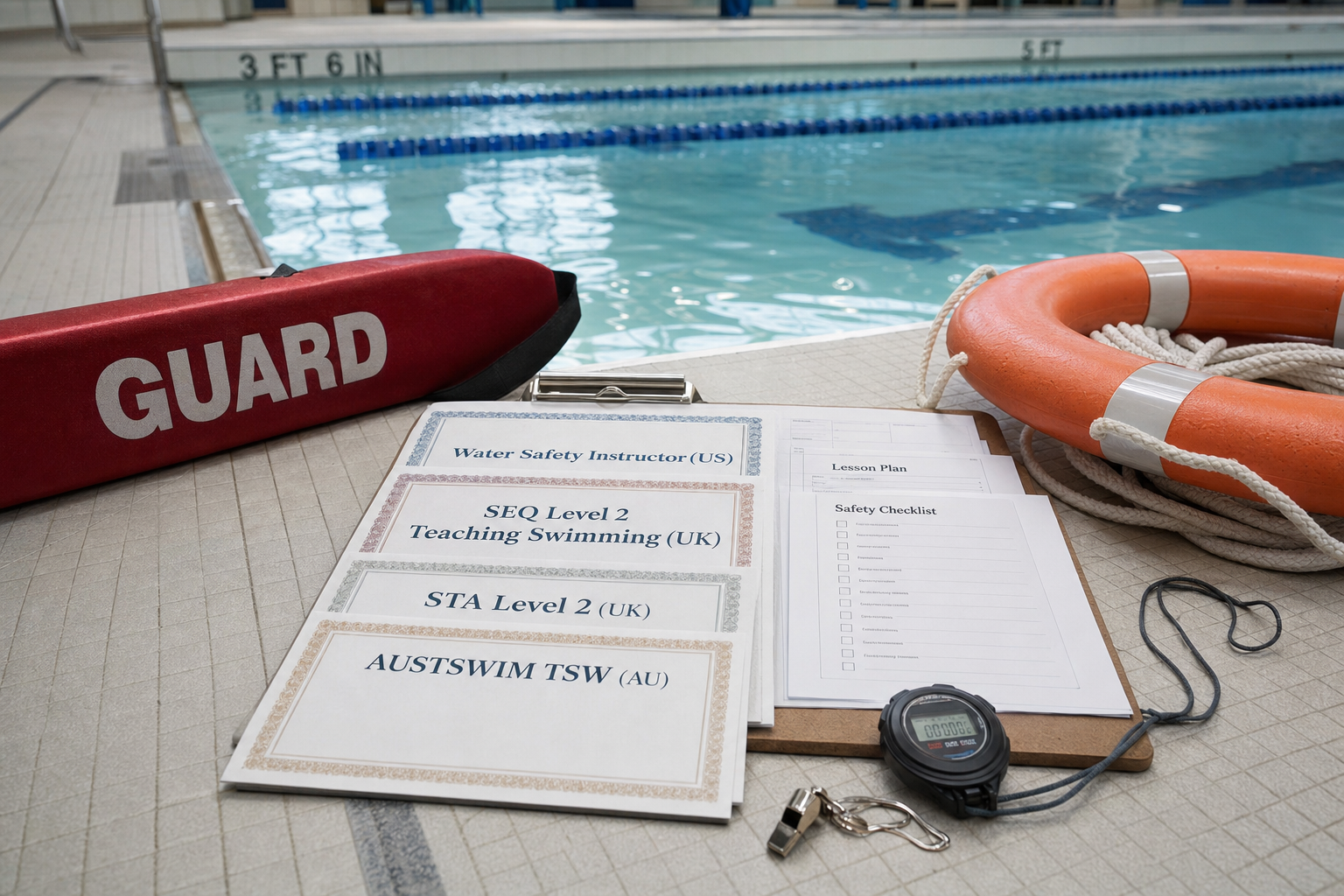
Want to know which swim teacher qualifications actually mean your child is in safe hands? Here’s what you need to understand about the most important certifications—American Red Cross WSI, Swim England/SEQ Level 1-2, STA Level 2, and AUSTSWIM TSW—so when you see acronyms, you’ll know what skills, safeguards, and guarantees lie behind them.
What Do These Certifications Really Imply?
American Red Cross – WSI (Water Safety Instructor)
If a swim teacher in the US holds the Water Safety Instructor (WSI) certification, they’re taught to lead Learn-to-Swim Levels 1-6, preschool programs, stroke refinement, safety training, rescue techniques, even diving boards.(redcross.org) The certification includes both theory and in-water assessments. They must also pass CPR and first aid—i.e., the CP-comparable safety foundations you want. Teachers with just the Basic Swim Instructor (BSI) level are more limited: they mostly support younger swimmers or beginners up through Learn-to-Swim Level 3.
Swim England / SEQ Level 1-2 (UK)
In England, the system changed in 2026: what used to be separate Level 1 Swimming Assistant + Level 2 Teaching Swimming courses are now being rolled into a single SEQ Level 2 Teaching Swimming qualification.(swimming.org) Once someone has SEQ Level 2, they can independently plan, deliver, monitor and evaluate lessons without needing a supervising Level 2 teacher.(surviveandsave-training.org)
This qualification ensures the teacher is skilled in stroke development, class and lesson planning, teaching abilities, communication, safeguarding, legal responsibilities, safety in the pool environment, risk assessment and inclusion.(active.je)
STA Level 2 Swimming Teacher (UK)
STA (The Swimming Teachers’ Association) offers a Level 2 Swimming Teacher qualification that’s regulated by Ofqual and endorsed by CIMSPA (the UK industry standard).(staexcel.co.uk) It covers work-ready skills: planning lessons, delivering and evaluating them, teaching all core strokes, survival and rescue techniques, water safety, and adapting teaching for various ages and abilities. There’s no longer a Level 1 with STA for outright beginners; Level 2 is the base for teaching by yourself.(sta.co.uk)
AUSTSWIM Teacher of Swimming & Water Safety (TSW) (Australia)
In Australia, the AUSTSWIM TSW is widely recognised. To earn it you need to show you can teach both swimming and water safety to children and adults, plan and review lessons, know rescue and survival skills, adapt for special needs, hold current CPR/first aid, and renew your licence every three years.(austswim.com.au) The teaching license requires completion of both theory (online or classroom) and in-pool assessments.(austswim.com.au)
If you want your child to start lessons, a programme like the 10-Week Plan from swimy.org (link: 10-Week Plan) can be useful in spotting what level the lessons are aimed at, what skills are expected week by week, and whether the teacher’s cert fits that plan.
Skills and Safeguards to Expect When a Teacher Has These Certs
If your teacher holds one of these qualifications, you should expect:
- Formal training in CPR or emergency first-aid, and legally required background checks or safeguarding modules.
- In-water evaluation of their teaching abilities—not just theory.
- The ability to plan structured, progressive lessons for swimmers ages 3-12, plus non-swimmers, beginners, improvers, and advanced kids.
- Strong water safety: rescue, survival, risk assessment in the pool environment.
- Inclusion: lessons adapted for different ages, confidence levels, or special educational needs.
[[ctakid]]
How to Verify Credentials—and Ask Safety-First Questions
Before you enrol your child, here are what you should check:
- Ask what their actual certificate name is: “Water Safety Instructor (Red Cross)”, “SEQ Level 2 Teaching Swimming (Swim England)”, “STA Level 2 Swimming Teacher”, “AUSTSWIM TSW”. Certificates that sound impressive but are unregistered may not carry legal or safety weight.
- Confirm the expiry and renewal of their licence. Many require proof of current CPR/first aid, updated safeguarding training, renewing every few years.
- Check for in-water assessment: not just classroom work. Teachers must demonstrate teaching in real swimming lessons with children present.
- Ask about ratios & supervision: how many kids per teacher/assistant (especially ages 3-6). Is there a Level 1 assistant in the pool if needed?
- Confirm they follow a known learn-to-swim pathway (say USA Red Cross levels, Swim England Pathway, STA or AUSTSWIM), so your child’s progress is structured.
Red Cross WSI vs AUSTSWIM (and SEQ Level 2 vs STA Level 2)
Here’s how they compare: WSI (US) is broader in stroke and program coverage (adult classes, higher levels) but in the UK and AU, the qualifying bodies align more closely now. SEQ Level 2 creates a one-course structure that streamlines the Swim England route.(swimming.org) STA’s Level 2 meets those new professional standards (CIMSPA) and includes safety, rescue, and inclusive skills.(staexcel.co.uk) In Australia, AUSTSWIM’s TSW includes a strong legal and safety framework, showing that qualified teachers are not only technically capable but accountable.(austswim.com.au)
Don’t Assume: Common Pitfalls to Avoid
If someone says “I coach at the club” or “I lead swim lessons,” that doesn’t always equal qualification. Always confirm the cert.
Expired or lapsed qualifications can leave safety aspects missing: CPR may no longer be valid, first aid outdated, legal requirements changed. If the teacher misses out on required safeguarding training, there may be no oversight.
Some certs have poor or no in-water assessment; it’s easy to check: ask if they taught real classes under supervision and whether they were assessed teaching children.
Bringing This to You: What Parents Should Do
When looking for lessons in spring or at any time, expect to see clear display of certificates or listings like: “STA Level 2 Swimming Teacher”, “SEQ Level 2 Teaching Swimming”, “AUSTSWIM TSW (Teacher of Swimming & Water Safety) Licence current until [date]”, or “Red Cross WSI certified + CPR up to date”. Those are signals that the teacher has undergone both theory and practical assessment, safety training, and is legally compliant.
Final Takeaways
For kids ages 3–12, the “best swim teacher qualifications” are ones that combine in-water, practical training with safety, lesson planning, and legal safeguards. Red Cross WSI, SEQ Level 2 (Swim England), STA Level 2, and AUSTSWIM TSW are all robust options—with differences in how they’re delivered, updated, and regulated. Ask about certificate names, CPR/first aid, renewals, and in-pool experience. Do this every season (especially spring) to ensure lessons are safe, structured, and dependable.
You don’t just want someone who “looks like a swim teacher” or “coaches at a club”- you want someone who’s passed the tests, keeps their certs current, can teach proper strokes and water safety, and holds your child’s safety as their highest priority. That’s what real qualifications deliver.
120+ swimming exercises sorted by age — with video and instructions. Developed by swim instructors, completely free.

120+ swimming exercises sorted by age — with video and instructions. Developed by swim instructors, completely free.