School Swimming: 25m, Strokes & Water Competency Explained
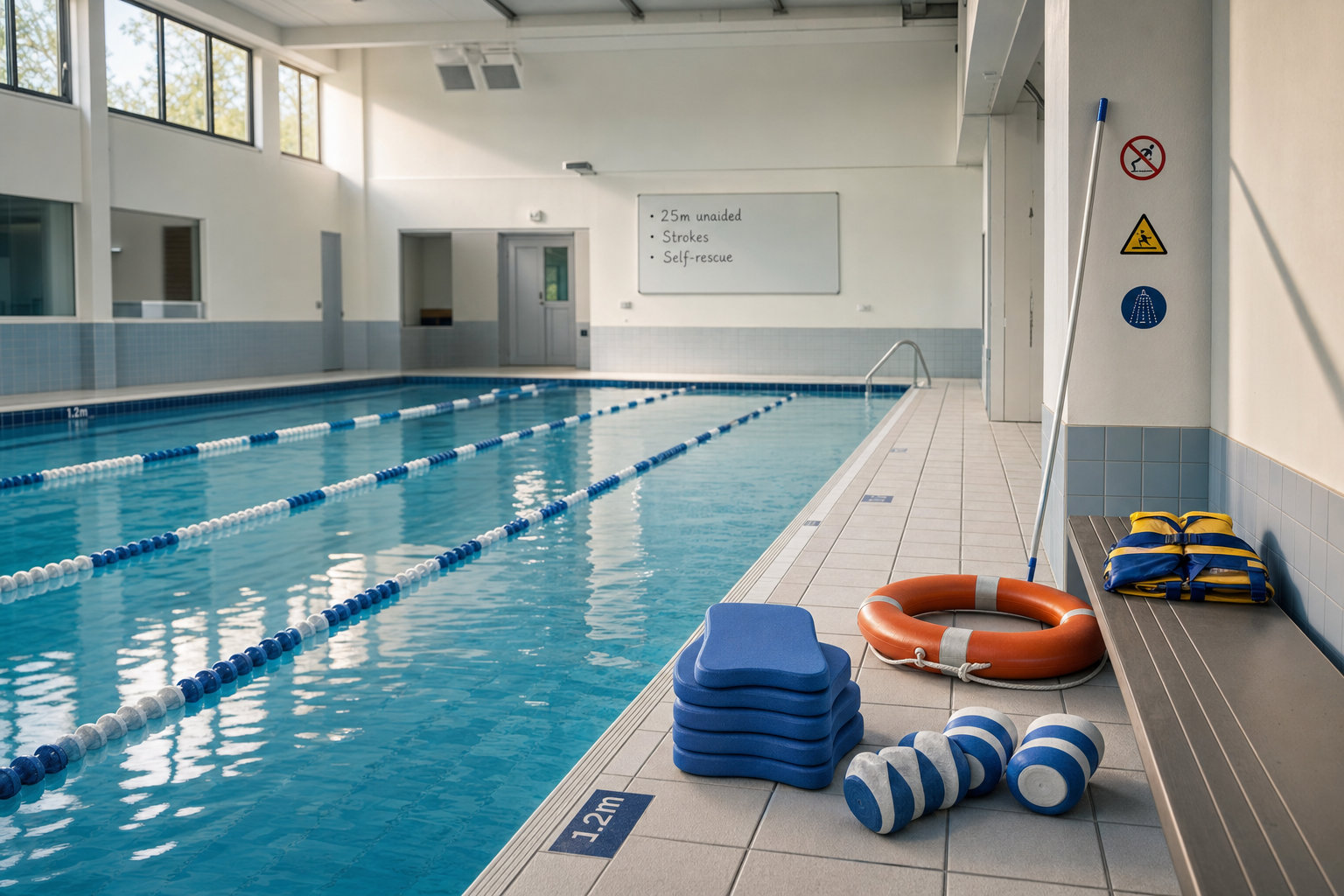
When it comes to primary school swimming 25m, here’s what schools are actually aiming for—and how it fits into water competency for kids aged 5–11. If you want your child to leave school safe in water (not just badge-ready), read on.
What School Swimming Programs Must Cover
By law, many primary schools—or government PE curricula—expect children by age 11 to meet three minimum standards: swim a sustained distance of at least 25 metres unaided, use a range of strokes (front crawl, backstroke, breaststroke, etc.), and be able to self-rescue in water situations. In the UK, for example, the national curriculum states pupils must “swim competently, confidently and proficiently over a distance of at least 25 metres,” “use a range of strokes effectively,” and “perform safe self-rescue in different water-based situations.” (swimming.org) School programs typically include floating, breathing control, submerging, and basic safety around water. They may also cover orientation (turning over, treading water) and changing strokes. (darlington.gov.uk)
School swimming runs during terms, so kids get sessions weeks at a time, usually as part of PE. Key Stage 1 (or grades around ages 5–7) focuses mostly on getting comfortable with water: entering safely, moving with supports, basic stroke arms and legs, floating. Key Stage 2 (ages 7–11) pushes to that 25m distance, combining strokes and building self-rescue—e.g. floating or treading, surviving if accidentally in water, exiting. (darlington.gov.uk)
Schools are safety-led: lifeguards or qualified staff are present, water depth and conditions are controlled, and priority is competence over speed or high technique. Stroke technique may be basic. If families want deeper technical skills or competitive strokes, that’s where private or club lessons come in. (swimming.org)
Water Competency: What It Really Means
“Water competency checklist” is more than just being able to swim laps. According to sources like Water Safety USA and the American Red Cross, water competency includes three components: swimming skills, water smarts, and the ability to help others safely. (watersafetyusa.org)
Swimming skills include being able to enter water safely (including over the head), resurface, float or tread for at least one minute, turn in water, swim a moderate distance (often 25 yards/metres) using any stroke, and exit water independently. Practicing in clothing also helps simulate real accidents. (redcross.org)
Water smarts means knowing about hazards (currents, weather, depth), always swimming with supervision, wearing life jackets when needed, avoiding risky behavior. Helping others means being able to recognize when someone is in trouble, knowing reach-or-throw rescue options, and basic first aid or CPR knowledge. (watersafetyusa.org)
If you want a structured way to help your child progress at home, the 10-Week Plan guides you step by step.
How School Swimming Differs from Private Lessons
Think of school swimming as a foundation. It sets legal or curriculum minimums: 25m, range of strokes, self-rescue. Private lessons go further in technique correction, stroke refinement, speed, and distance beyond 25m; they often offer smaller instructor-to-student ratios. Private lessons can also address water anxiety, individualized pacing, and often include club or competition preparation. (swimming.org)
For example, private or swim-club pathways often follow progressive learn-to-swim programs that detail levels of proficiency—say, a program may expect children to swim 50m or more, perform flip turns, be comfortable underwater, and swim butterfly. Schools might simply require “use a range of strokes” without pushing all of them deeply. (sacpa.org)
[[ctakid]]
One useful tool parents can use is the 10-Week Plan of swimy.org, which offers structured steps in private/home practice to reinforce skills learned at school, especially technique, safety, and water competence.
Realistic Milestones Parents Can Use
Here are milestones parents can watch for, roughly by age 5-11, to see if school swimming plus extra practice is building true competency. These are not strict, but useful guides.
By age 5-7: child can enter pool safely, submerge face, float supported and unsupported, move using arms and legs, basic strokes front/back; some breath control.
By age 7-9: swim 10–15m unaided using front crawl, then add backstroke; practice floating and treading; self-rescue basics like side exit, turning over, pushing off wall.
By age 9-11: achieve 25m unaided in more than one stroke; breaststroke added; ability to swim 25m at end of school swimming program; float or tread water for 30–60 seconds; experience with swimming in clothes or deeper water; know basic rescue and safety rules.
Parents should also check whether their child meets water competency checklist items: can exit water, avoid panicking, is safe around different water environments. If not, continue lessons beyond “25m badge” sessions.
How to Support Progress Outside School
You can help your child hit true competency goals, beyond what school delivers. Start by communicating with the swimming teacher or school to get a clear sense of your child’s attainment level. Know exactly what strokes they can do, for how far, and where technique lacks.
Use extra swim sessions: private lessons or swim schools often let children work on "weak strokes" or technique correction. Ensure consistency—progress is faster and safer with regular lessons throughout the year, not just one term. Practicing skills like floating, treading water, or swimming a bit further each week helps.
Encourage swimming in different settings (e.g. shallow vs deep, pools, natural water bodies), always with supervision. Practice small rescue skills: what to do if someone slips in, how to exit when no ladders, swimming in clothing.
Check your water competency checklist and reassess periodically. Think of it like building blocks: school gives the core, private/home adds the layers.
Avoid the pitfall where parents stop lessons once the child reaches the 25m target or earns a badge. That’s only a milestone—not full competency. Also avoid confusing school aims (safety, minimum strokes, 25m) with club or private aims (competition, advanced technique, butterfly stroke, endurance).
What Parents Should Know About Safety & Technique Depth
School swimming is safety-led. Teachers must ensure secure environments, lifeguards, safe entries, exits, group ratios. Technique depth varies widely—stroke perfection is not always the goal at school. They often focus more on usability and safety over finesse. If your child wants stronger form, start private lessons.
Seasonal terms matter: school swim terms may last only 6-12 weeks, so there’s limited time each year. Some children may need extra lessons in holiday seasons or private coaching to prevent regression.
Make sure that the swim program—whether at school or private—is following an accredited approach: instructors should be trained, lessons should include water safety components, inclusion of self-rescue, floating, breathing, etc.
Summary: What Your Child Should Leave School Able To Do
By the end of school terms (around ages 10-11), your child should be able to swim 25m unaided, use multiple strokes (front crawl, backstroke, breaststroke), float or tread water well, exit water safely, and have some self-rescue skills. They should understand water safety rules and behave safely around pools, lakes, beaches.
If they’re not there yet—or you want more—you can support them through the 10-Week Plan of swimy.org structured private/home practice, additional private lessons, and regular exposure to water challenges.
Make sure school swimming doesn’t feel like the finish line. It’s the launchpad toward lifelong water competence—and a lot more fun when you know your child is truly safe and capable in the water.
120+ swimming exercises sorted by age — with video and instructions. Developed by swim instructors, completely free.

120+ swimming exercises sorted by age — with video and instructions. Developed by swim instructors, completely free.