Sprint Breathing for 25s & 50s: Faster, Calmer Kids (Ages 8–12)
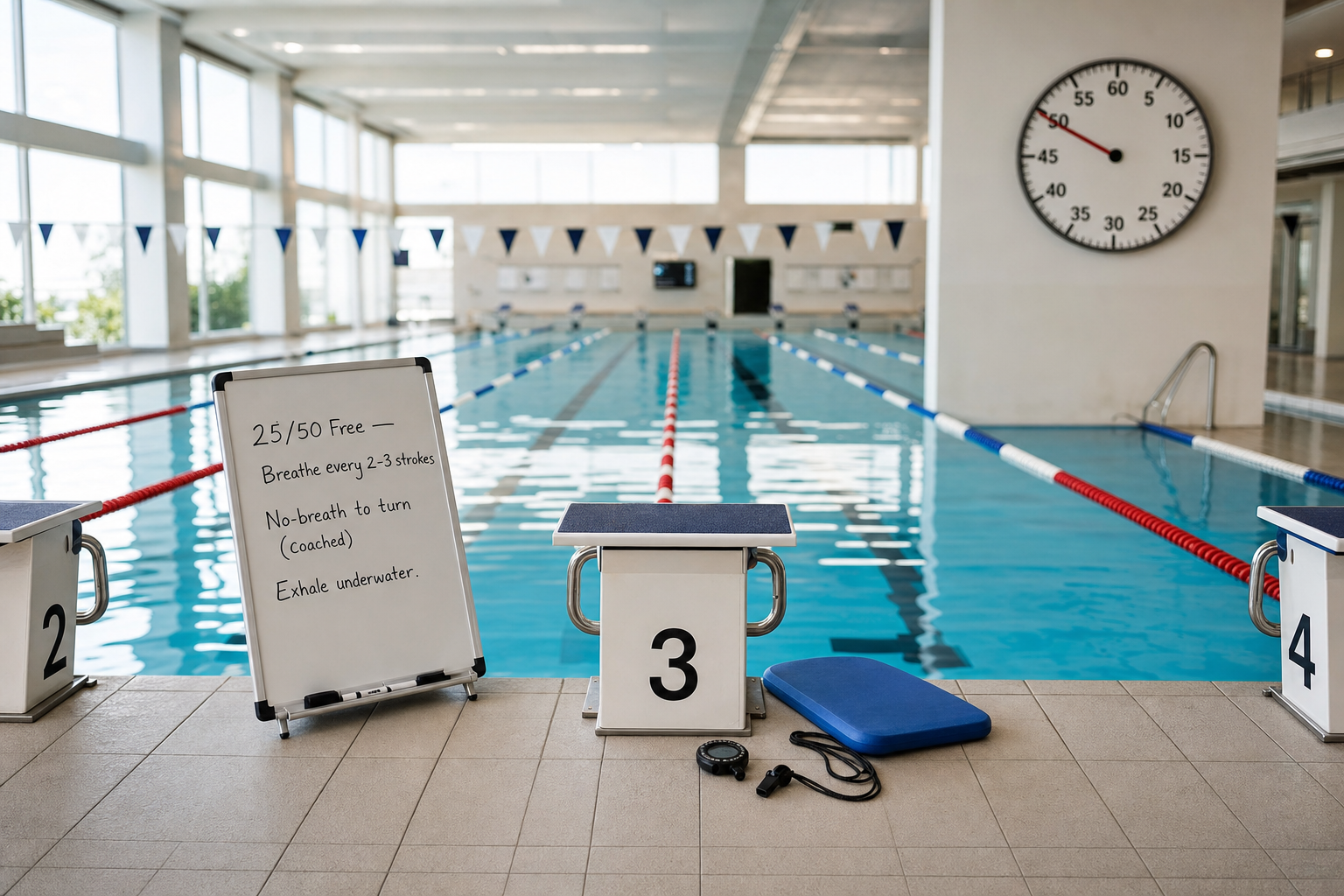
If your 8-12-year-old is sprinting 25 or 50 freestyle, one question always comes up first: how often should they breathe without risking breath-holding or hypoxia? Let’s cut to what matters most.
How Often to Breathe During 25- and 50-Yard (or Meter) Sprints
In 25s, a breath every 2 or 3 strokes is usual for most young sprinters. Many coaches will allow “no breaths” only for very short, coached efforts—like at the start, off the blocks, or finishes—never as a dare or continuous practice. Holding the breath too long causes carbon dioxide buildup, fatigue, and even risk of shallow water blackout. USA Swimming safety guidelines warn that hypoxic training should use progressive distances (e.g. 5 m, 10 m, 15 m), proper rest between efforts, and never hyperventilate beforehand.(usaswimming.org)
For 50s, especially during high-intensity efforts or meets, many well-trained young swimmers may try zero or just one or two breaths during the swim—or none until after the turn. “No breaths” or “only one breath” in a 50 free can reduce turbulence caused by head rotation and help maintain speed. Still, a fast single breath—with head rotation that’s small, body roll matched, and mouth just above water—is safer than trying to wait too long.(yourswimlog.com)
Patterns That Balance Speed and Relaxation
Successful sprint breathing patterns vary by child and coach, but some are more repeatable and safe:
Common patterns for sprints: breathing every 2 strokes (2-1-2, alternating sides), every 3 strokes, or every other stroke cycle. The key is that the breathing pattern stays consistent during the race or set, and the child practices that pattern so it becomes automatic.(swimer.app)
Training tips involve breathing drills in 25s: start by having your child swim normal sprint pace breathing every 3 strokes. When confident, introduce lengths with breathing every 5 strokes or practicing no-breath starts/turns. Then return to their baseline pattern so they don’t lose form. It’s similar to a cycle: control → challenge → recover → repeat.(swimer.app)
About halfway through a season or before big meets is a great time to introduce structured breathing work. For example, the 10-Week Plan from swimy.org lays out progressive patterns and drills that teach kids to become calm under sprint pressure.(swimmings.org)
If you want a structured way to help your child progress at home, the 10-Week Plan guides you step by step.
[[ctakid]]
Why “No-Breathers” Need to Stay Controlled, Not Risky
It can be tempting for kids to see “no breaths until the finish” as a badge of toughness. But safety must come first. “No breaths” is a coached tool, not a dare. USA Swimming safety policies explicitly forbid sets that involve dangerous underwater holding, hyperventilation, or extended breath-holding without supervision.(usaswimming.org)
Hypoxic (breath-restricted) training risks among children have been documented: loss of consciousness, disorientation, even drowning outcomes when practices got out of hand.(scholarworks.bgsu.edu)
So when “no breath” sprint drills are used, they must be supervised, short, and followed by enough rest. Coaches should remind kids to breathe when they need to, even if it means not “following the plan.”
A Sample Sprint Breathing Pattern for Ages 8-12
Here’s an example that balances speed, relaxation, and safety:
- Warm up: 25s with breathing every 3 strokes; focus on low head position, smooth rotation.
- Drill: 25s “blow-out” drill—exhale continuously underwater, inhale as needed.
- Main set: 4 × 50 at sprint pace—first 50 breath every 3 strokes, second 50 every 5, third 50 try no breath to the turn + one breath after turn, final 50 return to every 3 or 2 strokes, whichever preserves speed without tension.
- Rest: full recovery between each 50 so child isn’t gasping. Use easy swims afterward.
Through these steps, speed and calm breathing build together without risking unsafe hypoxic behavior.
Common Pitfalls & What Parents Should Watch
One big issue is holding the breath between strokes—kids sometimes try to stretch out until the last possible moment. That habit causes panic, stroke collapse, arms that pull unevenly, and can lead to real danger. A child should always be allowed to breathe when needed.
Another pitfall is changing patterns mid-race without enough training. If a swimmer starts with every-3 but shifts to every-2 because they feel out of air, that decision must come from comfort rather than desperation. Otherwise form breaks, fatigue spikes, and the risk of choking or poor technique increases.
Also watch for head lifting—a sign the swimmer is delaying breath too much. That ruins alignment, slows down the hips, and makes recovery much harder.
What Parents Can Do to Support
Talk with your child’s coach about sprint breathing during meets and practice cycles. Ask whether the sets involving “no breath” are supervision-heavy, short, and safe.
At home or at the pool, encourage breathing every 2 or 3 strokes in sprint practice, keeping exhalation steady underwater. Help them practice bilateral breathing (alternating sides) to balance muscles and neck strain.
Celebrate when your child keeps good technique under pressure—low head turns, smooth breathing, and strong finishes—even if that means they breathe more than you thought they might. Better technique + relaxed breathing wins more than holding on.
Sprint breathing in short frees is about finding the sweet spot: enough air to stay efficient, not so much that you lose speed. For kids aged 8-12, teachable pattern + safety + supervision = sprinting that’s faster, calmer, and sustainable.
120+ swimming exercises sorted by age — with video and instructions. Developed by swim instructors, completely free.

120+ swimming exercises sorted by age — with video and instructions. Developed by swim instructors, completely free.