Stroke School, Pre-Team, or Clinic? What Each Really Teaches (and When to Choose)
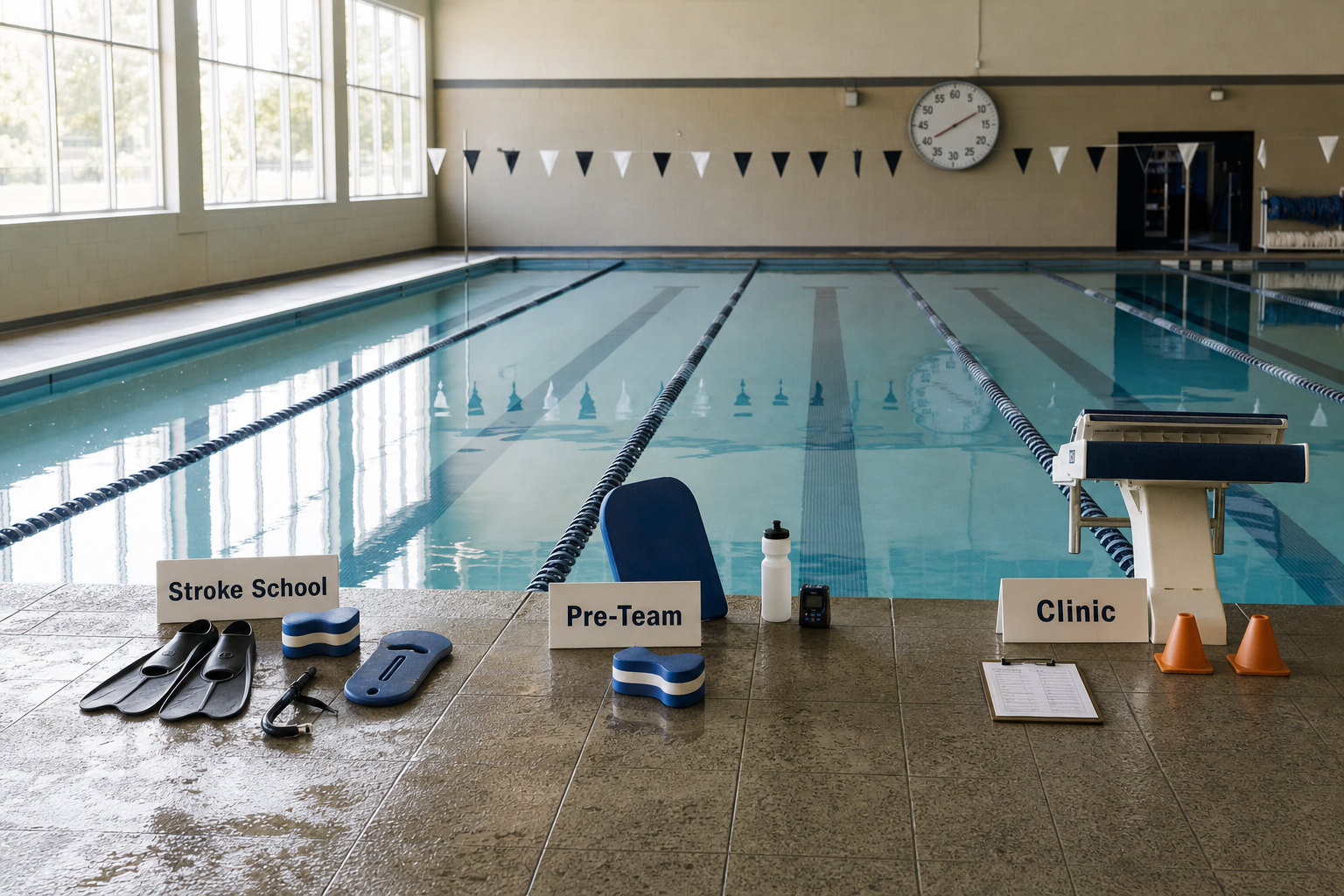
How do you know when your child (age 6-11) should move beyond swim lessons into something more like stroke school, a pre-team, or a clinic? It’s not about labels. It’s about skills, readiness, attention span, and deeper water confidence. Here’s how each option differs, what skills each targets, how often they run, and how to match the right lane with your child’s progress. Plus: what tryouts look for and how to prep.
What stroke school, pre-team, and clinic programs teach
Stroke school focuses on refining technique. Kids start mastering all four strokes—freestyle, backstroke, breaststroke, butterfly—with proper body position, breathing, and turns. Emphasis is on drills, slow motion corrections, push-offs and streamline work, often in lanes free from race pace stress. It’s where stroke defects are identified and corrected before speed becomes the goal.
Pre-team is the bridge between lessons and full team. It adds endurance—repeating lengths, maintaining form over laps—and builds confidence in deeper water. Kids in pre-team must follow coach instructions, stay focused through 45- to 60-minute sessions, and often get introduced to turns and legal finishes (for breaststroke, fly) and possibly basic dives or starts. A strong pre-team program helps swimmers match team expectations without rushing into meets or full-time training. Many programs also run clinics: shorter term intensives that zero in on stroke refinement and prep work especially just before tryouts or season starts. These help fill gaps for kids who are close but not 100% ready.
How often they run and season timings
Stroke schools often run year-round or seasonally with consistent twice‐a week classes, sometimes more outdoors in summer or indoors in colder months. Pre-team usually aligns with swim team seasons—fall or pre-summer intakes—offering training 2-4 days per week, depending on child’s age and club structure. Clinics show up mostly just before tryout weeks or at the start of fall/spring, lasting 4-6 weeks, once or twice a week. They’re meant to sharpen skills, not overload kids.
A good way to structure prep is to follow something like the “10-Week Plan” from Swimy.org which builds drills, endurance, dive-starts and stroke refinement gradually so your child’s ready for tryouts without burnout. This plan helps avoid jumping too fast into competitive routines. (swimy.org)
Matching ability with attention span and readiness
If your child still pauses in freestyle, holds the side wall often, or struggles with breath timing, they are likely not ready for pre-team. A child who can swim continuous 25-50 yards of freestyle and backstroke with side breathing, do legal turns or touches for breaststroke, and attempt butterfly kick motions, with comfort in deeper water, is primed for pre-team. Also, attention span matters: can they focus for full sessions of 45-60 minutes without frequent correction breaks? Do they manage fatigue without stopping every length? Endurance here is as key as stroke.
If you want a structured way to help your child progress at home, the 10-Week Plan guides you step by step.
Make sure to confirm deep-water readiness first—if a child is worried in water where they can’t touch bottom, don’t push start drills or dive begins until they feel secure. Safety always before competition.
[[ctakid]]
What tryouts check and how to prepare
Tryouts are more about placement than a pass-fail test. Coaches assess stroke proficiency: can your child swim recognizable forms of all four strokes, even if fly and breast are basic? Do they perform legal turns, starts, or dives if required? (parentcoachdesk.com) They also look at endurance: how many lengths can your child swim without holding on, stopping, or resting on the wall? A tryout often includes timed swims (25 or 50 yards/meters) in freestyle, backstroke, sometimes breaststroke and fly, plus some kick work and drills. (parentcoachdesk.com)
Coachability and group skills are equally important: can the child listen, follow instructions, wait their turn, manage side-breathing cues, and maintain safety? Clubs often divide groups by capability, not strictly age, to push growth with peers who match their current level. (parentcoachdesk.com)
To prepare, focus on these ahead of tryouts: practice legal turns and finishes, breathing technique, continuous swim reps with proper strokes, deepen comfort in water beyond touch depth, and simulate full practice durations. Use stroke drills to correct technique before speed builds. If possible, join a clinic just before tryout to polish skills.
Pitfalls parents often overlook
One mistake is rushing into team too soon: kids who enter too early often struggle with technique flaws that become ingrained or suffer loss of motivation. Chasing labels—“pre-team,” “clinic,” “team tryout accepted”—over the quality of coaching or coach feedback is another common trap. A lesser coach who gives minimal correction will yield less progress than a stroke school teacher who slows down drills and focuses on body alignment and ends.
Also, endurance readiness is often ignored. A child might swim one lap well, but can they swim several in a row, maintain form, and recover between reps? Without that, pool fatigue sets in quickly and progress stalls. Finally, always verify deep water readiness: unknown fear or insecurity in water where feet can’t touch can undermine performance, safety, and confidence.
Final thoughts on paths and decisions
To pick the right path, begin by assessing current skills—stroke technique, turns, breathing, endurance—and your child’s attention and motivation. If gaps exist, stroke school or lessons remain appropriate. If most benchmarks are met, pre-team or a clinic could accelerate growth and prep for tryouts. Tryouts mostly test technique, endurance, water safety, coachability. They aren’t speed contests in early years.
Summer or fall are the key seasons when swim programs ramp up intake and set tryouts. Use the months before those—late spring, early summer—to build stroke correctness, endurance, deep water confidence. Support your child’s progress by choosing coaching that prioritizes feedback and safety over status or label. That way, whether you’re considering stroke school vs pre-team or swim team prep for kids through clinics, your child lands in the right lane for faster, happier progress.
120+ swimming exercises sorted by age — with video and instructions. Developed by swim instructors, completely free.

120+ swimming exercises sorted by age — with video and instructions. Developed by swim instructors, completely free.