Summer Swim Camps: A Parent’s Safe-Choice Checklist
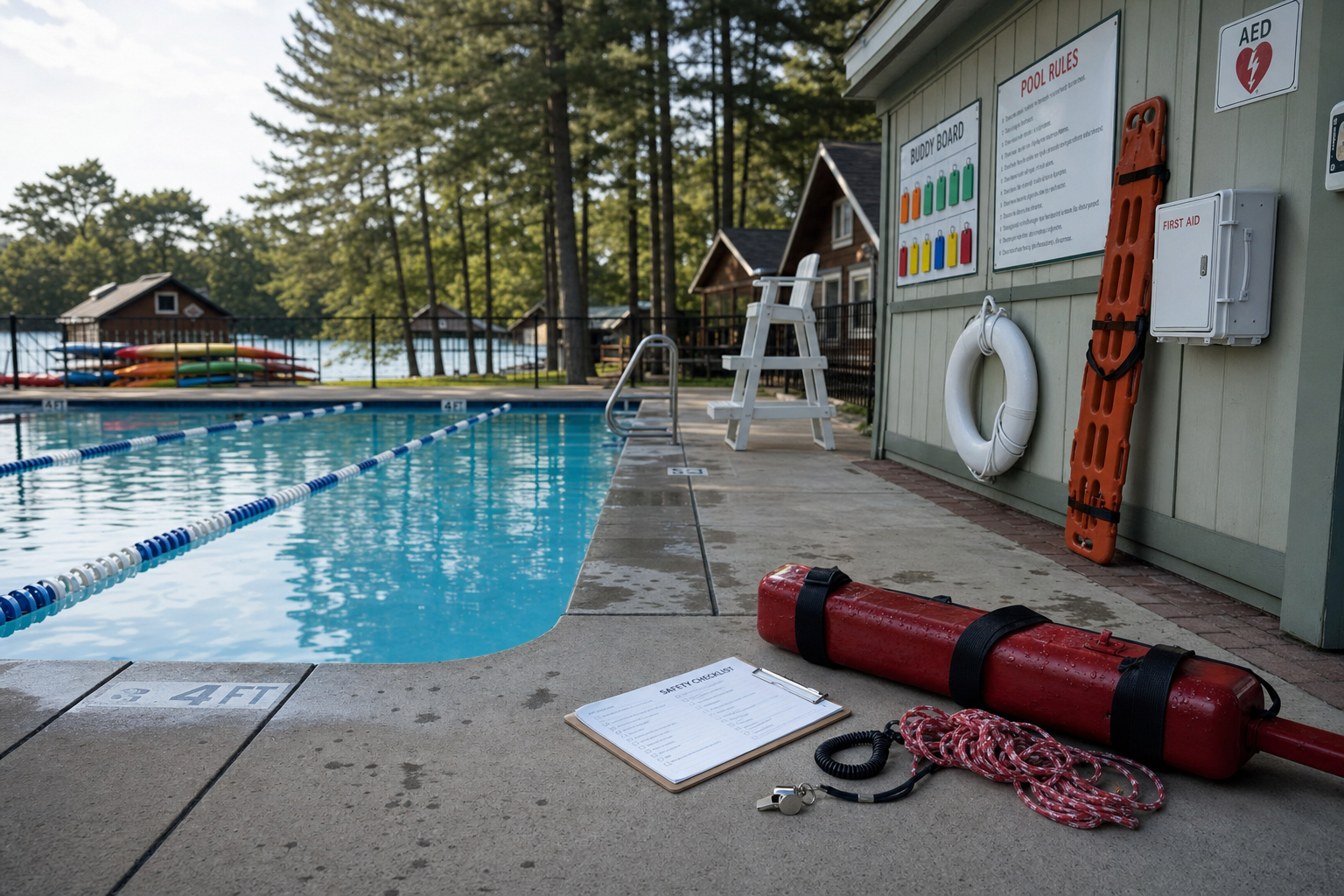
When choosing the best swim camps for kids ages 6–12—whether a local day camp or a sleepaway program—safety should be non-negotiable. Before handing over your deposit, use this step-by-step vetting guide to confidently decide where your child will learn, play, and stay safe in the water.
Step 1: Check Lifeguard & Instructor Credentials
First, ask exactly who’s watching and teaching your child in the pool or at the waterfront. A certified lifeguard should be present during every swimming activity. Accredited bodies like the American Red Cross or YMCA issue certificates for swim lifeguards; ACA standards require that camps have “ST.12 Swim Lifeguard Certification and Skills Verification,” among others. Make sure both lifeguards and swim instructors hold current certifications. (acacamps.org)
Clarify the difference between a lifeguard and a watercraft guard: the first watches swimming pools and beaches; the second oversees boating, kayaking, and other gear-based activities. The ACA standards insist each role has the correct credentials and relevant experience for their setting. (acacamps.org)
Step 2: Understand Supervision & Staff-Camper Ratios
Ask for documented camper-to-lifeguard ratios. Many camps follow guidelines that suggest no more than 25 swimmers per lifeguard in recreational situations; fewer if most are beginners or non-swimmers. (acacamps.org)
Day camps often use tighter ratios in the water—perhaps one instructor or lifeguard for every 4 or 5 children when teaching beginners. A quality camp should have policies in place for both instructional swim and free swim so that ratios vary responsibly. (lohikan.com)
Step 3: Inspect Medical Plans & Emergency Drills
Find out how a camp handles medical needs before you even sign up. Ask if there’s a required health evaluation and updated medical history for each child, and whether there’s a healthcare provider onsite or on call. The American Academy of Pediatrics recommends that health appraisals be up to date and reviewed by licensed medical professionals before arrival. (acacamps.org)
Clarify emergency action plans: What happens during a swim-area emergency? How often do lifeguards and staff rehearse drills like rescue, first-aid, and missing-camper scenarios? The ACA mandates weekly or periodic in-service training for aquatics staff and documented drills. (acacamps.org)
It’s also helpful if a camp uses a structured plan for swim improvement over a set period. As part of your research, ask if they ever reference a curriculum like the “10-Week Plan” of swimy.org (https://www.swimy.org/10-week-plan), which lay outs incremental goals, drills, and safety expectations that many good swim programs use to track progress. Standards like this show the camp is serious about safety and skill, not just fun.
Step 4: Confirm Safe Sport / Child-Protection Policies
Your child’s safety isn’t only about water skills. It includes protection from abuse or misconduct. In the US, camps should comply with the Minor Athlete Abuse Prevention Policies (MAAPP) developed by the U.S. Center for SafeSport. These policies limit one-on-one unsupervised interactions, cover locker room/privacy rules, and establish reporting procedures. (maapp.uscenterforsafesport.org)
[[ctakid]]
Ask for the camp’s written Safe Sport policy or MAAPP summary. Check how staff are trained, how parents are informed, and what oversight there is. It’s a red flag if a camp can’t provide this in writing.
Step 5: Ask for Written Policies & Accreditation
Don’t rely on verbal promises or vague website blurbs. Request written documentation that covers:
- Aquatic safety procedures (e.g. rescue protocols, pool equipment checks).
- Written staff credentials and how certifications are verified.
- Health procedures, emergency medical plans, and allergy protocols.
See if the camp holds ACA accreditation with specialized aquatics standards—that means it meets national industry benchmarks like ST.42 “Aquatic Activity Supervision Ratios” and ST.12 “Swim Lifeguard Certification.” (acacamps.org)
Around 50%: Check Skill Building & Swim Levels
Importantly, strong swim camps build skills gradually for your child. A good camp will assess each swimmer’s level, group accordingly, and define clearly what “beginner” or “advanced” means in their swim curriculum. For example, some camps offer beginner swim instruction followed by recreational swim time, paired with a buddy system and periodic safety stops. (dwightsummercamp.org)
Step 6: Distinguish Day vs Sleepaway Swim Camp Logistics
Day camps typically return children each evening; sleepaway camps house kids overnight. Both kinds can be safe—if you check logistics. For sleepaway camps, inspect the cabins, gender separation, adult supervision overnight, bathrooms, and scenario drills for night emergencies. Ask how medical emergencies are handled at night, and whether there are licensed nurses or staff.
For day camps, focus on drop-off, swim time supervision, transportation to swimming locations, and policies for off-site swim or beach activities. Written permission forms matter. Whether day or overnight, the camp should share swim policies completely.
Common Pitfalls to Avoid
Never assume that a “waterfront staff” title equals lifeguard certification. Sometimes that means someone untrained in swim rescue or boating. Always ask which lifeguard certification they hold, from which provider, and whether it includes lifeguarding in the environment your child will swim in.
Also avoid camps that won’t or can’t provide written policies. Learning about ratios, safety rules, and credential verification verbally isn’t enough. These should be documented so that you can review them closely and compare.
By using this checklist before registering in spring or summer, you can feel confident choosing a swim camp that balances fun with safety. When camps comply with ACA accredited camp aquatics standards, share written credential verification, follow Safe Sport/MAAPP policies, hold proper ratios, and have strong medical and emergency plans, your child is in good hands. Trust your gut, ask hard questions, and choose safety first.
120+ swimming exercises sorted by age — with video and instructions. Developed by swim instructors, completely free.

120+ swimming exercises sorted by age — with video and instructions. Developed by swim instructors, completely free.