Swim Golf for Kids: Count Strokes, Drop Times (Ages 8–12)
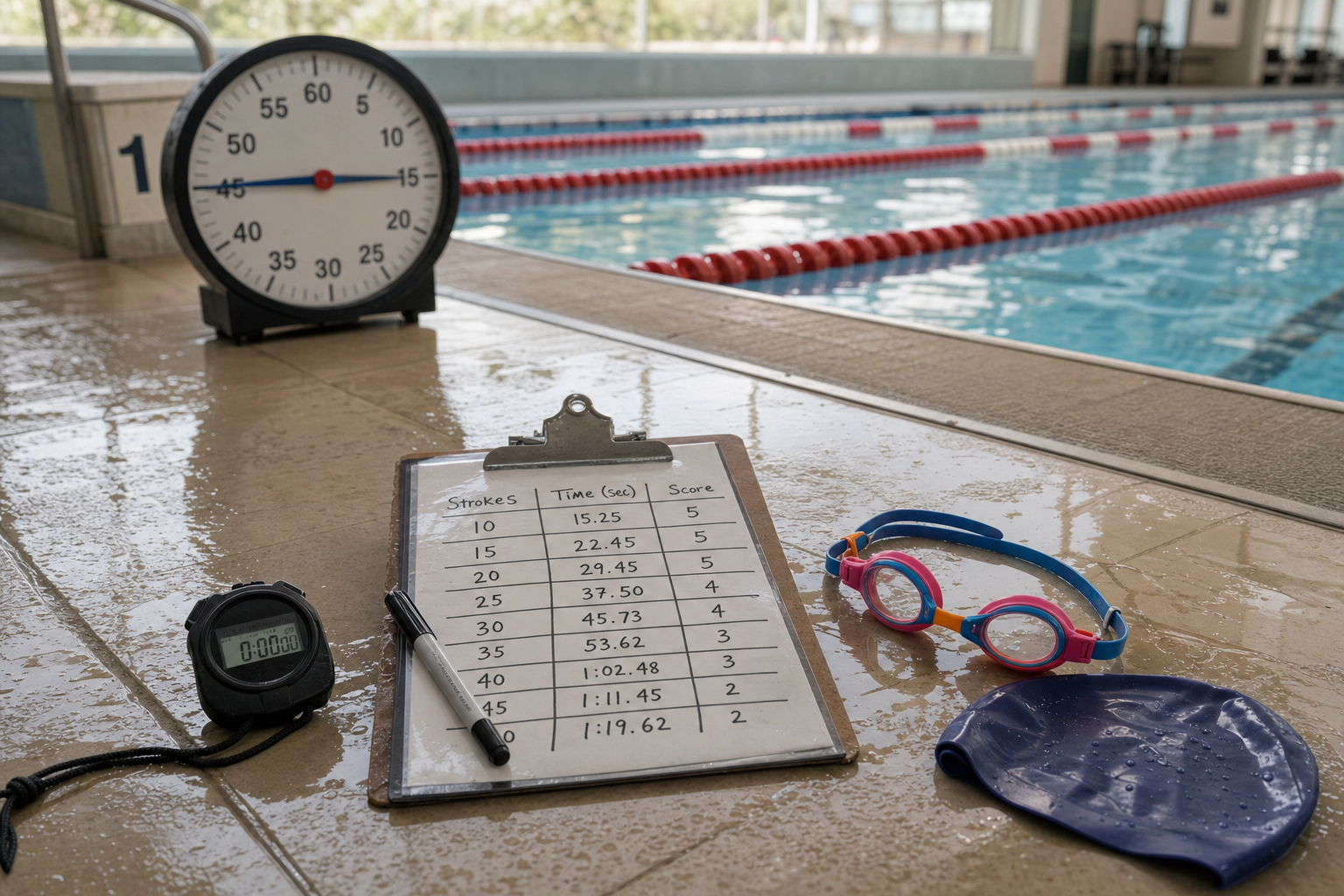
Want to help your 8- to 12-year-old swimmer boost efficiency—not just speed—with a swim game you can play using only a pace clock and fingers? This friendly version of Swim Golf (aka SWOLF) teaches distance-per-stroke, lets parents score and set targets, and keeps kids motivated—without needing a fancy wearable. It’s called “swim golf for kids,” and it works wonders.
What Is SWOLF Explained?
SWOLF is a metric that combines stroke count and time per lap to produce a single efficiency score. The formula is simple: SWOLF = Number of strokes + Time in seconds to swim one pool length. For example, swimming 25 meters in 20 seconds and taking 16 strokes gives a SWOLF of 36. A lower score means better efficiency—fewer strokes, faster lap.(swimswam.com) Wearables like Garmin automatically compute SWOLF for each lap using their sensors.(support.garmin.com)
For kids ages 8-12, this becomes a game: count strokes, track time, and see who “won golf” by getting closer to a personal target. It teaches them to value smooth strokes and smart pacing, not just rushing.
Why Stroke Count Game Children Love It
When kids count every stroke, they stay present in the water, thinking about technique—not simply swimming laps. They focus on clean hand entries, good pull, balanced body position—all elements that build stronger, more efficient swimmers.(swimswam.com) Tracking strokes and time helps kids and parents see progress clearly: maybe time stayed steady but strokes dropped by one; that’s a win. Over time, it builds confidence and a sense of control.
By framing everything in terms of “win golf” instead of “beat the clock,” swim golf for kids reduces anxiety about speed. It lowers the risk of pushing breath-holds or pushing too hard. It’s safer and more fun.
How Parents Can Score, Set Targets, and Celebrate Improvement
You don’t need a smartwatch. Grab a pace clock (or pool timer) and use fingers to count strokes. Here’s a kid-friendly protocol:
- Choose a pool length (25 yards or meters works well). Explain how many pool lengths you’ll do.
- On each lap, the child counts strokes by touching fingers as each hand enters the water, or uses simple cycles if you prefer. Parents time the lap in seconds.
- Record strokes + seconds = the “swim golf score” (just like SWOLF).
If you want a structured way to help your child progress at home, the 10-Week Plan guides you step by step.
To set targets, start with a baseline: swim 2 laps at a comfortable pace and note scores. Then set goals like “next week, drop score by 2 points” or “on lap 3, drop strokes by one stroke.” Use coaching cues (body position, full extension) to help.
When those targets are met, celebrate! High-fives, stickers, small rewards. Show charts of improvement over time so kids can visibly see their score dropping—motivation built by their own growth.
[[ctakid]]
Adding Structure – Plan and Safety
To avoid burnout and unsafe practices (hold breath, swim under rest), structure is key. Use built-in rest between reps. For example: swim a lap (score it), rest 20-30 seconds; repeat. Keep breath-holds and underwater dolphin kicks to normal, age-appropriate levels.
A helpful way to build this into a routine is with a light plan over several weeks. Something like the 10-Week Plan from swimy.org gives a roadmap where efficiency games such as swim golf are gradually introduced and improved upon. You might start with just one lap per session counting strokes, then increase volume, alternate speeds, or change targets. Using a fixed rest helps maintain safety and quality.
Also ensure kids’ stroke counting starts after push-off and excludes any underwater glide beyond what’s typical. Clear guidelines reduce confusion.
Common Pitfalls and How to Avoid Them
One trap: focusing only on lowering stroke count without keeping speed. If strokes drop but the time rises a lot, SWOLF might improve, but overall lap effort suffers. Encourage kids to aim for both smooth strokes and steady pace. Another issue is comparing kids against each other, rather than against their own past. Taller kids or those with longer arms naturally take fewer strokes—what matters most is improved efficiency over time.(en.wikipedia.org)
Also watch for sloppy form: when kids chase “lower score,” they might sacrifice technique. Delay the goal of dropping score until the child's stroke, body alignment, and breathing are stable.
Sample Swim Golf Game for Ages 8-12
Here’s a simple session idea:
Warm-up one or two easy laps. Then play a Game of 4 rounds: each round = 25 meters freestyle. Child counts strokes, parent records time. Between rounds rest enough for breathing and regrouping. After round 1, calculate score. Round 2, aim to keep strokes the same but swim 1 second faster. In Round 3, keep time and try to reduce strokes by one. In Round 4, combine both: same pace and one fewer stroke.
At the end, compare all four swim golf scores. Celebrate the smallest, safest improvement. Note what felt different—did lunges feel better? Did they glide longer? Use those observations to guide the next session.
Swim golf for kids uses the same core as SWOLF explained in adult training and wearables like Garmin: stroke count plus time per lap makes a score.(swimswam.com) For children 8-12 this becomes a playful tool that promotes efficiency, technique, self-monitoring, and steady progress—without sacrificing safety. Ready to try it? You’ll likely see the swim golf score drop—and your kid’s confidence rise.
120+ swimming exercises sorted by age — with video and instructions. Developed by swim instructors, completely free.

120+ swimming exercises sorted by age — with video and instructions. Developed by swim instructors, completely free.