Swim Lesson Levels, Decoded: Red Cross vs. YMCA vs. Swim England
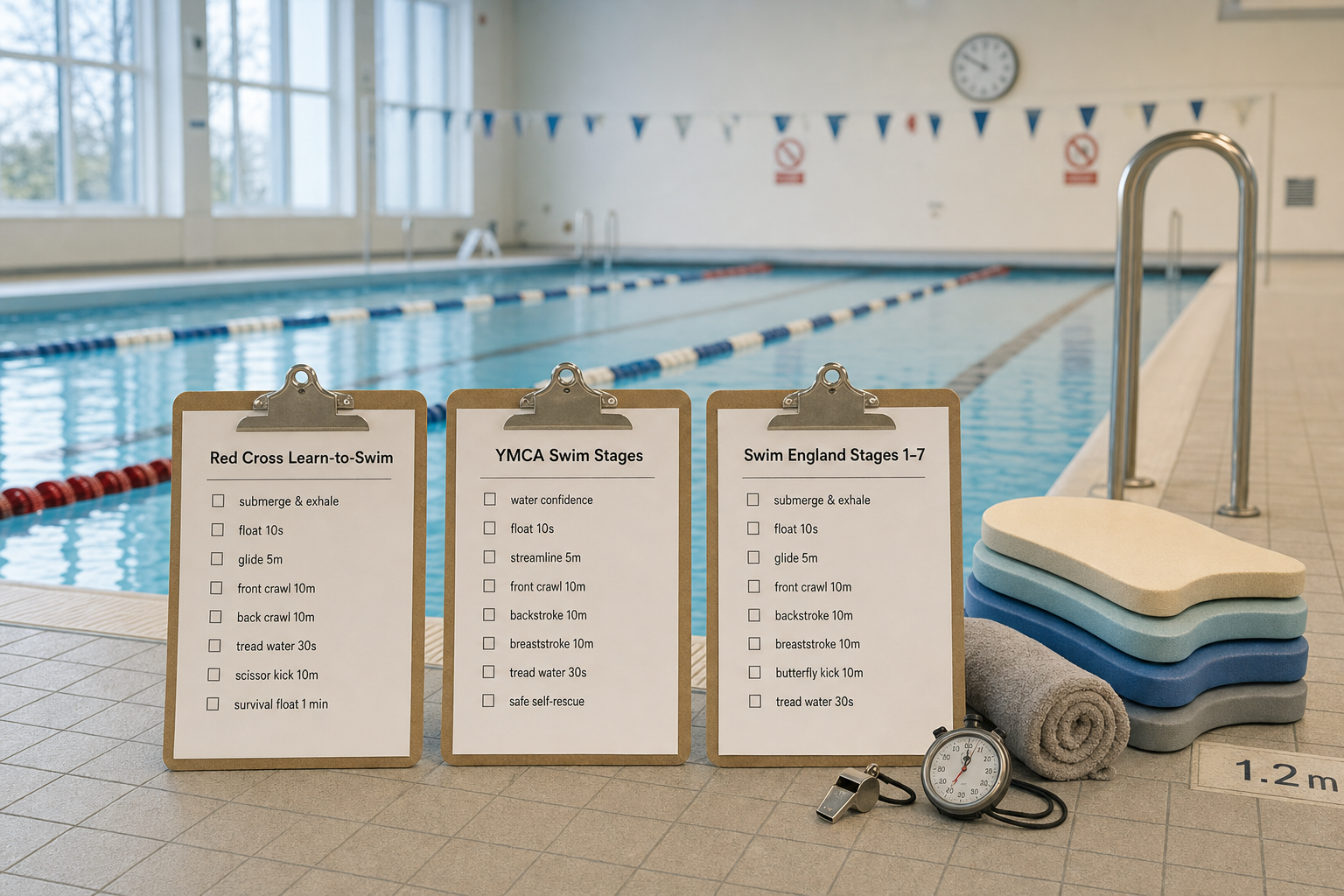
If you're asking yourself which swim level for my child, you’re in the right place. Below is a comparison of common swimming programs—American Red Cross Learn-to-Swim, YMCA swim stages, and Swim England Stages 1-7—so you can enroll your child in a level that’s just right as they move between pools, cities, or countries.
Decoding the Programs: What Each Offers
Red Cross Learn-to-Swim (USA, ages 3-12 roughly)
Red Cross Lessons are broken into six core levels designed to build skills step by step. Level 1 is “Introduction to Water Skills,” where swimmers learn to feel comfortable in water through basic floatation, bobbing, supported glides, and getting their faces wet. Level 2, “Fundamental Aquatic Skills,” adds unassisted floating (front and back), front and back glide, basic arm and leg actions, plus jumping into water over their head. By Level 3, “Stroke Development,” children begin swimming front crawl and backstroke properly, start butterfly or dolphin kicks, and strengthen breath control (rotary breathing). Level 4 (“Stroke Improvement”) refines all major strokes (including breaststroke) and introduces shallow dives, underwater swims, and stride jumps. Levels 5 (“Stroke Refinement”) and 6 (“Swimming and Skill Proficiency”) build endurance (swimming longer distances), refine technique, develop turns/dive skills, and cover rescue skills. (newmilfordct.myrec.com)
YMCA Swim Levels (USA, ages 3-12)
YMCA uses a similar progression in what they call “Stages.” Stages 1-3 are “Swim Basics” – Water Acclimation, Water Movement, Water Stamina. Young swimmers learn comfort in water, breath control, floating, front/back crawl, and safety skills such as treading water. Stages 4-6 are “Swim Strokes”: Stroke Introduction, Stroke Development, Stroke Mechanics. Kids in these stages refine front crawl and back crawl, then add breaststroke and butterfly, work on turns, diving, and building stamina for lap swimming. YMCA levels aim for both water safety and preparation for competitive or recreational swim paths. (regionalymca.org)
Swim England Stages 1-7 (UK, school-age children)
Swim England provides a structured Learn to Swim framework divided into Stages 1-7, each with clear outcome criteria. Stage 1 begins with entering water safely, moving forwards/back/sideways for 5 metres, floating, push-glide off walls, and understanding pool rules. Stage 2 builds independent floating, glides, traveling in water without support. By Stage 3, children swim 10 metres front and back, perform tuck floats, and understand key water safety messages. Stage 4 introduces all four strokes with kicking, gliding, shape changing, and float skills. Stage 5 adds treading water, jumping into deep water, forward somersaults, and swimming 10 metres of each stroke to standard. Stage 6 expects 25 metres swims, survival skills, surface dive, and Stage 7 focuses on mastery: 25-metres of each stroke, 50 metres one stroke, 100-metres with three strokes, diving, eggbeater tread, obstacle courses. (swimming.org)
If you want a structured way to help your child progress at home, the 10-Week Plan guides you step by step.
Cross-Reference: How Levels Match Up
Here’s a rough match-up so you can see what level in YMCA or Red Cross equates to a Swim England stage:
- If your child is comfortable in water, can float, forget face submersion fears → Red Cross Lvl 1 / YMCA Stage 1 ≈ Swim England Stage 1
- Able to swim short distances front/back, independent glides and floats → Red Cross Lvl 2-3 / YMCA Stages 2-3 ≈ Swim England Stage 2-3
- Learning butterfly kick, basic dives, stamina for 25 m, water safety → Red Cross Lvl 4-5 / YMCA Stage 4-5 ≈ Swim England Stage 4-5
- Swimming full 25-100 metres, all main strokes, turns, diving, rescue skills → Red Cross Lvl 6 / YMCA Stage 6 ≈ Swim England Stage 6-7
[[ctakid]]
Placement Criteria: Questions To Ask & Skill Checklist
To make sure your child is not skipping fundamentals or mis-placed, use this simple skill checklist:
Can your child comfortably float on front and back (5-10 seconds)? Can they glide off the wall with face in water? Can they swim at least 5-10 metres front crawl and backstroke with proper arm/leg coordination? Can they tread water for 30 seconds? Are they introduced to dive (standing dive or kneeling)? Do they know basic safety: exit the water, call for help, understand pool rules? These benchmarks map to Red Cross Level 2-3, YMCA Stage 2-3, and Swim England Stage 2-3.
Important questions to ask lesson coordinators: what stroke vocabulary do they use? How is breathing taught (when do they introduce rotary breathing)? At what level are all four strokes taught? Is there a swim test for placement? Do levels include safety & rescue skills or focus only on strokes?
Common Mistakes Parents Make
One pitfall is skipping fundamentals: pushing a child into Level 3 or Stage 4 when floats, glide, and comfort under water aren’t fully developed. That leads to tension, fear, and technical problems. Another is “level shopping,” moving up because of peer pressure or stage names rather than demonstrated skill. Also mixing pool-based goals with open-water expectations means children might think strokes work the same in lake, ocean or sea—curriculum focused on pools may not translate to open water safety.
When to Move Up
Look for consistency: child repeats skills with confidence and form, isn’t exhausted after required distances, can demonstrate safety skills without instructor prompts (e.g. treading or exit without assistance). Also, recovery: if former instructors (pool or club) confirm readiness, testament helps. Some YMCA branches and Red Cross providers require swim-tests before placing into higher levels. When traveling or relocating internationally, show certificates or detailed swim assessments so new instructors know where to place.
Bonus Tool for Parents
If you're involved at home with your child’s swimming journey, the 10-Week Plan from SwimY 10-Week Plan offers guided practice you can pair with lessons. It helps children reinforce basic skills like floating, gliding, and early stroke combos, bridging gaps between leveled lessons. (Use this alongside formal lessons.)
Final Thoughts: Matching Skills, Not Labels
Program names—Red Cross Level 4, YMCA Stage 5, Swim England Stage 6—matter less than the actual skills inside them. Focus on comfort, safety, and consistent execution. Ask for outcome sheets; many programs publish them so you and your child can track progress (Swim England’s outcomes are public). Enroll where the challenge is grow-towards rather than overwhelming. That way when school resumes or New Year hits, your child gets off the blocks confidently—not underwater.
By understanding how Red Cross vs YMCA swim levels compare, what Swim England stages expect, and what questions to ask, you’ll choose a swim level that supports confidence, safety, and real progress.
120+ swimming exercises sorted by age — with video and instructions. Developed by swim instructors, completely free.

120+ swimming exercises sorted by age — with video and instructions. Developed by swim instructors, completely free.