Switching Swim Schools: Keep Progress and Avoid Setbacks
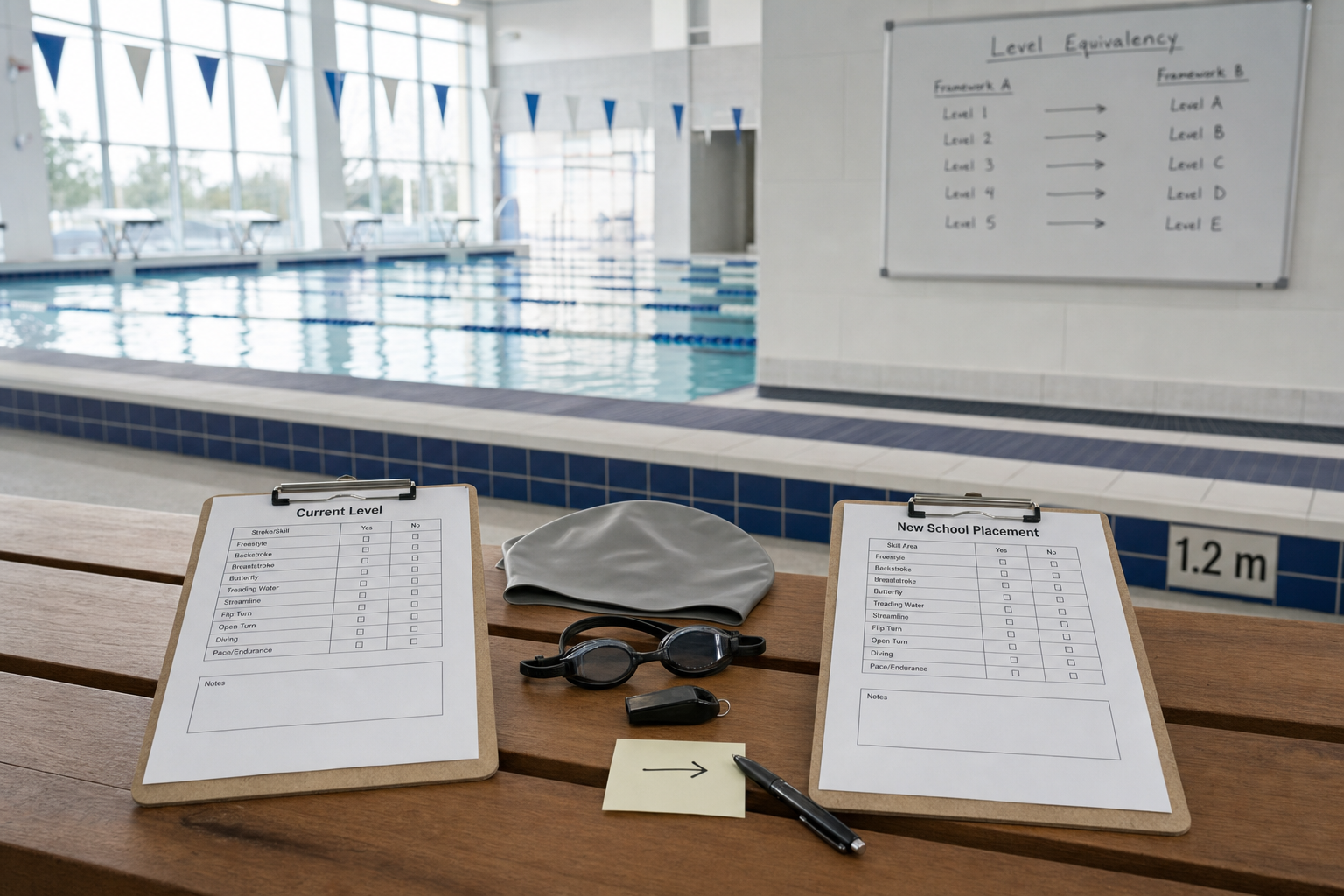
When your child is making strides in swim lessons and you’re thinking about switching swim schools, it can feel overwhelming. You want to make sure Elementary progress doesn’t get lost, and confidence stays high. Here’s a parent-first transfer plan built for kids ages 3-12: how to read level charts across Red Cross, YMCA, Swim England, AUS Swim, how to request progress records, pick the right time, and avoid common pitfalls when changing swim lessons mid-term.
Reading Swim Level Equivalency
To pull off a smooth switch, matching the same level of skill between programs matters more than matching names.
- Red Cross (USA, Levels 1–6) builds from being water-comfortable through stroke development to proficiency with all strokes and safety skills. Level 1 teaches floating and basic glides; Level 4 adds dives and breaststroke; Level 6 requires 25–100 yards of each stroke, turns, rescue skills. (newingtonct.gov)
- Swim England Stages 1-7 set clear benchmarks. Stage 1 focuses on entering water safely, flotation, understanding pool rules. By Stage 4, all four strokes are introduced; Stage 6 expects 25-metre swims of each stroke plus diving and safety; Stage 7 is mastery. (swimming.org)
- YMCA (USA) has Stages 1-6 similarly aligned: Basics (comfort, floating), Swim Strokes (stroke development, refining), then safety and stamina. YMCA Stage 5 or 6 compares roughly to Red Cross Level 5-6 or Swim England Stages 6-7. (swimy.org)
- Australian Frameworks differentiate by non-elite and elite streams with a foundation first approach. School-age children usually begin in “Non-elite Foundation” phases where technique, floatation, movement, safety are taught before moving toward competitive strokes. (swimming.org.au)
Knowing these equivalencies means when you fill out a trial lesson questionnaire or receive a level chart from a new swim school, you can see whether your child is really stepping back, holding steady, or possibly getting ahead too fast.
A Parent-First Transfer Plan
Here’s how to carry over your child’s hard-won skills without losing momentum or confidence.
Request Progress Records
Before you switch swim schools, ask the current provider for written or digital progress records. What strokes is your child doing, how far can they swim, how steady is their floating, have they learned safety skills like treading water, diving, or flips. These documents help the new school place your child correctly. Some programs even issue outcome sheets like Swim England does with its Learn to Swim Framework. (swimming.org)
Another tool to help bridge gaps between programs is SwimY’s "10-Week Plan", which you can follow alongside formal lessons when switching, to keep consistency in practice of floats, glides, and early strokes. https://www.swimy.org/10-week-plan [[ctakid]]
Trial Lessons & Right Questions
Many swim schools offer trial lessons or assessments. Use that opportunity to ask questions such as: “Which skills are you expecting from this level?”, “When do you teach butterfly or diving?”, “How do you teach breathing and body position?”, “How regularly do assessments happen?”, “If a child is plateauing, how do you help them catch up?” A trial lesson also lets you observe if the child is challenged but not overwhelmed.
Timing the Switch
Changing swim lessons mid-term can work—many Australian swim schools operate in 10-week terms—it may be wise to plan a switch at the end of a term or during school term breaks. For example, the AIS swim school uses 10-week beginner and advanced term fees. Ongoing assessments are often done in week 7, with promotions or changes starting in week 8. (ausport.gov.au)
Avoiding Common Pitfalls
Starting Too Low or Too High
Putting a child in a class labeled “advanced” when they haven’t mastered Stage/Level 2-3 (floating, glides, comfortable submersion) often causes frustration. Similarly, staying too long in a low level when skills are solid will lead to boredom and stalled progress. Matching skills is more crucial than matching level names or titles.
Skipping Assessment Swims
If the new school skips evaluating your child’s true capabilities, they might place them poorly. Assessments are especially critical when switching where frameworks differ. Always insist on one—many schools, especially in Australia and UK, do free or built-in assessments for new clients. (innerwest.nsw.gov.au)
Moving During Skill Plateaus
Some skills take time—body position, breathing, coordination won’t always improve linearly. If you move a child up too soon because you think they’re “ready”, you risk plateau or regression. Give children enough repetition until skills feel automatic, then switch.
Keeping Momentum & Confidence
When handled thoughtfully, the transition can even boost your child’s confidence. Praise what they already know. Show them the equivalency chart: “You swam Red Cross Level 3, over here in Swim England that's Stage 3; you’re catching up already.” Let them lead with small wins like a smooth front float or a strong backstroke arm pull. If progress records show growth, show those too. Celebrate consistent effort as much as distance or speed.
Finally, stay in communication with both old and new instructors. You might ask the old instructor for a recommendation or an observed weakness; the new one should respond by building on strengths and setting clear next goals. Confirm in writing what level your child is entering and what criteria are needed to move forward.
Changing swim schools mid-term doesn’t have to mean losing ground. By reading swim level equivalency charts, securing solid progress records, using trial lessons, and timing the switch well you can help your child keep momentum, maintain confidence, and continue growing in the water. If you match skills—not labels—and avoid the pitfalls, the switch can actually propel your child forward.
120+ swimming exercises sorted by age — with video and instructions. Developed by swim instructors, completely free.

120+ swimming exercises sorted by age — with video and instructions. Developed by swim instructors, completely free.