Tiny Class or Big Class? How to Choose Smart for Parent and Baby Swim Lessons
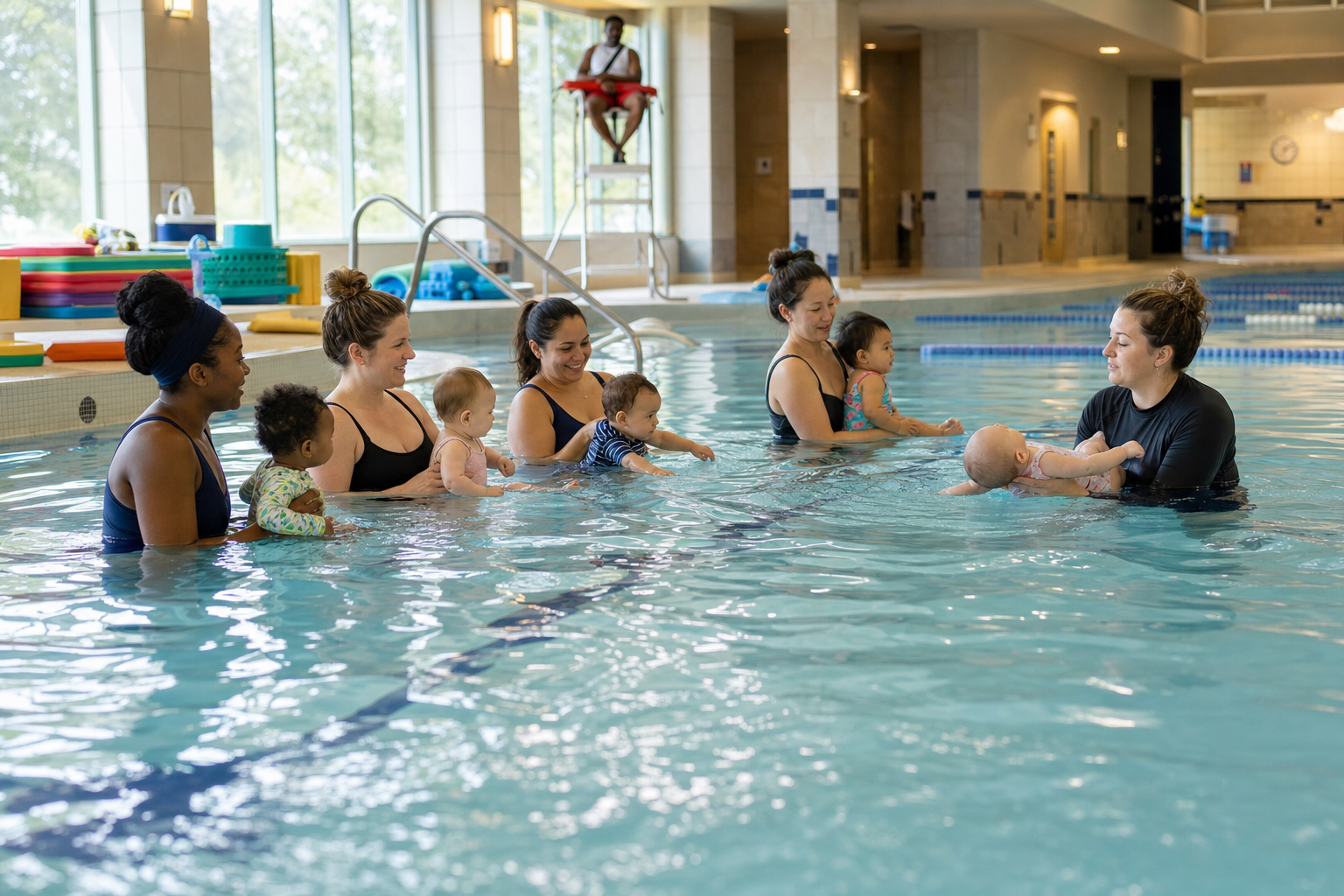
If you’re comparing “baby swim lessons near me,” one of the most important things isn’t price or pool location—it’s class size. How many babies are in the pool, how many instructors, how often they give one-on-one feedback—all of that affects safety, noise, and whether your child learns well. Here’s what matters most, so you can judge when a larger parent-baby swim class is good enough and when it’s worth paying more for something smaller.
What Experts Say: Instructor Ratios & Safety Visibility
Licensed programs like USA Swimming and the American Red Cross use instructor-to-student ratios as a key safety standard. For beginner or young swimmers, without a caregiver in the water, they recommend no more than 1 instructor per 4 students, or at most 1 per 6.(usaswimming.org) For classes where parents are in the water with their infant (who often can’t walk yet), the upper limit tends to be 6 to 8 families per instructor—though many high-quality programs aim for 4–6 families per instructor for ages 6–36 months to get better feedback and closer attention.(waterwisekids.com) If your baby is under 12 months, you should expect even tighter ratios—more frequent attention per child.(swimy.org)
Besides ratios, check for visible safety features. Are there lifeguards on duty? What emergency action plans do they have? Do they run drills? Are babies waiting between turns safely, ideally in shallow areas or on benches where staff can see them easily? A class full of babies being unsupervised while waiting is a red flag.
Larger Classes: When They Might Be Okay
Large parent-baby classes (8 or more families per instructor, or many students per instructor) might feel hectic. Noise, long waits, and less instructor feedback are common complaints in parent forums.(reddit.com) But in some cases they could work:
If your baby is 18 months or older, sits independently or walks, and doesn’t freak out easily, they may cope with a more crowded class. The caregiver’s presence can help calm things, and parents in the water can offer extra supervision. Also, if your goal is water confidence—getting used to being in the pool, enjoying splashes—rather than perfect technique or advanced safety skills, a more affordable larger class could be worth it.
Tiny Classes: When the Extra Cost Pays Off
For infants aged 4–12 months, toddlers under 2, or children who need closer attention, tiny classes deliver bigger benefits. In small classes (say, 4 babies with 1 instructor plus caregivers), you get faster progress, more instructor feedback, less waiting between turns, and lower noise. That improves how your child focuses, how safe they are, and how much you learn too.
If you want a structured way to build water confidence at home, the 10-Week Plan guides you step by step.
Many parents report big differences between classes with 3–4 kids versus larger ones. With fewer students, instructors can really watch each child’s cues—facial expression, arm movement, breathing—and step in quickly. With more kids, oversight stretches thin. Stories on parent forums often describe hearing about an instructor who missed a baby going under water in a crowded class.(reddit.com)
[[ctababy]]
What to Ask Before Signing Up
Use class-size evaluation as a filter when comparing options. Make these questions part of your phone call or visit:
“What is your instructor-to-baby (or family) ratio?” Ask specifically for the age group of your child. “What is the adult-child ratio inside and outside the pool?”
“Are parents expected to stay in the water? View from poolside? How involved are caregivers in each lesson?”
“Is there a lifeguard present? What emergency procedures or drills do you run? CPR/First Aid certification?”
“How much one-on-one feedback will each child get per class? How long are waiting times between turns?”
“Do you follow any external guidelines or standards (USA Swimming, Water Safety USA, Red Cross)?”
If you want a reference plan, check what swimy.org suggests in its “10-Week Plan” for infant and toddler swim progression—it describes how skills build gradually, letting you judge if a class’s structure gives enough time per child.(swimy.org)
Pricing, Location & Trade-Offs
A cheaper class might be near you or at peak time, but large class sizes can erode value. More students means less water time per child, less interaction, possibly less safety. On the flip side, smaller classes often cost more onsite or require traveling farther.
Think what you’re really paying for. Is it just pool access and fun? Or do you want those safety skills, water survival, real technique? If the latter, a smaller class—better ratio, better instructor feedback—is often worth the extra cost.
Real Parent Experiences & Common Pitfalls
Parent forums are full of stories. One parent with 18-month twins described how small groups (4 kids in a private shallow pool) made lessons calm and successful after weeks of stressful large-group lessons.(reddit.com) Others mention lower ratios like 3:1 or 4:1 bringing more safety and attention.(reddit.com) Some classes advertise “parent and baby swim class size” but pack too many babies, leading to chaotic, noisy sessions with minimal feedback.
Bottom Line: When Bigger Can Work and When It’s Time to Go Small
If your baby is older, a more confident water user, with a calm temperament, and your goal is socialization or exposure rather than technical or safety mastery, a slightly larger class may work. But for younger infants, new swimmers, or when water safety and skills matter most, small class size is not just better—it’s essential. The clarity of instructor feedback, fewer safety risks, lower noise, and better supervision all add up.
Don't choose the cheapest class by default: ask about adult-child ratio, lifeguard coverage, emergency drills, how babies wait between turns, and whether instructor feedback is meaningful. When you do your homework, you’ll find a swim school near you that offers just the right size to build confidence, skill, and safety for those precious first years.
120+ swimming exercises sorted by age — with video and instructions. Developed by swim instructors, completely free.

120+ swimming exercises sorted by age — with video and instructions. Developed by swim instructors, completely free.