Trial Swim Lesson Script: How to Get Useful Feedback in 10 Minutes
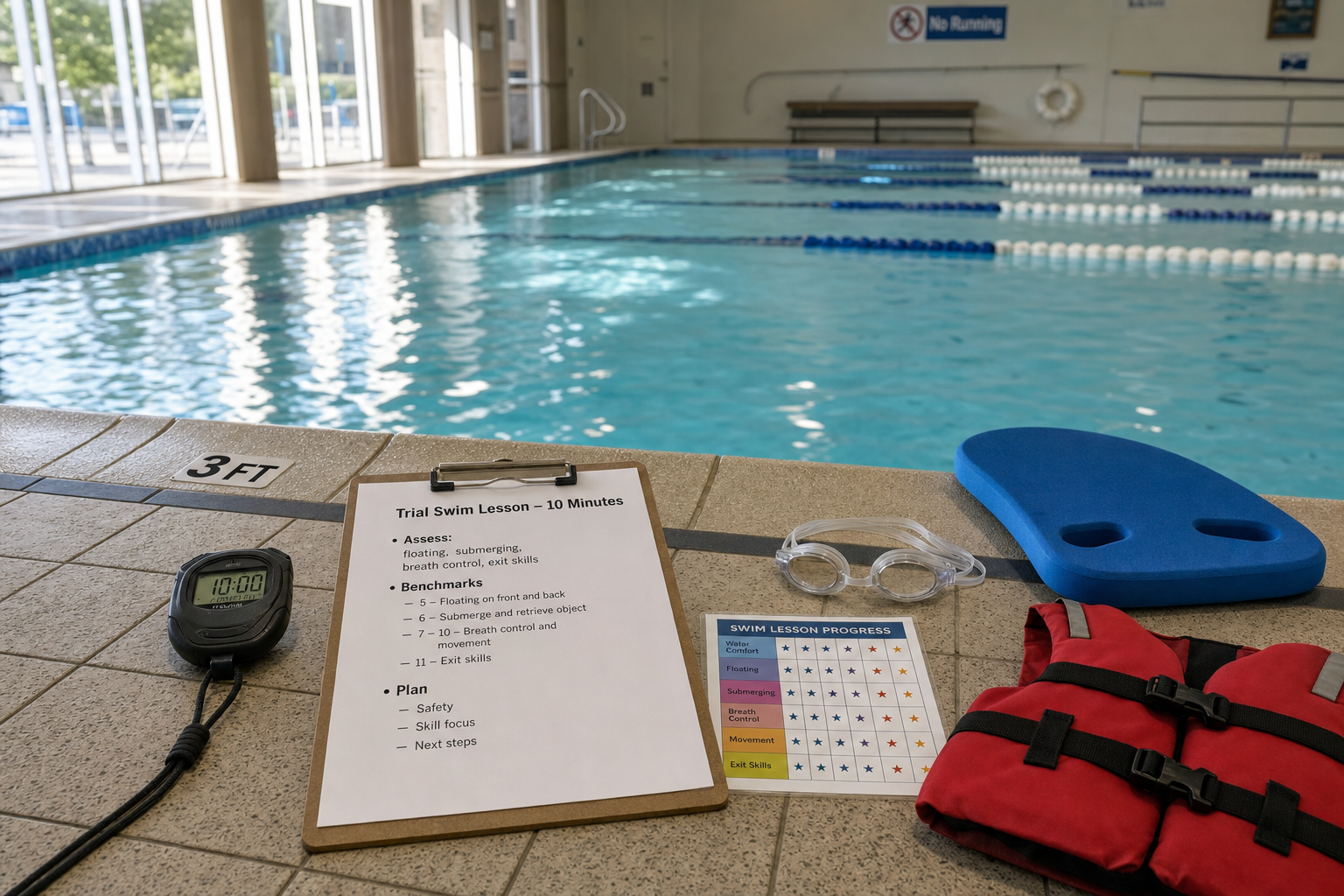
Want to make sure that 10-minute trial swim lesson delivers real value—clear placement, measurable progress, and a plan toward water competency? This script gives parents what to say, what to ask, and what to listen for, so you leave confident that your child is in the right class and growing in skills.
What Parents Should Ask Swim Instructors First
Start strong. As the child steps into the pool, pull aside the instructor and ask three essential questions. First: "What will you assess in my child today?" You want them to explain prey-and-prey skills like floating, submerging, breath control, moving through the water, and exiting the pool—these are all part of water competency, beyond just swim strokes. According to the American Academy of Pediatrics, water competency includes not only physical skills but risk assessment, safe attitudes, and behaviors.(publications.aap.org)
Second question: "What progress measures or benchmarks will you use?" Ask if there’s a formal way to track improvement—not just certificates or badges—and how often you’ll get written or verbal updates. Avoid settling for badges and ratios alone; good instructors should offer detailed feedback on areas like breath control, floating, drowning prevention skills, and the ability to reach safety. The AAP stresses children need many lessons to develop survival skills like treading water, resurfacing, and exiting the pool safely.(publications.aap.org)
Third: "Can you show me your lesson plan or outline for how you’ll build water competency?" A strong instructor will walk you through a plan—how skills will develop over weeks or months, what safety behaviors you’ll reinforce, and ideally a timeframe. Some programs use a structured curriculum. If you like, mention hearing about swimy.org’s 10-Week Plan as a reference point. That shows you're serious about consistency and milestones.
During the 10-Minute Trial: What to Watch and Listen For
In that short lesson, observe the instructor closely. Do they use warm water and maintain a low student-to-instructor ratio so children are safe and visible? Is there a clear plan of movement: do warm-ups, breathing, face-in-water and submerging, floating, exit skills? These reflect what the AAP says about swim lessons needing to teach both swim competency and water competency.(publications.aap.org)
Notice whether the instructor asks your child questions like “What do you do if you fall in?” or “Where’s the exit here?” Practical risk awareness is part of water competency—not all programs include it. Also observe whether they give you written goals—areas your child needs to work on—and a strategy: how many lessons per week, which skills will be built in which order.
If you want a structured way to help your child progress at home, the 10-Week Plan guides you step by step.
Sample Script: What You Can Say
Here’s a polished script you can use before or during the trial lesson:
“Hi, thanks for doing this trial. Could you tell me which skills you’ll assess with my child today, especially survival skills like floating, surfacing, exiting water, and handling unexpected falls? I’d also like to know what benchmarks you'll use for progress and how I’ll see that—in writing or just verbally. Lastly, could you show me your plan for developing their water competency over the coming weeks, and when I might see them placed in a level that matches their ability?”
[[ctakid]]
Use this script to avoid pitfalls like only asking about badges or class ratios. Let them know you expect concrete, written goals.
Questions to Ask After the Trial Wraps Up
Once the 10 minutes are up, when the child is out of the pool and warm, follow up with these questions: “Which level do you think they should go into, and why?” Listen for language like “growth area,” “skills to master first,” rather than just “next badge.” Ask “What specific skills should we focus on so they keep progressing toward water competency?” Finally, “How will future lessons build safety awareness and behavior—not just technique?”
If you want a swim school that follows solid standards, refer to HealthyChildren’s guide: they recommend swim lessons that teach basic lifesaving skills (floating, resurfacing, exiting water), strong instructor training and evaluation, and clear progression from one skill to the next.(healthychildren.org)
Why This Matters: Placement, Progress & Safety
Kids aged 3–12 vary a lot in physical ability, emotional readiness, and experience in water, so placing them in the wrong level can slow progress—or worse, hurt confidence. Using this script ensures your child is placed where they can both succeed and be challenged. Clear progress measures help you and the instructor stay on track. Teaching skills as part of water competency—such as knowing risks, safe behaviors, life jacket use—gives children tools for real safety, not just pool-side fun. The AAP’s new policy underscores this need: swim lessons aren’t just about stroke mechanics but about embedding safety, risk awareness, and behavior in every lesson.(publications.aap.org)
What Real Teaching Quality Looks Like
Real teaching quality means an instructor who listens, observes, adapts, gives feedback, and sets clear written goals. It means the swim school provides you with a written plan that discusses both technique and survival skills. It gives you measurable milestones. It emphasizes water competency as defined in the latest AAP report: safe attitudes, behaviors, risk assessment, knowledge, plus skills like floating, resurfacing, propulsion, exit.(publications.aap.org)
Putting It All Together
By asking the right questions to ask swim instructor—focusing on what skills are assessed, how progress is measured, and what their plan is—you avoid common traps (like only care about badges or student-to-teacher ratios). Using a trial swim lesson checklist like this script gives you the power to evaluate teaching quality. And by pushing for a plan oriented toward water competency in lessons, you ensure lessons aren’t just fun but build real, life-saving ability.
Your child will end up in the right class faster; you’ll know how well they’re progressing; and both of you will feel safer, more confident, and clear about what comes next. That’s a win for water, for safety, and for growth.
120+ swimming exercises sorted by age — with video and instructions. Developed by swim instructors, completely free.

120+ swimming exercises sorted by age — with video and instructions. Developed by swim instructors, completely free.