Visual Swim Routines for Toddlers: How Pictures Smooth Swim Lesson Transitions
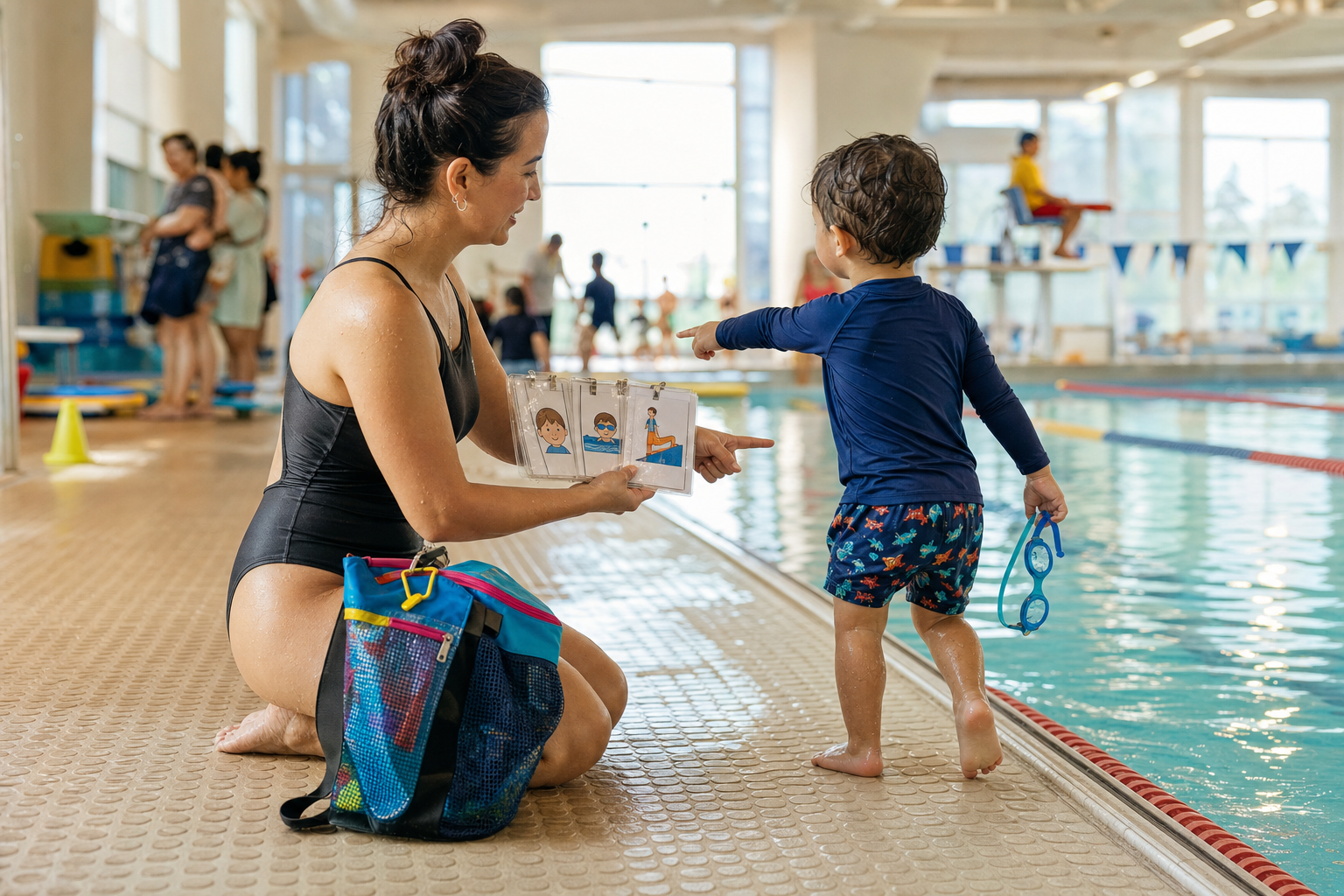
When you use a simple picture routine for your toddler, everything changes. You start reducing meltdowns before swim class. Your toddler begins to understand what happens before, during, and after swim lessons. The routine brings predictability. That helps parents stop bribing, threatening, or over-explaining transitions.
Why a Visual Schedule for Swim Class is a Game-Changer
Toddlers aged 18–36 months—especially speech-delayed, anxious, or sensory-sensitive little ones—thrive on predictability. With verbal cues alone, they often feel uncertain or overwhelmed. Visual schedules change this: by seeing each step laid out, they know what happens next so their anxiety dips and cooperation rises. Research confirms that visual schedules help young children feel secure, reduce stress around transitions, and build confidence in following routines. (sensorygift.com)
When that picture routine shows swim-related steps—like packing swim gear, arriving at the pool, warm-up games, swim class water time, drying off, changing—your toddler knows what to expect. They can follow along without needing constant verbal instructions. Fewer surprises means fewer tears.
Building a Clear Visual Swim Routine: Key Steps
To make this work, your visual swim routine should have 4–6 clear pictures. Too many will overwhelm a toddler and defeat the purpose. Experts recommend starting with one routine that regularly causes transition trouble and keeping steps simple. (parenting.firstcry.com)
Here’s how to build one: select the swim-lesson sequence you want to map. Common steps might be: gather swim bag, drive to pool, put on swimsuit, warm-up game, swim lesson, shower/dry off, clothes on. Then choose or create pictures—maybe photos of your child, or simple icons. Display them where your toddler can see them easily at home before swim days. Walk through the steps together, pointing to each picture, using short phrases (“first swim bag, then warm-up, then splash time”).
The board or chart you use should not distract from safety. Don’t take your phone to the pool deck as the routine board if it pulls your attention away from supervising your child. Use laminated cards on a clip, a quick wipe-board, or pockets you clip on your bag.
Little tip: if you follow a structured swim curriculum like Swimy’s “10-Week Plan,” you could align your visual schedule with the plan so your toddler knows how swim class builds week by week. (swimy.org)
If you want a structured way to build water confidence at home, the 10-Week Plan guides you step by step.
[[ctababy]]
Helping Children Who Are More Sensitive or Delayed
If your child struggles with speech delays, sensory sensitivities, or anxiety, visual schedules become even more effective. Visual supports are widely recommended for toddlers aged 16–36 months to help them understand transitions and activities better than verbal instructions alone. (headstart.gov)
Because these toddlers might get overloaded by sounds, temperature, crowd noise at the pool, or change itself, each picture in the routine acts like a calming signal. You reduce surprises about what happens next. That helps them regulate emotions. Your calmness and reduced need to repeat instructions also helps your confidence—and theirs.
Avoiding Common Pitfalls
Don’t overwhelm with too many steps. If the board has 8 or more pictures, scrolling through can be confusing; toddlers lose focus and cooperation tends to collapse. Stick to 4–6 steps for swim classes. Begin with the hardest transition—for example, getting dressed or walking in poolside—then add others only when you see success. (sensorygift.com)
Also, avoid using jargon or vague terms in pictures. Words like “lesson” or “free swim” may not mean much at first. Use steps that visually match what the child will see and do: “put on goggles”, “stand by pool edge”, “warm-up song”, “swim lesson in water”.
Maintain consistency. Use the same pictures and the same order every class. According to the Centers for Disease Control, routines that are predictable and repeated help toddlers feel safe and learn self-control. (cdc.gov)
How to Introduce and Use a Visual Schedule Effectively
Start at home. A day or two before swim day, sit down with your toddler and show the pictures in order. Talk about each step (“After we drive, we will play the warm-up game”).
Create a ritual around the visual schedule: maybe a special routine of placing the swim stuff into your child’s bag while showing the first picture. On swim day, revisit it. At each transition—putting on swimsuit, walking to pool—you point to the next picture. When they reach the final picture—dry-off or snack—you praise or just smile. The goal isn’t perfection, it’s decreasing resistance and building trust.
Parents often feel pressure to fix “power struggles” with rewards or threats. It works better to use the visual schedule as a neutral guide. No bribing. No threatening. No over-explaining. Just clarity.
Real Results: What Changes to Expect
After a couple of weeks of using a visual swim lesson routine, many parents notice that transitions at swim class become smoother. Fewer tears, less delay, fewer arguments over putting on swimsuits or leaving the pool. Toddlers begin to anticipate what’s coming and cooperate with fewer reminders.
Speech-delayed children may start using more gestures or verbal cues themselves: pointing at cards, saying “put goggles”, or “pool time”. Sensitive children may show less resistance when entering noisy, wet, or unfamiliar pool environments.
Even anxious toddlers can feel calmer. They see that after water play comes dry clothes, snack, or home time. That sense of order calms their nervous system.
Bringing It All Together
A toddler swim lesson routine using a visual schedule is more than just pictures. It’s a path to clearer expectations, fewer battles, and more peace—for both child and parent. Keep it simple: 4–6 steps, consistent images, concrete actions. Use it gently, with repetition and support. Over time, you’ll find that swim days feel less like stress and more like fun, growth, and bonding.
By using this tool, you’ll help prepare your toddler for swimming lessons and build confidence in both of you.
120+ swimming exercises sorted by age — with video and instructions. Developed by swim instructors, completely free.

120+ swimming exercises sorted by age — with video and instructions. Developed by swim instructors, completely free.