Why a Parent Orientation Before Baby Swim Lessons Matters
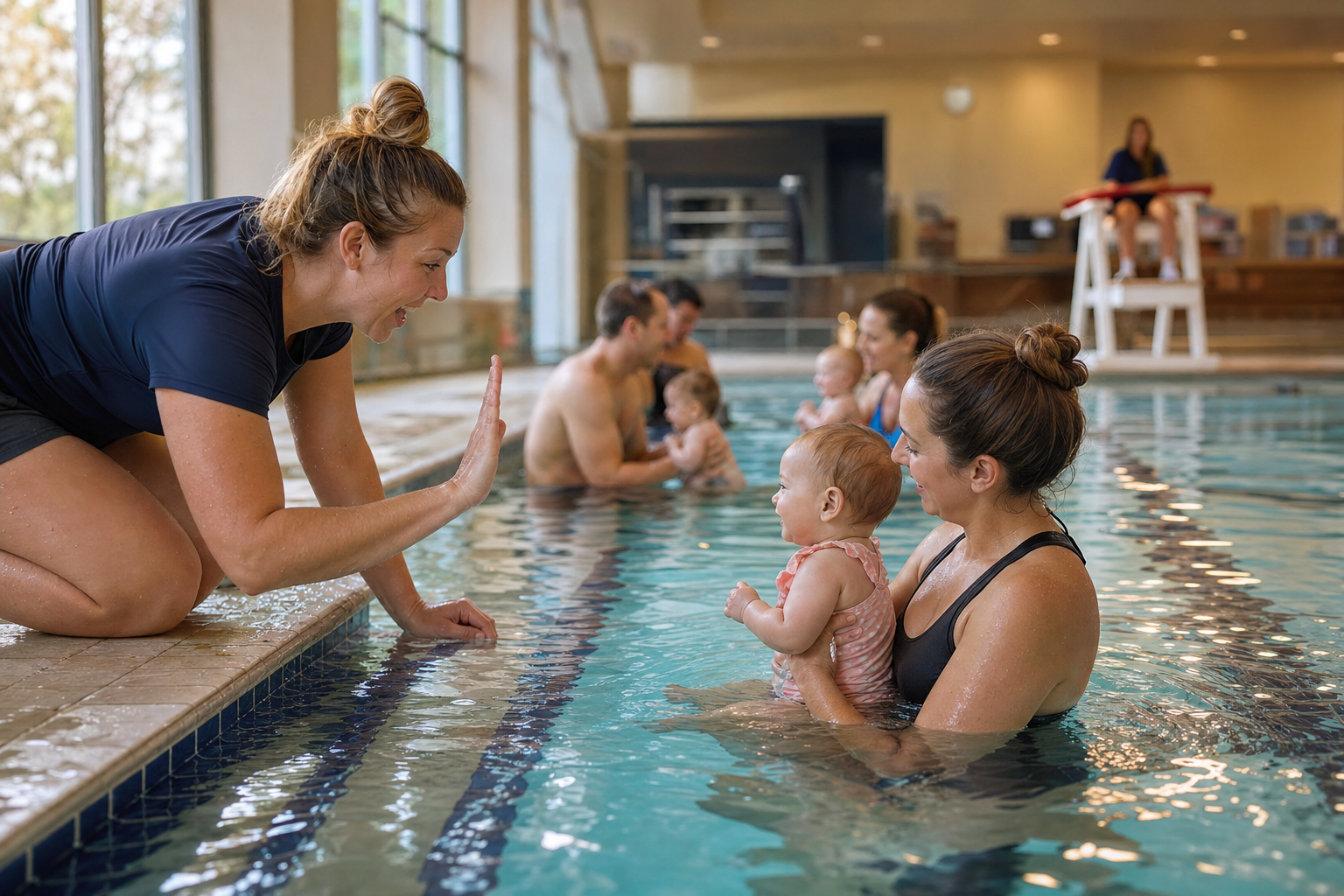
A simple, short parent orientation can transform your baby’s first swim lesson from a nervous, confusing routine into a clear, safe learning partnership. When caregivers understand class goals, cue words, boundaries, and what to expect before the first submersion, song, or wall-activity, babies benefit big time. Let’s dive straight into what you must know as a parent—or caregiver—for classes for ages 6 to 36 months.
What Happens in Parent Orientation
Right before lessons begin, an orientation or “pre-lesson micro-course” will typically walk you through what your baby will learn, how you’ll participate, and crucial safety basics. The American Red Cross, for example, offers Orientation to Swim Lessons for Parents and Caregivers, a free online class that covers water safety information for parents, what the Red Cross Parent & Child Aquatics program does for ages 6 months to 3 years, and how to get the most out of swim lessons. (redcross.org)
In addition, the Red Cross Parent & Child Aquatics course teaches parents how to hold and support their child in water, how to help their child become comfortable with submersion, blowing bubbles, floating, and basic water readiness skills. (redcross.org)
Key Goals, Cue Words, and Limits—Set Before the Splash
During orientation you’ll be given guidance so your baby isn’t surprised by transitions in class. You’ll learn cue words—short, consistent phrases like “ready, set, go,” or “bubble time”—used by the teacher. You’ll also learn holds: tummy-support, back-float support, face-to-face holds. You and the instructor will agree on limits: how far under water (if at all) on early days, how long songs last, how to adapt when your baby resists. This prepares you so classes are predictable for both parent and baby.
Curiously, some programs offer a plan of action you can follow weekly to build comfort and skills. For example, swimy.org has a 10-Week Plan to help babies progress, and uses cue words and goal-setting each week—this kind of structured outline gives parents clarity and supports consistent practice between lessons. The 10-Week Plan of swimy.org is a good model for planning personal practice at home to reinforce in-class learning.
Water Safety Still Comes Before Swim Skills
Orientation always emphasizes that lessons do not drown-proof babies. Water safety for parents includes reminders that adults remain responsible in and around water. Supervision stays constant even if your child seems comfortable in the water or in a class. The American Academy of Pediatrics warns against overestimating a toddler’s water competency and suggests parent education to correct common misconceptions, like thinking a child “can save themselves” after a few lessons. (publications.aap.org)
If you want a structured way to build water confidence at home, the 10-Week Plan guides you step by step.
The Centers for Disease Control (CDC) backs this up: swimming lessons help reduce drowning risk but must be paired with close, constant supervision, secured pools, life jackets, and layers of protection. (cdc.gov)
[[ctababy]]
What You, as a Parent, Should Expect and Do
You’ll be in the pool with your baby for parent-child classes. You’ll get instructions on how to hold your baby safely, when to support them in front or back floats, how to interpret their cues—signs of tiredness or discomfort. Some programs show you how to safely do submersions, always with your baby’s comfort and safety as top priority. Orientation also covers class policies: swim diapers, water temperature (warm water helps), cleanliness, instructor ratios. (healthychildren.org)
Between lessons, you’ll have practices to help your baby build confidence: home bath-time bubble blowing, familiarizing with stepping into shallow water feet first, repeating cue words. You’ll track progress and share with the instructor where your baby seems anxious so they can adjust.
Who Benefits Most—and When to Begin
Classes aimed at ages 6-36 months are designed with developmental readiness in mind. Babies under 1 year are usually not developmentally able to coordinate enough for "survival swim skills," especially pushing off, floating unassisted, or coordinating breath with motion. Orientation helps parents understand that building comfort and trust in the water comes first. (publications.aap.org)
After the first birthday, more formal swim lessons become appropriate. But even then, orientation reinforces that swim lessons are just part of water safety—supervision, barriers, life jackets, and safe pool designs are still required. (publications.aap.org)
How Orientation Changes the Class Experience
When you go into the first lesson already knowing words like “bubble time” or “float,” you speak the same language as the teacher. When you understand limits—like short songs, minimal submersion, choosing when to rest—it gives your baby trust and your instructor better understanding. That makes lessons more joyful, less scary, more cooperative.
You’ll also walk out of each class more confident: noticing when your baby is tired, knowing how to react if there are slips or sneezes, and reinforcing safety habits at home and around pools. It turns lessons from something you simply attend, into a safe learning partnership where everyone knows the goals.
Final Thoughts: Keep Layers of Protection Always On
Even after multiple lessons there is no guarantee that a baby or toddler is “water safe.” No lesson, no technique, no amount of comfort in the water prevents drowning on its own. What you learned in parent orientation helps you stay alert, avoid assumptions, maintain supervision, and use all available safety layers: pool fences, lifeguards, life jackets, and safe behaviors. Use what you learn in orientation not just during class, but every time water is involved—baby baths, sprinkler days, family pool time. Your knowledge, your attention, your cues matter most.
Parent orientation swim lessons lay the foundation. They set the map before the ocean crossing—without it, the waters feel murky. With them, every splash becomes part of a safer, more joyful journey for your child.
120+ swimming exercises sorted by age — with video and instructions. Developed by swim instructors, completely free.

120+ swimming exercises sorted by age — with video and instructions. Developed by swim instructors, completely free.