When Your Baby Is the Youngest in the Age Band: What Parents Really Need to Know
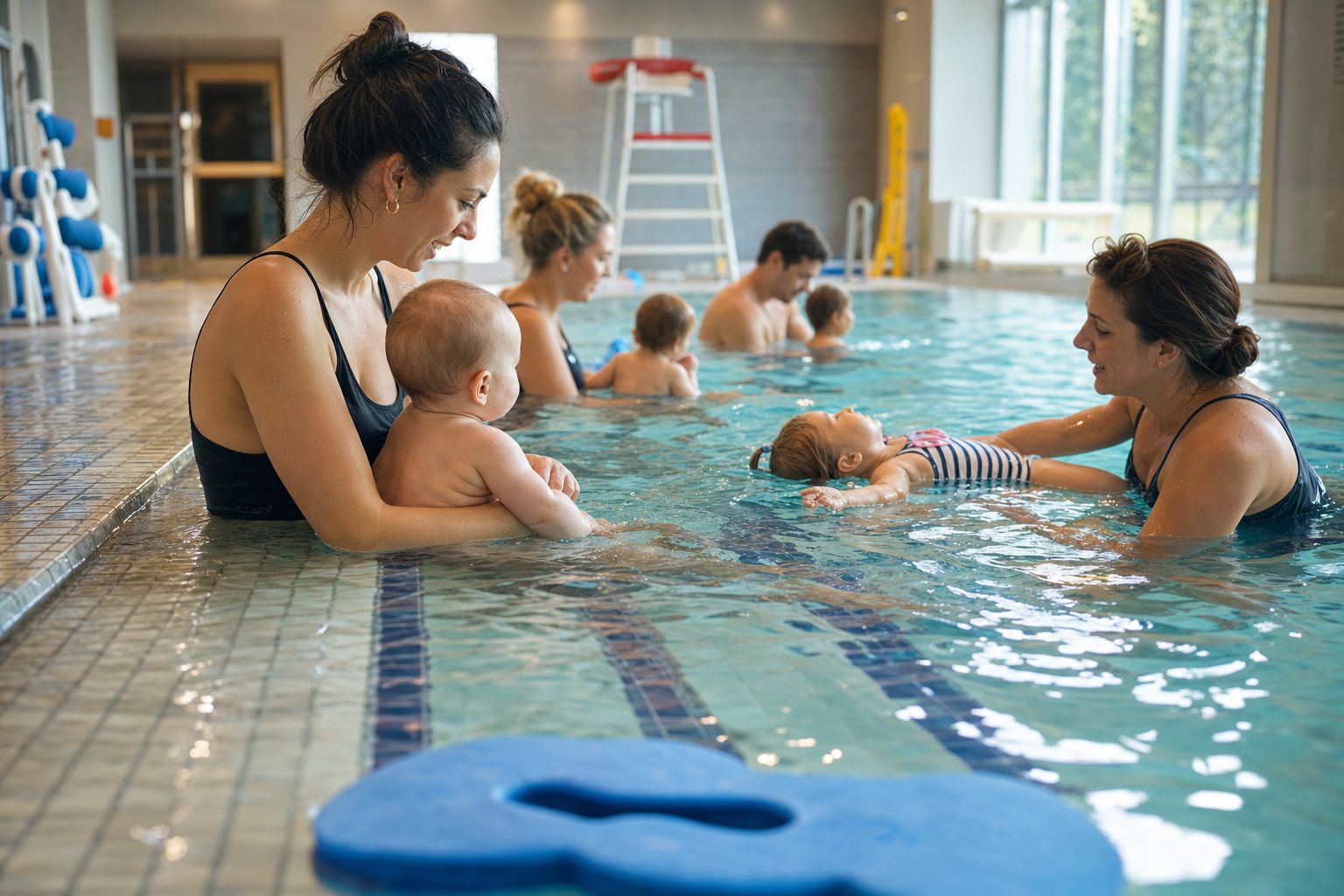
If your 6-month-old is joining a parent-child swim class marketed for “ages 6-36 months,” the difference compared to the older toddlers isn’t just height—it’s mobility, stamina, emotional readiness, and even fear responses. Even though swim schools advertise broad age bands, assuming a class will fit every child in that range can lead to frustration or safety issues. Here’s how to tell if the class activities match your baby, not just the advertised age range.
Spotting the Gaps: What a 6-Month-Old Can (and Can’t) Do Compared to a 24-Month-Old
At six months, babies are usually just learning to roll, maybe sitting with support, and have limited strength in their arms and legs. Toddlers around 24 months are walking, exploring, even trying little climbs. So when swim class designs warm-ups, floats, bubbling, or kopacross tags, the younger infant might fatigue quickly, become overwhelmed, or struggle to understand instructions meant for someone more mobile. The result can be a fearful baby who associates water with stress, not joy.
Medical and developmental research confirms infants under 1 year aren’t yet neurodevelopmentally prepared for complex swimming skills. They can learn reflexive back-floating or how to roll onto their back and breathe, but coordinating strokes or sustained propulsion isn’t realistic. (publications.aap.org) Toddlers, by contrast, as preschool-aged children, can acquire survival swim skills and begin to work on coordination. (publications.aap.org)
So parents: being the youngest in a class isn’t wrong, but recognizing those physical and psychological differences is key.
What to Seek in a Class So It Truly Works for the Youngest
Begin by asking swim schools very specific questions. Is there an evaluation before you enrol? How are ages and skill levels grouped internally? Many programs with “6-36 month” bands still divide this group into younger infant and older toddler tracks based on readiness. For example, some YMCA classes split “Parent/Child A: 6-24 months” and “Parent/Child B: 2-3 years” so kids with different developmental levels get tasks suited for them. (metrowestymca.org)
Check how much physical demand is placed on toddlers: are they expected to swim, float independently, or follow complicated drills? If your baby is expected to keep up with toddlers, ask for modifications or consider choosing a class whose curriculum is explicitly slower paced.
If you want a structured way to build water confidence at home, the 10-Week Plan guides you step by step.
Seek small group sizes or better yet, private or semi-private lessons. If there are many toddlers in a mixed class, much time can be spent waiting or doing motions babies can’t yet perform—leading to disinterest or distress.
Also important: water temperature and supervision. For kids under 3, water heated between about 87-94°F helps prevent chilling, especially if they’ll be partially submerged a lot. (healthychildren.org) Always look for classes with “touch supervision,” meaning an adult (parent or guardian) is within arm’s reach. (healthychildren.org)
[[ctababy]]
Real Decisions: Class Types and Alternatives
There are different styles of parent-child swim classes. Traditional classes focus on comfort, floating, water play, blowing bubbles. Other programs, like Infant Swimming Resource (ISR), start survival-oriented training even for babies as young as 6 months: floating, rolling to float, self-rescue, sometimes clothed entry drills. These require more emotional readiness and can’t be rushed. (arizonainfantswim.com)
If you find your baby isn’t keeping up in the mixed class—or is showing reluctance—consider doing a shorter option, or a program that divides the 6-36 month band into more narrow sub-bands. You might also try following a structured guide like the swimy.org “10-Week Plan” which helps families pick age-appropriate activities week by week and matches expectations to developmental stages.
It’s normal for parents to feel pressure from curriculum marketing, but ensuring safety, fun, and confidence matters more than “just making the age cutoff.”
How to Judge Whether the Class Really Fits Your Baby
In the first few lessons, observe how your baby responds. Are they:
- Fatigued or tearful after basic tasks, while other toddlers seem energetic?
- Hesitant to put their face in, or freeze during group floats or drills?
- Unable to follow visual or verbal cues meant for older toddlers?
These are clues the pace or expectations might be too advanced.
Talk to the instructor. Ask if there’s room for alternative participation—for instance, letting the baby dip in only when ready, taking breaks, or doing modified endpoints. A high-quality swim school will welcome this conversation and adapt.
Also, consider taking a class where adult participation is required in the water. Having you in the pool helps you see what your baby is doing, encourages them, and gives them comfort. (usaswimming.org)
Swim lessons should feel like play with structure for the youngest children—not like strict swimming drills. Mistaking physical readiness or setting giant expectations too soon can result in safety concerns or burnout.
Bottom Line: Your Baby’s Pace Matters
Advertised age ranges like “6-36 months” or “Parent/Child swim class age range” give a loose guideline but don’t guarantee fit. When your baby is youngest in the age band, you’ll need to do some detective work. You must judge individually by observing physical ability, emotional comfort, fear responses, and whether instructor expectations align with your child—not just the class syllabus.
Infant vs toddler swim lessons aren’t interchangeable. Your 6-month-old isn’t going to paddle like a two-year-old yet, and that’s totally okay. If you ask the right questions, watch closely, choose classes that welcome accommodation, and prioritize safety, your baby can thrive—gaining love for water, early safety skills, and confidence—at a pace that suits them.
120+ swimming exercises sorted by age — with video and instructions. Developed by swim instructors, completely free.

120+ swimming exercises sorted by age — with video and instructions. Developed by swim instructors, completely free.